January 23, 2026
Weekly Energy News January 23, 2026
Market Commentary: In recent trading days, the NYMEX February gas contract surged by an astonishing $2.40 per Million British Thermal Units (MMBtu), nearly reaching an increase of 80 percent, now trading in the mid-$5s per MMBtu, according to data from CME Group and Platts, part of S&P Global Energy. This remarkable spike in gas prices emerges as a severe cold front is forecasted to hit the US Midwest, Northeast, and Southeast. Analysts warn that this approaching storm could be a rare, once-in-a-generation occurrence. As a result, we can expect double or even triple-digit spot gas prices, accompanied by significant withdrawals from storage and likely production freeze-offs.
FEB26’ NYMEX closed Thursday at $5.045 (up $0.17)
• High for the day $5.650
• Low for the day $4.769
Early trading for the prompt month is trading at $5.202
• https://www.cmegroup.com/markets/energy/natural-gas/natural-gas.html
• https://www.fxempire.com/commodities/natural-gas
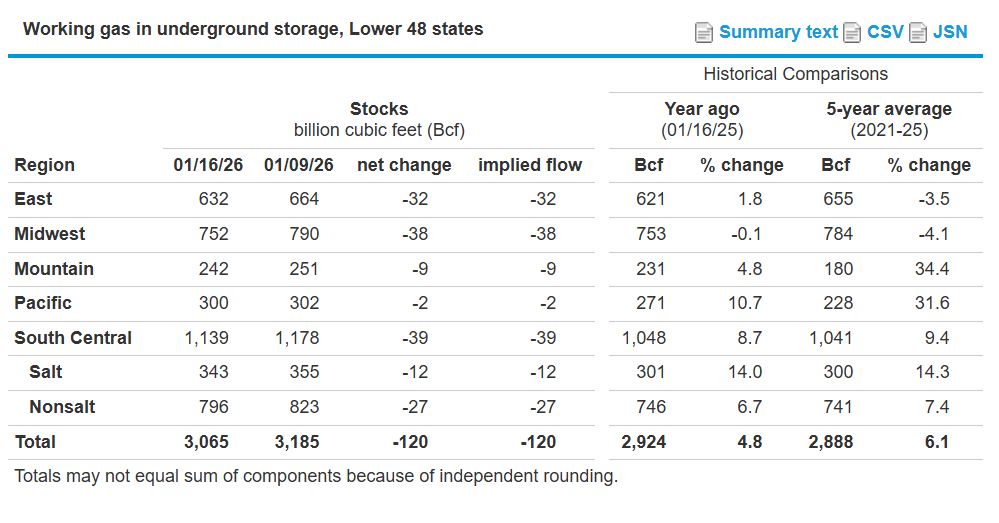
EIA Storage: In a surprising bullish development, the EIA reported on January 22 that there was a withdrawal of 120 Bcf from domestic gas storage, exceeding market anticipations. This latest estimate from the EIA significantly surpassed the consensus forecast from the Platts gas storage survey, which had predicted a pull of only 104 Bcf. Following the release of the EIA’s storage report, the NYMEX February gas futures contract increased by about 10 cents, trading just above $5.60 MMBtu. This uptick came after an overnight rally that had already pushed prompt prices up from the previous day's close of $4.875/MMBtu. While the EIA's findings were bullish compared to market expectations, they remained relatively bearish when viewed against historical data. Over the last five years, the EIA has averaged a withdrawal of 191 Bcf for this same week, and back in 2025, the agency even reported a larger pull of 228 Bcf. As of the week ending January 16, the total amount of US gas in storage was 3.065 Tcf. Domestic inventories stood at 177 Bcf, or just over 6 percent, above the five-year average of 2.888 Tcf. Additionally, stocks were 141 Bcf, nearly 5 percent higher than the level from a year ago, which was 2.924 Tcf, according to EIA data.
EIA:
Summary
Working gas in storage was 3,065 Bcf as of Friday, January 16, 2026, according to EIA estimates. This represents a net decrease of 120 Bcf from the previous week. Stocks were 141 Bcf higher than last year at this time and 177 Bcf above the five-year average of 2,888 Bcf. At 3,065 Bcf, total working gas is above the five-year historical range.
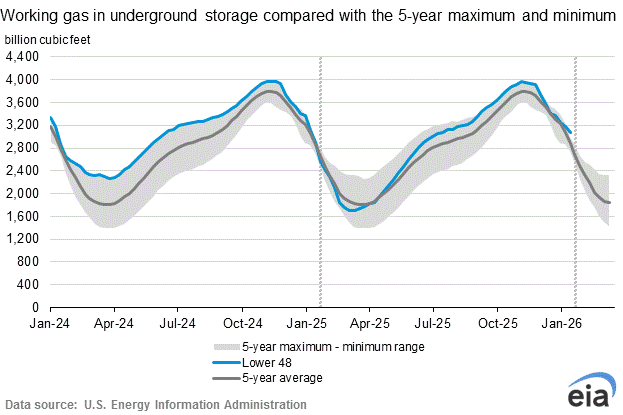
Note: The shaded area indicates the range between the historical minimum and maximum values for the weekly series from 2021 through 2025. The dashed vertical lines indicate current and year-ago weekly periods.

Weather: As of January 23rd, weather warnings affect millions of Americans due to frigid temperatures and hazardous snow conditions. A surge of cold air has arrived, dropping temperatures and bringing heavy snow and ice to more than two dozen states, from the Midwest and Northeast to Texas. Gusty winds could create wind chills as low as minus 50 degrees Fahrenheit in the northern and central Plains. At least a dozen states have declared emergencies because of the potential for severe ice accumulation, which might cause prolonged power outages and dangerous travel conditions.
In the first half of February, warmer than average temperatures are predicted, especially in the first 10 days. This warmth will allow arctic air to push into the continental U.S. As the month progresses, temperatures are likely to shift to cooler conditions. While areas around the Great Lakes may not experience warmer weather, regions further west can expect some warming. After early February's warmth, expect conditions to shift, ushering in another round of arctic air around the 14th. This change could trigger significant winter storms, making February a potentially snowy month. Forecasts indicate a more favorable pattern for winter storms in the last two weeks of the month, which will likely increase the chances for snowfall. Midwest Weather. “Winter Storm This Weekend.” Midwest Weather (Substack), 2026. Subscriber-only newsletter.


Market Data:
January 23, 2026

Weekly Energy News January 23, 2026
January 23, 2026
Market Commentary: In recent trading days, the NYMEX February gas contract surged by an astonishing $2.40 per Million British Thermal Units (MMBtu), nearly reaching an increase of 80 percent, now trading in the mid-$5s per MMBtu, according to data from CME Group and Platts, part of S&P Global Energy. This remarkable spike in gas prices emerges as a severe cold front is forecasted to hit the US Midwest, Northeast, and Southeast. Analysts warn that this approaching storm could be a rare, once-in-a-generation occurrence. As a result, we can expect double or even triple-digit spot gas prices, accompanied by significant withdrawals from storage and likely production freeze-offs.
FEB26’ NYMEX closed Thursday at $5.045 (up $0.17)
• High for the day $5.650
• Low for the day $4.769
Early trading for the prompt month is trading at $5.202
• https://www.cmegroup.com/markets/energy/natural-gas/natural-gas.html
• https://www.fxempire.com/commodities/natural-gas
EIA Storage: In a surprising bullish development, the EIA reported on January 22 that there was a withdrawal of 120 Bcf from domestic gas storage, exceeding market anticipations. This latest estimate from the EIA significantly surpassed the consensus forecast from the Platts gas storage survey, which had predicted a pull of only 104 Bcf. Following the release of the EIA’s storage report, the NYMEX February gas futures contract increased by about 10 cents, trading just above $5.60 MMBtu. This uptick came after an overnight rally that had already pushed prompt prices up from the previous day's close of $4.875/MMBtu. While the EIA's findings were bullish compared to market expectations, they remained relatively bearish when viewed against historical data. Over the last five years, the EIA has averaged a withdrawal of 191 Bcf for this same week, and back in 2025, the agency even reported a larger pull of 228 Bcf. As of the week ending January 16, the total amount of US gas in storage was 3.065 Tcf. Domestic inventories stood at 177 Bcf, or just over 6 percent, above the five-year average of 2.888 Tcf. Additionally, stocks were 141 Bcf, nearly 5 percent higher than the level from a year ago, which was 2.924 Tcf, according to EIA data.
EIA:
Summary
Working gas in storage was 3,065 Bcf as of Friday, January 16, 2026, according to EIA estimates. This represents a net decrease of 120 Bcf from the previous week. Stocks were 141 Bcf higher than last year at this time and 177 Bcf above the five-year average of 2,888 Bcf. At 3,065 Bcf, total working gas is above the five-year historical range.
Note: The shaded area indicates the range between the historical minimum and maximum values for the weekly series from 2021 through 2025. The dashed vertical lines indicate current and year-ago weekly periods.
Weather: As of January 23rd, weather warnings affect millions of Americans due to frigid temperatures and hazardous snow conditions. A surge of cold air has arrived, dropping temperatures and bringing heavy snow and ice to more than two dozen states, from the Midwest and Northeast to Texas. Gusty winds could create wind chills as low as minus 50 degrees Fahrenheit in the northern and central Plains. At least a dozen states have declared emergencies because of the potential for severe ice accumulation, which might cause prolonged power outages and dangerous travel conditions.
In the first half of February, warmer than average temperatures are predicted, especially in the first 10 days. This warmth will allow arctic air to push into the continental U.S. As the month progresses, temperatures are likely to shift to cooler conditions. While areas around the Great Lakes may not experience warmer weather, regions further west can expect some warming. After early February's warmth, expect conditions to shift, ushering in another round of arctic air around the 14th. This change could trigger significant winter storms, making February a potentially snowy month. Forecasts indicate a more favorable pattern for winter storms in the last two weeks of the month, which will likely increase the chances for snowfall. Midwest Weather. “Winter Storm This Weekend.” Midwest Weather (Substack), 2026. Subscriber-only newsletter.
Market Data:
January 23, 2026
January 23, 2026
Weekly Energy News January 23, 2026
Market Commentary: In recent trading days, the NYMEX February gas contract surged by an astonishing $2.40 per Million British Thermal Units (MMBtu), nearly reaching an increase of 80 percent, now trading in the mid-$5s per MMBtu, according to data from CME Group and Platts, part of S&P Global Energy. This remarkable spike in gas prices emerges as a severe cold front is forecasted to hit the US Midwest, Northeast, and Southeast. Analysts warn that this approaching storm could be a rare, once-in-a-generation occurrence. As a result, we can expect double or even triple-digit spot gas prices, accompanied by significant withdrawals from storage and likely production freeze-offs.
FEB26’ NYMEX closed Thursday at $5.045 (up $0.17)
• High for the day $5.650
• Low for the day $4.769
Early trading for the prompt month is trading at $5.202
• https://www.cmegroup.com/markets/energy/natural-gas/natural-gas.html
• https://www.fxempire.com/commodities/natural-gas
EIA Storage: In a surprising bullish development, the EIA reported on January 22 that there was a withdrawal of 120 Bcf from domestic gas storage, exceeding market anticipations. This latest estimate from the EIA significantly surpassed the consensus forecast from the Platts gas storage survey, which had predicted a pull of only 104 Bcf. Following the release of the EIA’s storage report, the NYMEX February gas futures contract increased by about 10 cents, trading just above $5.60 MMBtu. This uptick came after an overnight rally that had already pushed prompt prices up from the previous day's close of $4.875/MMBtu. While the EIA's findings were bullish compared to market expectations, they remained relatively bearish when viewed against historical data. Over the last five years, the EIA has averaged a withdrawal of 191 Bcf for this same week, and back in 2025, the agency even reported a larger pull of 228 Bcf. As of the week ending January 16, the total amount of US gas in storage was 3.065 Tcf. Domestic inventories stood at 177 Bcf, or just over 6 percent, above the five-year average of 2.888 Tcf. Additionally, stocks were 141 Bcf, nearly 5 percent higher than the level from a year ago, which was 2.924 Tcf, according to EIA data.
EIA:
Summary
Working gas in storage was 3,065 Bcf as of Friday, January 16, 2026, according to EIA estimates. This represents a net decrease of 120 Bcf from the previous week. Stocks were 141 Bcf higher than last year at this time and 177 Bcf above the five-year average of 2,888 Bcf. At 3,065 Bcf, total working gas is above the five-year historical range.
Note: The shaded area indicates the range between the historical minimum and maximum values for the weekly series from 2021 through 2025. The dashed vertical lines indicate current and year-ago weekly periods.
Weather: As of January 23rd, weather warnings affect millions of Americans due to frigid temperatures and hazardous snow conditions. A surge of cold air has arrived, dropping temperatures and bringing heavy snow and ice to more than two dozen states, from the Midwest and Northeast to Texas. Gusty winds could create wind chills as low as minus 50 degrees Fahrenheit in the northern and central Plains. At least a dozen states have declared emergencies because of the potential for severe ice accumulation, which might cause prolonged power outages and dangerous travel conditions.
In the first half of February, warmer than average temperatures are predicted, especially in the first 10 days. This warmth will allow arctic air to push into the continental U.S. As the month progresses, temperatures are likely to shift to cooler conditions. While areas around the Great Lakes may not experience warmer weather, regions further west can expect some warming. After early February's warmth, expect conditions to shift, ushering in another round of arctic air around the 14th. This change could trigger significant winter storms, making February a potentially snowy month. Forecasts indicate a more favorable pattern for winter storms in the last two weeks of the month, which will likely increase the chances for snowfall. Midwest Weather. “Winter Storm This Weekend.” Midwest Weather (Substack), 2026. Subscriber-only newsletter.
January 23, 2026
Weekly Energy News January 23, 2026
Market Commentary: In recent trading days, the NYMEX February gas contract surged by an astonishing $2.40 per Million British Thermal Units (MMBtu), nearly reaching an increase of 80 percent, now trading in the mid-$5s per MMBtu, according to data from CME Group and Platts, part of S&P Global Energy. This remarkable spike in gas prices emerges as a severe cold front is forecasted to hit the US Midwest, Northeast, and Southeast. Analysts warn that this approaching storm could be a rare, once-in-a-generation occurrence. As a result, we can expect double or even triple-digit spot gas prices, accompanied by significant withdrawals from storage and likely production freeze-offs.
FEB26’ NYMEX closed Thursday at $5.045 (up $0.17)
• High for the day $5.650
• Low for the day $4.769
Early trading for the prompt month is trading at $5.202
• https://www.cmegroup.com/markets/energy/natural-gas/natural-gas.html
• https://www.fxempire.com/commodities/natural-gas
EIA Storage: In a surprising bullish development, the EIA reported on January 22 that there was a withdrawal of 120 Bcf from domestic gas storage, exceeding market anticipations. This latest estimate from the EIA significantly surpassed the consensus forecast from the Platts gas storage survey, which had predicted a pull of only 104 Bcf. Following the release of the EIA’s storage report, the NYMEX February gas futures contract increased by about 10 cents, trading just above $5.60 MMBtu. This uptick came after an overnight rally that had already pushed prompt prices up from the previous day's close of $4.875/MMBtu. While the EIA's findings were bullish compared to market expectations, they remained relatively bearish when viewed against historical data. Over the last five years, the EIA has averaged a withdrawal of 191 Bcf for this same week, and back in 2025, the agency even reported a larger pull of 228 Bcf. As of the week ending January 16, the total amount of US gas in storage was 3.065 Tcf. Domestic inventories stood at 177 Bcf, or just over 6 percent, above the five-year average of 2.888 Tcf. Additionally, stocks were 141 Bcf, nearly 5 percent higher than the level from a year ago, which was 2.924 Tcf, according to EIA data.
EIA:
Summary
Working gas in storage was 3,065 Bcf as of Friday, January 16, 2026, according to EIA estimates. This represents a net decrease of 120 Bcf from the previous week. Stocks were 141 Bcf higher than last year at this time and 177 Bcf above the five-year average of 2,888 Bcf. At 3,065 Bcf, total working gas is above the five-year historical range.
Note: The shaded area indicates the range between the historical minimum and maximum values for the weekly series from 2021 through 2025. The dashed vertical lines indicate current and year-ago weekly periods.
Weather: As of January 23rd, weather warnings affect millions of Americans due to frigid temperatures and hazardous snow conditions. A surge of cold air has arrived, dropping temperatures and bringing heavy snow and ice to more than two dozen states, from the Midwest and Northeast to Texas. Gusty winds could create wind chills as low as minus 50 degrees Fahrenheit in the northern and central Plains. At least a dozen states have declared emergencies because of the potential for severe ice accumulation, which might cause prolonged power outages and dangerous travel conditions.
In the first half of February, warmer than average temperatures are predicted, especially in the first 10 days. This warmth will allow arctic air to push into the continental U.S. As the month progresses, temperatures are likely to shift to cooler conditions. While areas around the Great Lakes may not experience warmer weather, regions further west can expect some warming. After early February's warmth, expect conditions to shift, ushering in another round of arctic air around the 14th. This change could trigger significant winter storms, making February a potentially snowy month. Forecasts indicate a more favorable pattern for winter storms in the last two weeks of the month, which will likely increase the chances for snowfall. Midwest Weather. “Winter Storm This Weekend.” Midwest Weather (Substack), 2026. Subscriber-only newsletter.
January 23, 2026
Weekly Energy News January 23, 2026
Market Commentary: In recent trading days, the NYMEX February gas contract surged by an astonishing $2.40 per Million British Thermal Units (MMBtu), nearly reaching an increase of 80 percent, now trading in the mid-$5s per MMBtu, according to data from CME Group and Platts, part of S&P Global Energy. This remarkable spike in gas prices emerges as a severe cold front is forecasted to hit the US Midwest, Northeast, and Southeast. Analysts warn that this approaching storm could be a rare, once-in-a-generation occurrence. As a result, we can expect double or even triple-digit spot gas prices, accompanied by significant withdrawals from storage and likely production freeze-offs.
FEB26’ NYMEX closed Thursday at $5.045 (up $0.17)
• High for the day $5.650
• Low for the day $4.769
Early trading for the prompt month is trading at $5.202
• https://www.cmegroup.com/markets/energy/natural-gas/natural-gas.html
• https://www.fxempire.com/commodities/natural-gas
EIA Storage: In a surprising bullish development, the EIA reported on January 22 that there was a withdrawal of 120 Bcf from domestic gas storage, exceeding market anticipations. This latest estimate from the EIA significantly surpassed the consensus forecast from the Platts gas storage survey, which had predicted a pull of only 104 Bcf. Following the release of the EIA’s storage report, the NYMEX February gas futures contract increased by about 10 cents, trading just above $5.60 MMBtu. This uptick came after an overnight rally that had already pushed prompt prices up from the previous day's close of $4.875/MMBtu. While the EIA's findings were bullish compared to market expectations, they remained relatively bearish when viewed against historical data. Over the last five years, the EIA has averaged a withdrawal of 191 Bcf for this same week, and back in 2025, the agency even reported a larger pull of 228 Bcf. As of the week ending January 16, the total amount of US gas in storage was 3.065 Tcf. Domestic inventories stood at 177 Bcf, or just over 6 percent, above the five-year average of 2.888 Tcf. Additionally, stocks were 141 Bcf, nearly 5 percent higher than the level from a year ago, which was 2.924 Tcf, according to EIA data.
EIA:
Summary
Working gas in storage was 3,065 Bcf as of Friday, January 16, 2026, according to EIA estimates. This represents a net decrease of 120 Bcf from the previous week. Stocks were 141 Bcf higher than last year at this time and 177 Bcf above the five-year average of 2,888 Bcf. At 3,065 Bcf, total working gas is above the five-year historical range.
Note: The shaded area indicates the range between the historical minimum and maximum values for the weekly series from 2021 through 2025. The dashed vertical lines indicate current and year-ago weekly periods.
Weather: As of January 23rd, weather warnings affect millions of Americans due to frigid temperatures and hazardous snow conditions. A surge of cold air has arrived, dropping temperatures and bringing heavy snow and ice to more than two dozen states, from the Midwest and Northeast to Texas. Gusty winds could create wind chills as low as minus 50 degrees Fahrenheit in the northern and central Plains. At least a dozen states have declared emergencies because of the potential for severe ice accumulation, which might cause prolonged power outages and dangerous travel conditions.
In the first half of February, warmer than average temperatures are predicted, especially in the first 10 days. This warmth will allow arctic air to push into the continental U.S. As the month progresses, temperatures are likely to shift to cooler conditions. While areas around the Great Lakes may not experience warmer weather, regions further west can expect some warming. After early February's warmth, expect conditions to shift, ushering in another round of arctic air around the 14th. This change could trigger significant winter storms, making February a potentially snowy month. Forecasts indicate a more favorable pattern for winter storms in the last two weeks of the month, which will likely increase the chances for snowfall. Midwest Weather. “Winter Storm This Weekend.” Midwest Weather (Substack), 2026. Subscriber-only newsletter.

January 23, 2026
Market Commentary: In recent trading days, the NYMEX February gas contract surged by an astonishing $2.40 per Million British Thermal Units (MMBtu), nearly reaching an increase of 80 percent, now trading in the mid-$5s per MMBtu, according to data from CME Group and Platts, part of S&P Global Energy. This remarkable spike in gas prices emerges as a severe cold front is forecasted to hit the US Midwest, Northeast, and Southeast. Analysts warn that this approaching storm could be a rare, once-in-a-generation occurrence. As a result, we can expect double or even triple-digit spot gas prices, accompanied by significant withdrawals from storage and likely production freeze-offs.
FEB26’ NYMEX closed Thursday at $5.045 (up $0.17)
• High for the day $5.650
• Low for the day $4.769
Early trading for the prompt month is trading at $5.202
• https://www.cmegroup.com/markets/energy/natural-gas/natural-gas.html
• https://www.fxempire.com/commodities/natural-gas
EIA Storage: In a surprising bullish development, the EIA reported on January 22 that there was a withdrawal of 120 Bcf from domestic gas storage, exceeding market anticipations. This latest estimate from the EIA significantly surpassed the consensus forecast from the Platts gas storage survey, which had predicted a pull of only 104 Bcf. Following the release of the EIA’s storage report, the NYMEX February gas futures contract increased by about 10 cents, trading just above $5.60 MMBtu. This uptick came after an overnight rally that had already pushed prompt prices up from the previous day's close of $4.875/MMBtu. While the EIA's findings were bullish compared to market expectations, they remained relatively bearish when viewed against historical data. Over the last five years, the EIA has averaged a withdrawal of 191 Bcf for this same week, and back in 2025, the agency even reported a larger pull of 228 Bcf. As of the week ending January 16, the total amount of US gas in storage was 3.065 Tcf. Domestic inventories stood at 177 Bcf, or just over 6 percent, above the five-year average of 2.888 Tcf. Additionally, stocks were 141 Bcf, nearly 5 percent higher than the level from a year ago, which was 2.924 Tcf, according to EIA data.
EIA:
Summary
Working gas in storage was 3,065 Bcf as of Friday, January 16, 2026, according to EIA estimates. This represents a net decrease of 120 Bcf from the previous week. Stocks were 141 Bcf higher than last year at this time and 177 Bcf above the five-year average of 2,888 Bcf. At 3,065 Bcf, total working gas is above the five-year historical range.
Note: The shaded area indicates the range between the historical minimum and maximum values for the weekly series from 2021 through 2025. The dashed vertical lines indicate current and year-ago weekly periods.
Weather: As of January 23rd, weather warnings affect millions of Americans due to frigid temperatures and hazardous snow conditions. A surge of cold air has arrived, dropping temperatures and bringing heavy snow and ice to more than two dozen states, from the Midwest and Northeast to Texas. Gusty winds could create wind chills as low as minus 50 degrees Fahrenheit in the northern and central Plains. At least a dozen states have declared emergencies because of the potential for severe ice accumulation, which might cause prolonged power outages and dangerous travel conditions.
In the first half of February, warmer than average temperatures are predicted, especially in the first 10 days. This warmth will allow arctic air to push into the continental U.S. As the month progresses, temperatures are likely to shift to cooler conditions. While areas around the Great Lakes may not experience warmer weather, regions further west can expect some warming. After early February's warmth, expect conditions to shift, ushering in another round of arctic air around the 14th. This change could trigger significant winter storms, making February a potentially snowy month. Forecasts indicate a more favorable pattern for winter storms in the last two weeks of the month, which will likely increase the chances for snowfall. Midwest Weather. “Winter Storm This Weekend.” Midwest Weather (Substack), 2026. Subscriber-only newsletter.
January 23, 2026
Weekly Energy News January 23, 2026
Market Commentary: In recent trading days, the NYMEX February gas contract surged by an astonishing $2.40 per Million British Thermal Units (MMBtu), nearly reaching an increase of 80 percent, now trading in the mid-$5s per MMBtu, according to data from CME Group and Platts, part of S&P Global Energy. This remarkable spike in gas prices emerges as a severe cold front is forecasted to hit the US Midwest, Northeast, and Southeast. Analysts warn that this approaching storm could be a rare, once-in-a-generation occurrence. As a result, we can expect double or even triple-digit spot gas prices, accompanied by significant withdrawals from storage and likely production freeze-offs.
FEB26’ NYMEX closed Thursday at $5.045 (up $0.17)
• High for the day $5.650
• Low for the day $4.769
Early trading for the prompt month is trading at $5.202
• https://www.cmegroup.com/markets/energy/natural-gas/natural-gas.html
• https://www.fxempire.com/commodities/natural-gas
EIA Storage: In a surprising bullish development, the EIA reported on January 22 that there was a withdrawal of 120 Bcf from domestic gas storage, exceeding market anticipations. This latest estimate from the EIA significantly surpassed the consensus forecast from the Platts gas storage survey, which had predicted a pull of only 104 Bcf. Following the release of the EIA’s storage report, the NYMEX February gas futures contract increased by about 10 cents, trading just above $5.60 MMBtu. This uptick came after an overnight rally that had already pushed prompt prices up from the previous day's close of $4.875/MMBtu. While the EIA's findings were bullish compared to market expectations, they remained relatively bearish when viewed against historical data. Over the last five years, the EIA has averaged a withdrawal of 191 Bcf for this same week, and back in 2025, the agency even reported a larger pull of 228 Bcf. As of the week ending January 16, the total amount of US gas in storage was 3.065 Tcf. Domestic inventories stood at 177 Bcf, or just over 6 percent, above the five-year average of 2.888 Tcf. Additionally, stocks were 141 Bcf, nearly 5 percent higher than the level from a year ago, which was 2.924 Tcf, according to EIA data.
EIA:
Summary
Working gas in storage was 3,065 Bcf as of Friday, January 16, 2026, according to EIA estimates. This represents a net decrease of 120 Bcf from the previous week. Stocks were 141 Bcf higher than last year at this time and 177 Bcf above the five-year average of 2,888 Bcf. At 3,065 Bcf, total working gas is above the five-year historical range.
Note: The shaded area indicates the range between the historical minimum and maximum values for the weekly series from 2021 through 2025. The dashed vertical lines indicate current and year-ago weekly periods.
Weather: As of January 23rd, weather warnings affect millions of Americans due to frigid temperatures and hazardous snow conditions. A surge of cold air has arrived, dropping temperatures and bringing heavy snow and ice to more than two dozen states, from the Midwest and Northeast to Texas. Gusty winds could create wind chills as low as minus 50 degrees Fahrenheit in the northern and central Plains. At least a dozen states have declared emergencies because of the potential for severe ice accumulation, which might cause prolonged power outages and dangerous travel conditions.
In the first half of February, warmer than average temperatures are predicted, especially in the first 10 days. This warmth will allow arctic air to push into the continental U.S. As the month progresses, temperatures are likely to shift to cooler conditions. While areas around the Great Lakes may not experience warmer weather, regions further west can expect some warming. After early February's warmth, expect conditions to shift, ushering in another round of arctic air around the 14th. This change could trigger significant winter storms, making February a potentially snowy month. Forecasts indicate a more favorable pattern for winter storms in the last two weeks of the month, which will likely increase the chances for snowfall. Midwest Weather. “Winter Storm This Weekend.” Midwest Weather (Substack), 2026. Subscriber-only newsletter.
January 23, 2026
Weekly Energy News January 23, 2026
Market Commentary: In recent trading days, the NYMEX February gas contract surged by an astonishing $2.40 per Million British Thermal Units (MMBtu), nearly reaching an increase of 80 percent, now trading in the mid-$5s per MMBtu, according to data from CME Group and Platts, part of S&P Global Energy. This remarkable spike in gas prices emerges as a severe cold front is forecasted to hit the US Midwest, Northeast, and Southeast. Analysts warn that this approaching storm could be a rare, once-in-a-generation occurrence. As a result, we can expect double or even triple-digit spot gas prices, accompanied by significant withdrawals from storage and likely production freeze-offs.
FEB26’ NYMEX closed Thursday at $5.045 (up $0.17)
• High for the day $5.650
• Low for the day $4.769
Early trading for the prompt month is trading at $5.202
• https://www.cmegroup.com/markets/energy/natural-gas/natural-gas.html
• https://www.fxempire.com/commodities/natural-gas
EIA Storage: In a surprising bullish development, the EIA reported on January 22 that there was a withdrawal of 120 Bcf from domestic gas storage, exceeding market anticipations. This latest estimate from the EIA significantly surpassed the consensus forecast from the Platts gas storage survey, which had predicted a pull of only 104 Bcf. Following the release of the EIA’s storage report, the NYMEX February gas futures contract increased by about 10 cents, trading just above $5.60 MMBtu. This uptick came after an overnight rally that had already pushed prompt prices up from the previous day's close of $4.875/MMBtu. While the EIA's findings were bullish compared to market expectations, they remained relatively bearish when viewed against historical data. Over the last five years, the EIA has averaged a withdrawal of 191 Bcf for this same week, and back in 2025, the agency even reported a larger pull of 228 Bcf. As of the week ending January 16, the total amount of US gas in storage was 3.065 Tcf. Domestic inventories stood at 177 Bcf, or just over 6 percent, above the five-year average of 2.888 Tcf. Additionally, stocks were 141 Bcf, nearly 5 percent higher than the level from a year ago, which was 2.924 Tcf, according to EIA data.
EIA:
Summary
Working gas in storage was 3,065 Bcf as of Friday, January 16, 2026, according to EIA estimates. This represents a net decrease of 120 Bcf from the previous week. Stocks were 141 Bcf higher than last year at this time and 177 Bcf above the five-year average of 2,888 Bcf. At 3,065 Bcf, total working gas is above the five-year historical range.
Note: The shaded area indicates the range between the historical minimum and maximum values for the weekly series from 2021 through 2025. The dashed vertical lines indicate current and year-ago weekly periods.
Weather: As of January 23rd, weather warnings affect millions of Americans due to frigid temperatures and hazardous snow conditions. A surge of cold air has arrived, dropping temperatures and bringing heavy snow and ice to more than two dozen states, from the Midwest and Northeast to Texas. Gusty winds could create wind chills as low as minus 50 degrees Fahrenheit in the northern and central Plains. At least a dozen states have declared emergencies because of the potential for severe ice accumulation, which might cause prolonged power outages and dangerous travel conditions.
In the first half of February, warmer than average temperatures are predicted, especially in the first 10 days. This warmth will allow arctic air to push into the continental U.S. As the month progresses, temperatures are likely to shift to cooler conditions. While areas around the Great Lakes may not experience warmer weather, regions further west can expect some warming. After early February's warmth, expect conditions to shift, ushering in another round of arctic air around the 14th. This change could trigger significant winter storms, making February a potentially snowy month. Forecasts indicate a more favorable pattern for winter storms in the last two weeks of the month, which will likely increase the chances for snowfall. Midwest Weather. “Winter Storm This Weekend.” Midwest Weather (Substack), 2026. Subscriber-only newsletter.
Make Your Choice Gas Selection in Three Easy Steps
Click here to access our online tool, or call our Choice gas commodity experts at 1 (877) 790-4990.
Step 1: Enter your account number
- Your Black Hills Energy account number is located at the top right-hand corner of your bill.
Step 2: Review price options and make your selection
Step 3: Confirm your selection and enter your control number
- You received a control number in your 2026 Choice Gas selection packet mailed to you from Black Hills Energy. If you cannot locate this, you can retrieve your control number by calling 877-245-3506 or visit choicegas.com
Once enrolled, you will be removed from supplier marketing communications within 24 hours.


Sign Up for Our Energy Newsletters
Sign UpRecent Posts