September 4, 2026
Weekly Energy News
Market Update: NYMEX natural gas futures retreated on September 3 after the U.S. Energy Information Administration reported a net injection of 30 Bcf for the week ending August 28 — smaller than the five-year average build of 37 Bcf for the comparable week, but sufficient to cool the brief rally that had lifted the October contract above $3.00/MMBtu intraday. The October 2026 front-month contract settled at $2.913/MMBtu, down 4.3 cents on the session, while November fell 5.3 cents to $3.037/MMBtu. Three of five storage regions posted net withdrawals during the report week, an unusual late-August occurrence that reflects intense summer heat gripping much of the country.
The sharpest market action this week was in the Southeast, where a sustained heatwave drove spot gas prices to their highest summer 2026 levels since 2022. Florida Gas Zone 3 surged above $7.60/MMBtu and Transco Zone 5 South climbed to $7.70/MMBtu for September 4 flows. Pipeline operators responded with operational alerts.
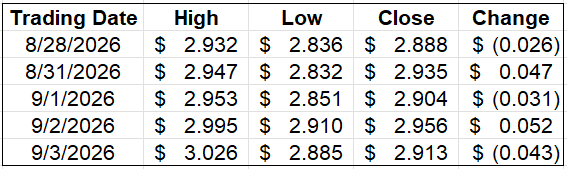
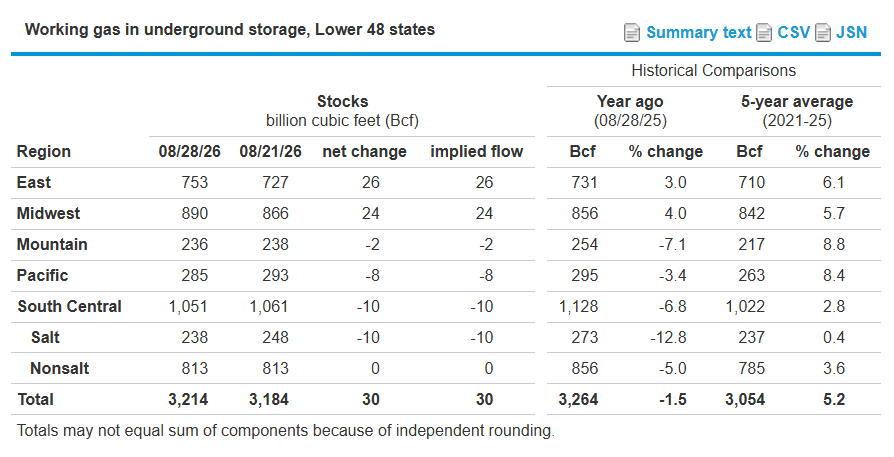
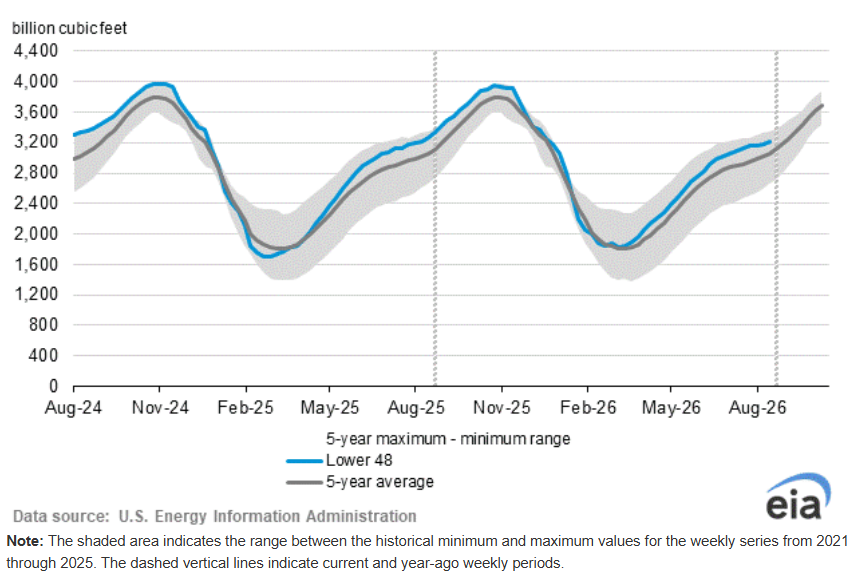
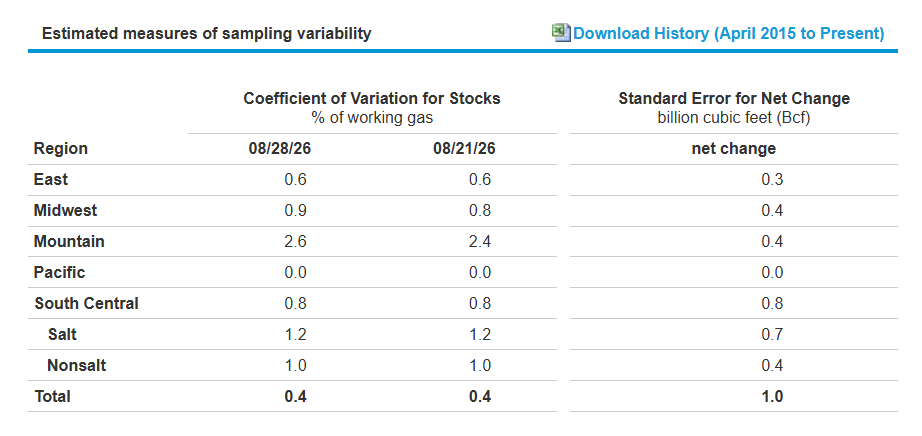
Storage Report: The EIA reported a net injection of 30 Bcf for the week ending August 28, below the five-year average of 37 Bcf and below analyst consensus of ~32 Bcf. South Central, Pacific, and Mountain regions all drew down storage — unusual for late August — offset by East (+26 Bcf) and Midwest (+24 Bcf) injections. Total working gas stands at 3,214 Bcf, 160 Bcf (5.2%) above the five-year average but 50 Bcf below year-ago levels.
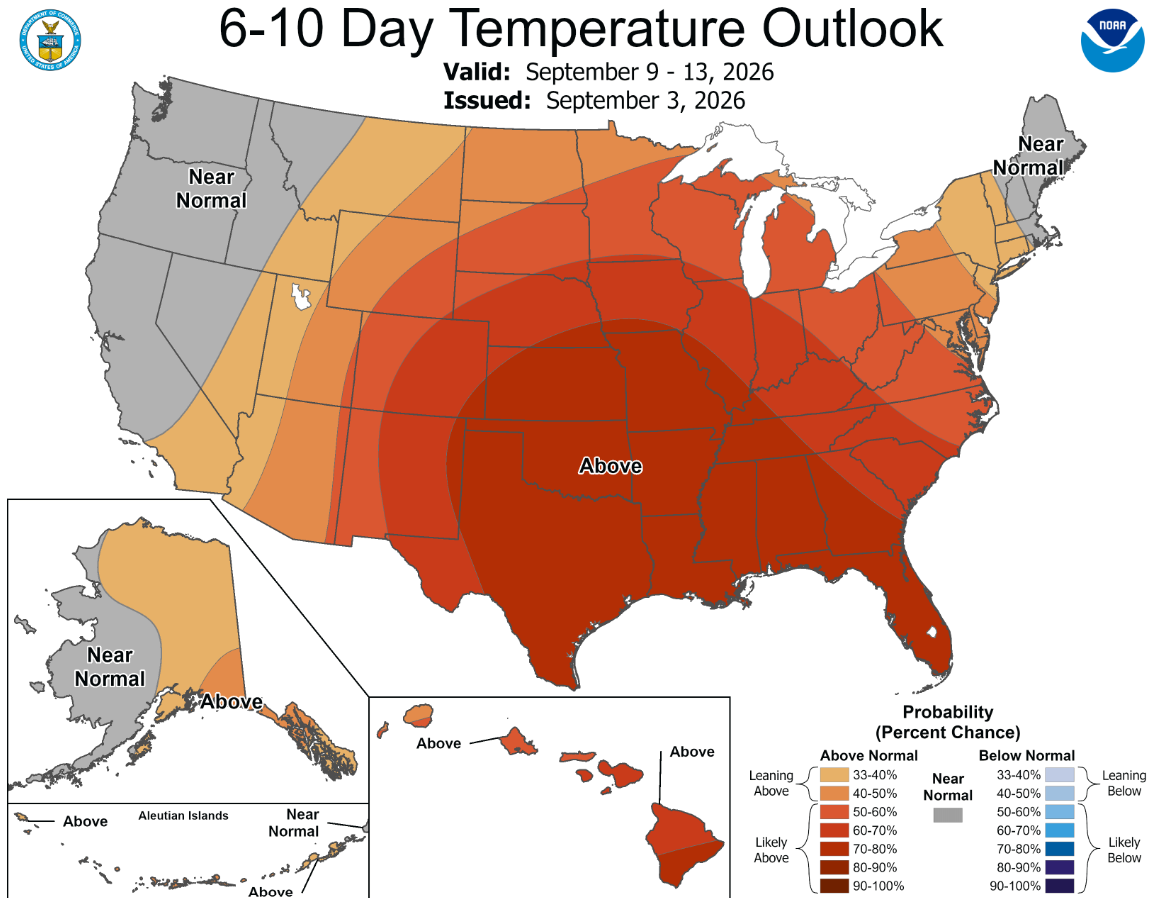
Weather: NOAA's 6–10 day outlook (valid September 9–13) calls for above-normal temperatures from the Desert Southwest and Rockies eastward through most of the Atlantic Coast, with 70%+ probability along the Gulf Coast — supportive of continued power burn and limited storage builds heading into mid-September. Near-normal conditions are expected for the Pacific Coast and northern New England.
Market Data:
September 4, 2026

Weekly Energy News
September 4, 2026
Market Update: NYMEX natural gas futures retreated on September 3 after the U.S. Energy Information Administration reported a net injection of 30 Bcf for the week ending August 28 — smaller than the five-year average build of 37 Bcf for the comparable week, but sufficient to cool the brief rally that had lifted the October contract above $3.00/MMBtu intraday. The October 2026 front-month contract settled at $2.913/MMBtu, down 4.3 cents on the session, while November fell 5.3 cents to $3.037/MMBtu. Three of five storage regions posted net withdrawals during the report week, an unusual late-August occurrence that reflects intense summer heat gripping much of the country.
The sharpest market action this week was in the Southeast, where a sustained heatwave drove spot gas prices to their highest summer 2026 levels since 2022. Florida Gas Zone 3 surged above $7.60/MMBtu and Transco Zone 5 South climbed to $7.70/MMBtu for September 4 flows. Pipeline operators responded with operational alerts.
Storage Report: The EIA reported a net injection of 30 Bcf for the week ending August 28, below the five-year average of 37 Bcf and below analyst consensus of ~32 Bcf. South Central, Pacific, and Mountain regions all drew down storage — unusual for late August — offset by East (+26 Bcf) and Midwest (+24 Bcf) injections. Total working gas stands at 3,214 Bcf, 160 Bcf (5.2%) above the five-year average but 50 Bcf below year-ago levels.
Weather: NOAA's 6–10 day outlook (valid September 9–13) calls for above-normal temperatures from the Desert Southwest and Rockies eastward through most of the Atlantic Coast, with 70%+ probability along the Gulf Coast — supportive of continued power burn and limited storage builds heading into mid-September. Near-normal conditions are expected for the Pacific Coast and northern New England.
Market Data:
September 4, 2026
September 4, 2026
Weekly Energy News
Market Update: NYMEX natural gas futures retreated on September 3 after the U.S. Energy Information Administration reported a net injection of 30 Bcf for the week ending August 28 — smaller than the five-year average build of 37 Bcf for the comparable week, but sufficient to cool the brief rally that had lifted the October contract above $3.00/MMBtu intraday. The October 2026 front-month contract settled at $2.913/MMBtu, down 4.3 cents on the session, while November fell 5.3 cents to $3.037/MMBtu. Three of five storage regions posted net withdrawals during the report week, an unusual late-August occurrence that reflects intense summer heat gripping much of the country.
The sharpest market action this week was in the Southeast, where a sustained heatwave drove spot gas prices to their highest summer 2026 levels since 2022. Florida Gas Zone 3 surged above $7.60/MMBtu and Transco Zone 5 South climbed to $7.70/MMBtu for September 4 flows. Pipeline operators responded with operational alerts.
Storage Report: The EIA reported a net injection of 30 Bcf for the week ending August 28, below the five-year average of 37 Bcf and below analyst consensus of ~32 Bcf. South Central, Pacific, and Mountain regions all drew down storage — unusual for late August — offset by East (+26 Bcf) and Midwest (+24 Bcf) injections. Total working gas stands at 3,214 Bcf, 160 Bcf (5.2%) above the five-year average but 50 Bcf below year-ago levels.
Weather: NOAA's 6–10 day outlook (valid September 9–13) calls for above-normal temperatures from the Desert Southwest and Rockies eastward through most of the Atlantic Coast, with 70%+ probability along the Gulf Coast — supportive of continued power burn and limited storage builds heading into mid-September. Near-normal conditions are expected for the Pacific Coast and northern New England.
September 4, 2026
Weekly Energy News
Market Update: NYMEX natural gas futures retreated on September 3 after the U.S. Energy Information Administration reported a net injection of 30 Bcf for the week ending August 28 — smaller than the five-year average build of 37 Bcf for the comparable week, but sufficient to cool the brief rally that had lifted the October contract above $3.00/MMBtu intraday. The October 2026 front-month contract settled at $2.913/MMBtu, down 4.3 cents on the session, while November fell 5.3 cents to $3.037/MMBtu. Three of five storage regions posted net withdrawals during the report week, an unusual late-August occurrence that reflects intense summer heat gripping much of the country.
The sharpest market action this week was in the Southeast, where a sustained heatwave drove spot gas prices to their highest summer 2026 levels since 2022. Florida Gas Zone 3 surged above $7.60/MMBtu and Transco Zone 5 South climbed to $7.70/MMBtu for September 4 flows. Pipeline operators responded with operational alerts.
Storage Report: The EIA reported a net injection of 30 Bcf for the week ending August 28, below the five-year average of 37 Bcf and below analyst consensus of ~32 Bcf. South Central, Pacific, and Mountain regions all drew down storage — unusual for late August — offset by East (+26 Bcf) and Midwest (+24 Bcf) injections. Total working gas stands at 3,214 Bcf, 160 Bcf (5.2%) above the five-year average but 50 Bcf below year-ago levels.
Weather: NOAA's 6–10 day outlook (valid September 9–13) calls for above-normal temperatures from the Desert Southwest and Rockies eastward through most of the Atlantic Coast, with 70%+ probability along the Gulf Coast — supportive of continued power burn and limited storage builds heading into mid-September. Near-normal conditions are expected for the Pacific Coast and northern New England.
September 4, 2026
Weekly Energy News
Market Update: NYMEX natural gas futures retreated on September 3 after the U.S. Energy Information Administration reported a net injection of 30 Bcf for the week ending August 28 — smaller than the five-year average build of 37 Bcf for the comparable week, but sufficient to cool the brief rally that had lifted the October contract above $3.00/MMBtu intraday. The October 2026 front-month contract settled at $2.913/MMBtu, down 4.3 cents on the session, while November fell 5.3 cents to $3.037/MMBtu. Three of five storage regions posted net withdrawals during the report week, an unusual late-August occurrence that reflects intense summer heat gripping much of the country.
The sharpest market action this week was in the Southeast, where a sustained heatwave drove spot gas prices to their highest summer 2026 levels since 2022. Florida Gas Zone 3 surged above $7.60/MMBtu and Transco Zone 5 South climbed to $7.70/MMBtu for September 4 flows. Pipeline operators responded with operational alerts.
Storage Report: The EIA reported a net injection of 30 Bcf for the week ending August 28, below the five-year average of 37 Bcf and below analyst consensus of ~32 Bcf. South Central, Pacific, and Mountain regions all drew down storage — unusual for late August — offset by East (+26 Bcf) and Midwest (+24 Bcf) injections. Total working gas stands at 3,214 Bcf, 160 Bcf (5.2%) above the five-year average but 50 Bcf below year-ago levels.
Weather: NOAA's 6–10 day outlook (valid September 9–13) calls for above-normal temperatures from the Desert Southwest and Rockies eastward through most of the Atlantic Coast, with 70%+ probability along the Gulf Coast — supportive of continued power burn and limited storage builds heading into mid-September. Near-normal conditions are expected for the Pacific Coast and northern New England.

September 4, 2026
Market Update: NYMEX natural gas futures retreated on September 3 after the U.S. Energy Information Administration reported a net injection of 30 Bcf for the week ending August 28 — smaller than the five-year average build of 37 Bcf for the comparable week, but sufficient to cool the brief rally that had lifted the October contract above $3.00/MMBtu intraday. The October 2026 front-month contract settled at $2.913/MMBtu, down 4.3 cents on the session, while November fell 5.3 cents to $3.037/MMBtu. Three of five storage regions posted net withdrawals during the report week, an unusual late-August occurrence that reflects intense summer heat gripping much of the country.
The sharpest market action this week was in the Southeast, where a sustained heatwave drove spot gas prices to their highest summer 2026 levels since 2022. Florida Gas Zone 3 surged above $7.60/MMBtu and Transco Zone 5 South climbed to $7.70/MMBtu for September 4 flows. Pipeline operators responded with operational alerts.
Storage Report: The EIA reported a net injection of 30 Bcf for the week ending August 28, below the five-year average of 37 Bcf and below analyst consensus of ~32 Bcf. South Central, Pacific, and Mountain regions all drew down storage — unusual for late August — offset by East (+26 Bcf) and Midwest (+24 Bcf) injections. Total working gas stands at 3,214 Bcf, 160 Bcf (5.2%) above the five-year average but 50 Bcf below year-ago levels.
Weather: NOAA's 6–10 day outlook (valid September 9–13) calls for above-normal temperatures from the Desert Southwest and Rockies eastward through most of the Atlantic Coast, with 70%+ probability along the Gulf Coast — supportive of continued power burn and limited storage builds heading into mid-September. Near-normal conditions are expected for the Pacific Coast and northern New England.
September 4, 2026
Weekly Energy News
Market Update: NYMEX natural gas futures retreated on September 3 after the U.S. Energy Information Administration reported a net injection of 30 Bcf for the week ending August 28 — smaller than the five-year average build of 37 Bcf for the comparable week, but sufficient to cool the brief rally that had lifted the October contract above $3.00/MMBtu intraday. The October 2026 front-month contract settled at $2.913/MMBtu, down 4.3 cents on the session, while November fell 5.3 cents to $3.037/MMBtu. Three of five storage regions posted net withdrawals during the report week, an unusual late-August occurrence that reflects intense summer heat gripping much of the country.
The sharpest market action this week was in the Southeast, where a sustained heatwave drove spot gas prices to their highest summer 2026 levels since 2022. Florida Gas Zone 3 surged above $7.60/MMBtu and Transco Zone 5 South climbed to $7.70/MMBtu for September 4 flows. Pipeline operators responded with operational alerts.
Storage Report: The EIA reported a net injection of 30 Bcf for the week ending August 28, below the five-year average of 37 Bcf and below analyst consensus of ~32 Bcf. South Central, Pacific, and Mountain regions all drew down storage — unusual for late August — offset by East (+26 Bcf) and Midwest (+24 Bcf) injections. Total working gas stands at 3,214 Bcf, 160 Bcf (5.2%) above the five-year average but 50 Bcf below year-ago levels.
Weather: NOAA's 6–10 day outlook (valid September 9–13) calls for above-normal temperatures from the Desert Southwest and Rockies eastward through most of the Atlantic Coast, with 70%+ probability along the Gulf Coast — supportive of continued power burn and limited storage builds heading into mid-September. Near-normal conditions are expected for the Pacific Coast and northern New England.
September 4, 2026
Weekly Energy News
Market Update: NYMEX natural gas futures retreated on September 3 after the U.S. Energy Information Administration reported a net injection of 30 Bcf for the week ending August 28 — smaller than the five-year average build of 37 Bcf for the comparable week, but sufficient to cool the brief rally that had lifted the October contract above $3.00/MMBtu intraday. The October 2026 front-month contract settled at $2.913/MMBtu, down 4.3 cents on the session, while November fell 5.3 cents to $3.037/MMBtu. Three of five storage regions posted net withdrawals during the report week, an unusual late-August occurrence that reflects intense summer heat gripping much of the country.
The sharpest market action this week was in the Southeast, where a sustained heatwave drove spot gas prices to their highest summer 2026 levels since 2022. Florida Gas Zone 3 surged above $7.60/MMBtu and Transco Zone 5 South climbed to $7.70/MMBtu for September 4 flows. Pipeline operators responded with operational alerts.
Storage Report: The EIA reported a net injection of 30 Bcf for the week ending August 28, below the five-year average of 37 Bcf and below analyst consensus of ~32 Bcf. South Central, Pacific, and Mountain regions all drew down storage — unusual for late August — offset by East (+26 Bcf) and Midwest (+24 Bcf) injections. Total working gas stands at 3,214 Bcf, 160 Bcf (5.2%) above the five-year average but 50 Bcf below year-ago levels.
Weather: NOAA's 6–10 day outlook (valid September 9–13) calls for above-normal temperatures from the Desert Southwest and Rockies eastward through most of the Atlantic Coast, with 70%+ probability along the Gulf Coast — supportive of continued power burn and limited storage builds heading into mid-September. Near-normal conditions are expected for the Pacific Coast and northern New England.
Make Your Choice Gas Selection in Three Easy Steps
Click here to access our online tool, or call our Choice gas commodity experts at 1 (877) 790-4990.
Step 1: Enter your account number
- Your Black Hills Energy account number is located at the top right-hand corner of your bill.
Step 2: Review price options and make your selection
Step 3: Confirm your selection and enter your control number
- You received a control number in your 2026 Choice Gas selection packet mailed to you from Black Hills Energy. If you cannot locate this, you can retrieve your control number by calling 877-245-3506 or visit choicegas.com
Once enrolled, you will be removed from supplier marketing communications within 24 hours.


Sign Up for Our Energy Newsletters
Sign UpRecent Posts