October 30, 2026
Weekly Energy News
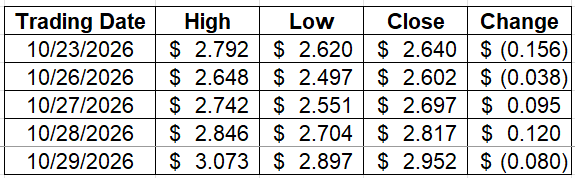
Market Update: Natural gas prices remain under pressure heading into winter. NYMEX Henry Hub December futures, now the prompt month, settled at $2.952/MMBtu on October 29, down 8 cents on the day and 20 cents from a week earlier, after the EIA reported a larger-than-expected storage build. The November contract expired at $2.817/MMBtu on October 28, just days after posting its lowest prompt-month settlement in six months ($2.602/MMBtu on October 26). Still, the market is pricing in winter demand: January settled at $3.392/MMBtu, about 44 cents above December, while March settled at $2.446/MMBtu, reflecting expectations of ample supply once the heating season ends. Henry Hub cash fell 18 cents to $2.670/MMBtu for October 30–31 flows.
Ample supply remains the main headwind. The EIA expects U.S. production to reach a record 112.2 Bcf/d in 2026 and 116.1 Bcf/d in 2027, and some producers, including Antero Resources, are already curtailing output in response to low prices. Demand is growing as well, with record U.S. consumption of 120.0 Bcf/d expected in 2026 on rising LNG exports and data-center power needs, and Cheniere expects competition for LNG cargoes to intensify this winter.
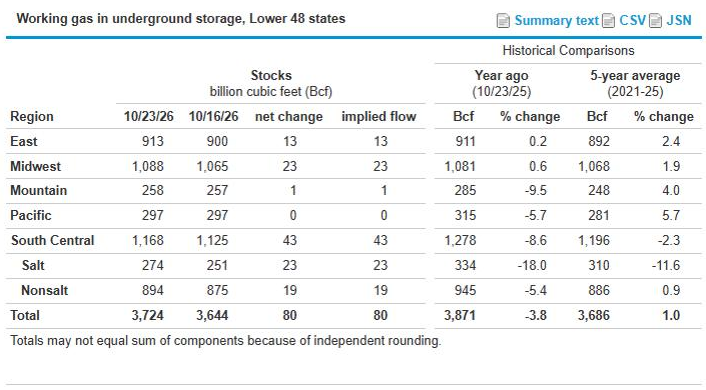
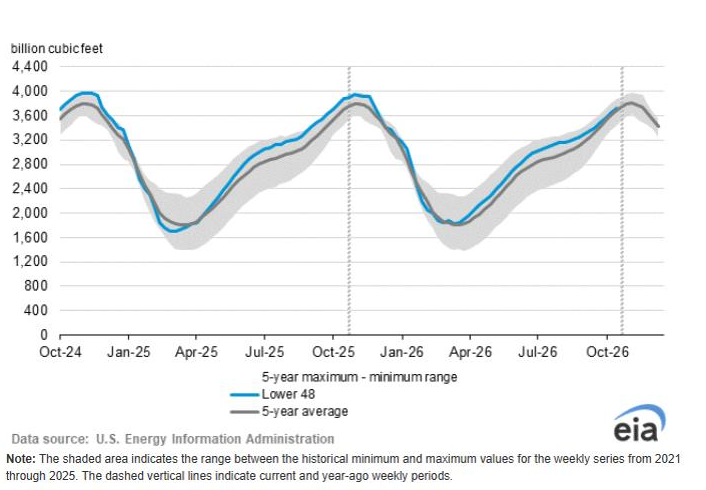
Storage Report: The EIA reported an 80 Bcf injection for the week ended October 23, above the 68 Bcf analyst estimate and the five-year average of 77 Bcf, marking the first above-average build in 11 weeks. Total working gas stands at 3.724 Tcf, 38 Bcf (1.0%) above the five-year average and 147 Bcf (3.8%) below year-ago levels.

Weather: NOAA’s 6–10 day outlook (valid November 4–8) favors above-normal temperatures across nearly the entire Lower 48, with the highest odds over the Great Lakes, Ohio Valley and Northeast, while near-normal temperatures are favored in the Southwest. Mild early-November weather should keep heating demand light and allow injections to continue.

Market Data:
October 30, 2026

Weekly Energy News
October 30, 2026
Market Update: Natural gas prices remain under pressure heading into winter. NYMEX Henry Hub December futures, now the prompt month, settled at $2.952/MMBtu on October 29, down 8 cents on the day and 20 cents from a week earlier, after the EIA reported a larger-than-expected storage build. The November contract expired at $2.817/MMBtu on October 28, just days after posting its lowest prompt-month settlement in six months ($2.602/MMBtu on October 26). Still, the market is pricing in winter demand: January settled at $3.392/MMBtu, about 44 cents above December, while March settled at $2.446/MMBtu, reflecting expectations of ample supply once the heating season ends. Henry Hub cash fell 18 cents to $2.670/MMBtu for October 30–31 flows.
Ample supply remains the main headwind. The EIA expects U.S. production to reach a record 112.2 Bcf/d in 2026 and 116.1 Bcf/d in 2027, and some producers, including Antero Resources, are already curtailing output in response to low prices. Demand is growing as well, with record U.S. consumption of 120.0 Bcf/d expected in 2026 on rising LNG exports and data-center power needs, and Cheniere expects competition for LNG cargoes to intensify this winter.
Storage Report: The EIA reported an 80 Bcf injection for the week ended October 23, above the 68 Bcf analyst estimate and the five-year average of 77 Bcf, marking the first above-average build in 11 weeks. Total working gas stands at 3.724 Tcf, 38 Bcf (1.0%) above the five-year average and 147 Bcf (3.8%) below year-ago levels.
Weather: NOAA’s 6–10 day outlook (valid November 4–8) favors above-normal temperatures across nearly the entire Lower 48, with the highest odds over the Great Lakes, Ohio Valley and Northeast, while near-normal temperatures are favored in the Southwest. Mild early-November weather should keep heating demand light and allow injections to continue.
Market Data:
October 30, 2026
October 30, 2026
Weekly Energy News
Market Update: Natural gas prices remain under pressure heading into winter. NYMEX Henry Hub December futures, now the prompt month, settled at $2.952/MMBtu on October 29, down 8 cents on the day and 20 cents from a week earlier, after the EIA reported a larger-than-expected storage build. The November contract expired at $2.817/MMBtu on October 28, just days after posting its lowest prompt-month settlement in six months ($2.602/MMBtu on October 26). Still, the market is pricing in winter demand: January settled at $3.392/MMBtu, about 44 cents above December, while March settled at $2.446/MMBtu, reflecting expectations of ample supply once the heating season ends. Henry Hub cash fell 18 cents to $2.670/MMBtu for October 30–31 flows.
Ample supply remains the main headwind. The EIA expects U.S. production to reach a record 112.2 Bcf/d in 2026 and 116.1 Bcf/d in 2027, and some producers, including Antero Resources, are already curtailing output in response to low prices. Demand is growing as well, with record U.S. consumption of 120.0 Bcf/d expected in 2026 on rising LNG exports and data-center power needs, and Cheniere expects competition for LNG cargoes to intensify this winter.
Storage Report: The EIA reported an 80 Bcf injection for the week ended October 23, above the 68 Bcf analyst estimate and the five-year average of 77 Bcf, marking the first above-average build in 11 weeks. Total working gas stands at 3.724 Tcf, 38 Bcf (1.0%) above the five-year average and 147 Bcf (3.8%) below year-ago levels.
Weather: NOAA’s 6–10 day outlook (valid November 4–8) favors above-normal temperatures across nearly the entire Lower 48, with the highest odds over the Great Lakes, Ohio Valley and Northeast, while near-normal temperatures are favored in the Southwest. Mild early-November weather should keep heating demand light and allow injections to continue.

October 30, 2026
Market Update: Natural gas prices remain under pressure heading into winter. NYMEX Henry Hub December futures, now the prompt month, settled at $2.952/MMBtu on October 29, down 8 cents on the day and 20 cents from a week earlier, after the EIA reported a larger-than-expected storage build. The November contract expired at $2.817/MMBtu on October 28, just days after posting its lowest prompt-month settlement in six months ($2.602/MMBtu on October 26). Still, the market is pricing in winter demand: January settled at $3.392/MMBtu, about 44 cents above December, while March settled at $2.446/MMBtu, reflecting expectations of ample supply once the heating season ends. Henry Hub cash fell 18 cents to $2.670/MMBtu for October 30–31 flows.
Ample supply remains the main headwind. The EIA expects U.S. production to reach a record 112.2 Bcf/d in 2026 and 116.1 Bcf/d in 2027, and some producers, including Antero Resources, are already curtailing output in response to low prices. Demand is growing as well, with record U.S. consumption of 120.0 Bcf/d expected in 2026 on rising LNG exports and data-center power needs, and Cheniere expects competition for LNG cargoes to intensify this winter.
Storage Report: The EIA reported an 80 Bcf injection for the week ended October 23, above the 68 Bcf analyst estimate and the five-year average of 77 Bcf, marking the first above-average build in 11 weeks. Total working gas stands at 3.724 Tcf, 38 Bcf (1.0%) above the five-year average and 147 Bcf (3.8%) below year-ago levels.
Weather: NOAA’s 6–10 day outlook (valid November 4–8) favors above-normal temperatures across nearly the entire Lower 48, with the highest odds over the Great Lakes, Ohio Valley and Northeast, while near-normal temperatures are favored in the Southwest. Mild early-November weather should keep heating demand light and allow injections to continue.
October 30, 2026
Weekly Energy News
Market Update: Natural gas prices remain under pressure heading into winter. NYMEX Henry Hub December futures, now the prompt month, settled at $2.952/MMBtu on October 29, down 8 cents on the day and 20 cents from a week earlier, after the EIA reported a larger-than-expected storage build. The November contract expired at $2.817/MMBtu on October 28, just days after posting its lowest prompt-month settlement in six months ($2.602/MMBtu on October 26). Still, the market is pricing in winter demand: January settled at $3.392/MMBtu, about 44 cents above December, while March settled at $2.446/MMBtu, reflecting expectations of ample supply once the heating season ends. Henry Hub cash fell 18 cents to $2.670/MMBtu for October 30–31 flows.
Ample supply remains the main headwind. The EIA expects U.S. production to reach a record 112.2 Bcf/d in 2026 and 116.1 Bcf/d in 2027, and some producers, including Antero Resources, are already curtailing output in response to low prices. Demand is growing as well, with record U.S. consumption of 120.0 Bcf/d expected in 2026 on rising LNG exports and data-center power needs, and Cheniere expects competition for LNG cargoes to intensify this winter.
Storage Report: The EIA reported an 80 Bcf injection for the week ended October 23, above the 68 Bcf analyst estimate and the five-year average of 77 Bcf, marking the first above-average build in 11 weeks. Total working gas stands at 3.724 Tcf, 38 Bcf (1.0%) above the five-year average and 147 Bcf (3.8%) below year-ago levels.
Weather: NOAA’s 6–10 day outlook (valid November 4–8) favors above-normal temperatures across nearly the entire Lower 48, with the highest odds over the Great Lakes, Ohio Valley and Northeast, while near-normal temperatures are favored in the Southwest. Mild early-November weather should keep heating demand light and allow injections to continue.
Make Your Choice Gas Selection in Three Easy Steps
Click here to access our online tool, or call our Choice gas commodity experts at 1 (877) 790-4990.
Step 1: Enter your account number
- Your Black Hills Energy account number is located at the top right-hand corner of your bill.
Step 2: Review price options and make your selection
Step 3: Confirm your selection and enter your control number
- You received a control number in your 2026 Choice Gas selection packet mailed to you from Black Hills Energy. If you cannot locate this, you can retrieve your control number by calling 877-245-3506 or visit choicegas.com
Once enrolled, you will be removed from supplier marketing communications within 24 hours.


Sign Up for Our Energy Newsletters
Sign UpRecent Posts