October 16, 2026
Weekly Energy News
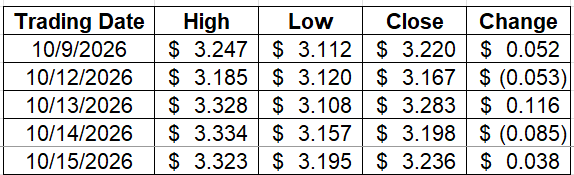
Market Update: NYMEX Henry Hub November futures rose 3.8 cents on October 15 to settle at $3.236/MMBtu after touching an intraday high near $3.32, the prompt month’s highest level since early July. Support came from a force majeure on Columbia Gas’s Mountaineer XPress Pipeline in West Virginia, which cut Appalachian supply by nearly 1.9 Bcf/d, along with a bullish storage report. Henry Hub cash settled at $3.300/MMBtu and the Platts national average at $2.510/MMBtu for October 16 flows.
Fundamentals are tightening: U.S. production has averaged 110 Bcf/d so far in October, down from 112.3 Bcf/d in September, while LNG feedgas demand rebounded to about 20.3 Bcf/d after Cove Point returned from maintenance on October 12. On the policy front, FERC proposed a streamlined review program for LNG projects, while the National Weather Service’s winter outlook calls for a strong El Niño and a warmer-than-normal northern U.S., a potential headwind for heating demand.
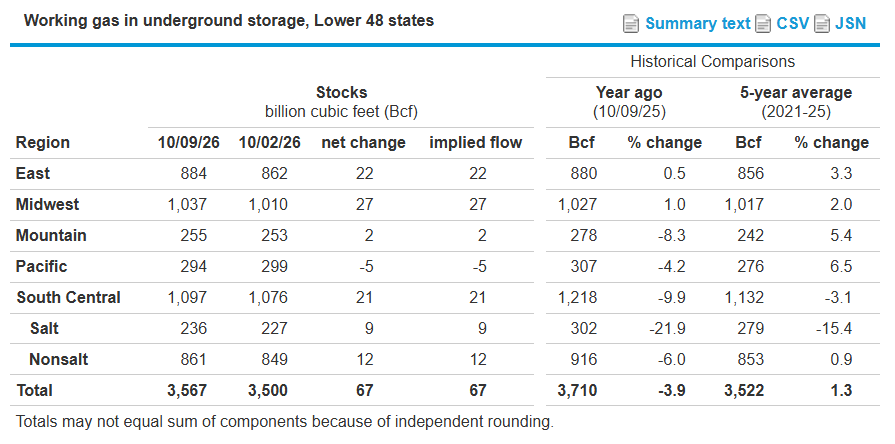
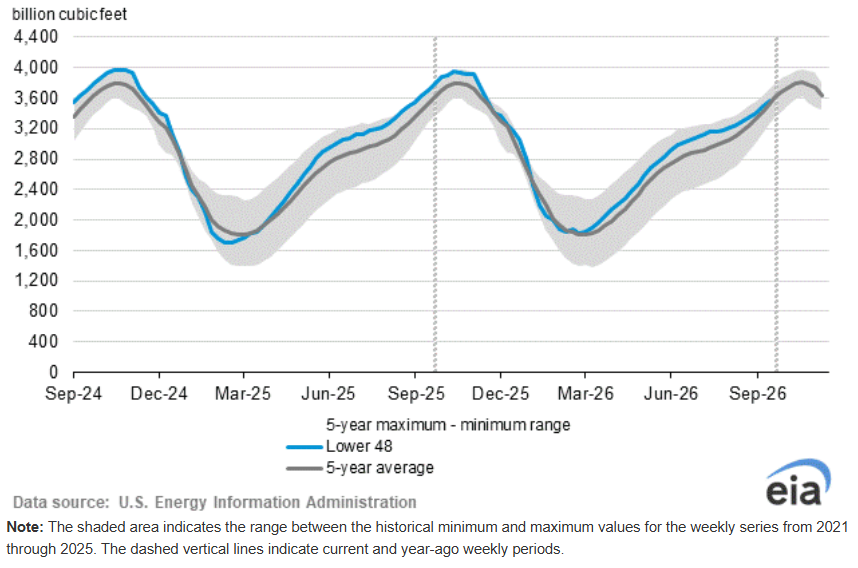
Storage Report: The EIA reported a 67 Bcf injection for the week ended October 9, 10 Bcf below the 77 Bcf consensus and well below the five-year average of 90 Bcf. Total working gas stands at 3.567 Tcf, 45 Bcf (1.3%) above the five-year average, the ninth straight week the surplus has narrowed, and 143 Bcf (3.9%) below year-ago levels.
Weather: NOAA’s 6–10 day outlook (valid October 21–25) strongly favors above-normal temperatures across nearly all of the U.S. east of the Rockies, with the highest odds in the Upper Midwest, while below-normal readings are favored in the Southwest and Great Basin. Continued warmth should keep heating demand light and could stretch the injection season into early November.

Market Data:
October 16, 2026

Weekly Energy News
October 16, 2026
Market Update: NYMEX Henry Hub November futures rose 3.8 cents on October 15 to settle at $3.236/MMBtu after touching an intraday high near $3.32, the prompt month’s highest level since early July. Support came from a force majeure on Columbia Gas’s Mountaineer XPress Pipeline in West Virginia, which cut Appalachian supply by nearly 1.9 Bcf/d, along with a bullish storage report. Henry Hub cash settled at $3.300/MMBtu and the Platts national average at $2.510/MMBtu for October 16 flows.
Fundamentals are tightening: U.S. production has averaged 110 Bcf/d so far in October, down from 112.3 Bcf/d in September, while LNG feedgas demand rebounded to about 20.3 Bcf/d after Cove Point returned from maintenance on October 12. On the policy front, FERC proposed a streamlined review program for LNG projects, while the National Weather Service’s winter outlook calls for a strong El Niño and a warmer-than-normal northern U.S., a potential headwind for heating demand.
Storage Report: The EIA reported a 67 Bcf injection for the week ended October 9, 10 Bcf below the 77 Bcf consensus and well below the five-year average of 90 Bcf. Total working gas stands at 3.567 Tcf, 45 Bcf (1.3%) above the five-year average, the ninth straight week the surplus has narrowed, and 143 Bcf (3.9%) below year-ago levels.
Weather: NOAA’s 6–10 day outlook (valid October 21–25) strongly favors above-normal temperatures across nearly all of the U.S. east of the Rockies, with the highest odds in the Upper Midwest, while below-normal readings are favored in the Southwest and Great Basin. Continued warmth should keep heating demand light and could stretch the injection season into early November.
Market Data:
October 16, 2026
October 16, 2026
Weekly Energy News
Market Update: NYMEX Henry Hub November futures rose 3.8 cents on October 15 to settle at $3.236/MMBtu after touching an intraday high near $3.32, the prompt month’s highest level since early July. Support came from a force majeure on Columbia Gas’s Mountaineer XPress Pipeline in West Virginia, which cut Appalachian supply by nearly 1.9 Bcf/d, along with a bullish storage report. Henry Hub cash settled at $3.300/MMBtu and the Platts national average at $2.510/MMBtu for October 16 flows.
Fundamentals are tightening: U.S. production has averaged 110 Bcf/d so far in October, down from 112.3 Bcf/d in September, while LNG feedgas demand rebounded to about 20.3 Bcf/d after Cove Point returned from maintenance on October 12. On the policy front, FERC proposed a streamlined review program for LNG projects, while the National Weather Service’s winter outlook calls for a strong El Niño and a warmer-than-normal northern U.S., a potential headwind for heating demand.
Storage Report: The EIA reported a 67 Bcf injection for the week ended October 9, 10 Bcf below the 77 Bcf consensus and well below the five-year average of 90 Bcf. Total working gas stands at 3.567 Tcf, 45 Bcf (1.3%) above the five-year average, the ninth straight week the surplus has narrowed, and 143 Bcf (3.9%) below year-ago levels.
Weather: NOAA’s 6–10 day outlook (valid October 21–25) strongly favors above-normal temperatures across nearly all of the U.S. east of the Rockies, with the highest odds in the Upper Midwest, while below-normal readings are favored in the Southwest and Great Basin. Continued warmth should keep heating demand light and could stretch the injection season into early November.
October 16, 2026
Weekly Energy News
Market Update: NYMEX Henry Hub November futures rose 3.8 cents on October 15 to settle at $3.236/MMBtu after touching an intraday high near $3.32, the prompt month’s highest level since early July. Support came from a force majeure on Columbia Gas’s Mountaineer XPress Pipeline in West Virginia, which cut Appalachian supply by nearly 1.9 Bcf/d, along with a bullish storage report. Henry Hub cash settled at $3.300/MMBtu and the Platts national average at $2.510/MMBtu for October 16 flows.
Fundamentals are tightening: U.S. production has averaged 110 Bcf/d so far in October, down from 112.3 Bcf/d in September, while LNG feedgas demand rebounded to about 20.3 Bcf/d after Cove Point returned from maintenance on October 12. On the policy front, FERC proposed a streamlined review program for LNG projects, while the National Weather Service’s winter outlook calls for a strong El Niño and a warmer-than-normal northern U.S., a potential headwind for heating demand.
Storage Report: The EIA reported a 67 Bcf injection for the week ended October 9, 10 Bcf below the 77 Bcf consensus and well below the five-year average of 90 Bcf. Total working gas stands at 3.567 Tcf, 45 Bcf (1.3%) above the five-year average, the ninth straight week the surplus has narrowed, and 143 Bcf (3.9%) below year-ago levels.
Weather: NOAA’s 6–10 day outlook (valid October 21–25) strongly favors above-normal temperatures across nearly all of the U.S. east of the Rockies, with the highest odds in the Upper Midwest, while below-normal readings are favored in the Southwest and Great Basin. Continued warmth should keep heating demand light and could stretch the injection season into early November.
October 16, 2026
Weekly Energy News
Market Update: NYMEX Henry Hub November futures rose 3.8 cents on October 15 to settle at $3.236/MMBtu after touching an intraday high near $3.32, the prompt month’s highest level since early July. Support came from a force majeure on Columbia Gas’s Mountaineer XPress Pipeline in West Virginia, which cut Appalachian supply by nearly 1.9 Bcf/d, along with a bullish storage report. Henry Hub cash settled at $3.300/MMBtu and the Platts national average at $2.510/MMBtu for October 16 flows.
Fundamentals are tightening: U.S. production has averaged 110 Bcf/d so far in October, down from 112.3 Bcf/d in September, while LNG feedgas demand rebounded to about 20.3 Bcf/d after Cove Point returned from maintenance on October 12. On the policy front, FERC proposed a streamlined review program for LNG projects, while the National Weather Service’s winter outlook calls for a strong El Niño and a warmer-than-normal northern U.S., a potential headwind for heating demand.
Storage Report: The EIA reported a 67 Bcf injection for the week ended October 9, 10 Bcf below the 77 Bcf consensus and well below the five-year average of 90 Bcf. Total working gas stands at 3.567 Tcf, 45 Bcf (1.3%) above the five-year average, the ninth straight week the surplus has narrowed, and 143 Bcf (3.9%) below year-ago levels.
Weather: NOAA’s 6–10 day outlook (valid October 21–25) strongly favors above-normal temperatures across nearly all of the U.S. east of the Rockies, with the highest odds in the Upper Midwest, while below-normal readings are favored in the Southwest and Great Basin. Continued warmth should keep heating demand light and could stretch the injection season into early November.

October 16, 2026
Market Update: NYMEX Henry Hub November futures rose 3.8 cents on October 15 to settle at $3.236/MMBtu after touching an intraday high near $3.32, the prompt month’s highest level since early July. Support came from a force majeure on Columbia Gas’s Mountaineer XPress Pipeline in West Virginia, which cut Appalachian supply by nearly 1.9 Bcf/d, along with a bullish storage report. Henry Hub cash settled at $3.300/MMBtu and the Platts national average at $2.510/MMBtu for October 16 flows.
Fundamentals are tightening: U.S. production has averaged 110 Bcf/d so far in October, down from 112.3 Bcf/d in September, while LNG feedgas demand rebounded to about 20.3 Bcf/d after Cove Point returned from maintenance on October 12. On the policy front, FERC proposed a streamlined review program for LNG projects, while the National Weather Service’s winter outlook calls for a strong El Niño and a warmer-than-normal northern U.S., a potential headwind for heating demand.
Storage Report: The EIA reported a 67 Bcf injection for the week ended October 9, 10 Bcf below the 77 Bcf consensus and well below the five-year average of 90 Bcf. Total working gas stands at 3.567 Tcf, 45 Bcf (1.3%) above the five-year average, the ninth straight week the surplus has narrowed, and 143 Bcf (3.9%) below year-ago levels.
Weather: NOAA’s 6–10 day outlook (valid October 21–25) strongly favors above-normal temperatures across nearly all of the U.S. east of the Rockies, with the highest odds in the Upper Midwest, while below-normal readings are favored in the Southwest and Great Basin. Continued warmth should keep heating demand light and could stretch the injection season into early November.
October 16, 2026
Weekly Energy News
Market Update: NYMEX Henry Hub November futures rose 3.8 cents on October 15 to settle at $3.236/MMBtu after touching an intraday high near $3.32, the prompt month’s highest level since early July. Support came from a force majeure on Columbia Gas’s Mountaineer XPress Pipeline in West Virginia, which cut Appalachian supply by nearly 1.9 Bcf/d, along with a bullish storage report. Henry Hub cash settled at $3.300/MMBtu and the Platts national average at $2.510/MMBtu for October 16 flows.
Fundamentals are tightening: U.S. production has averaged 110 Bcf/d so far in October, down from 112.3 Bcf/d in September, while LNG feedgas demand rebounded to about 20.3 Bcf/d after Cove Point returned from maintenance on October 12. On the policy front, FERC proposed a streamlined review program for LNG projects, while the National Weather Service’s winter outlook calls for a strong El Niño and a warmer-than-normal northern U.S., a potential headwind for heating demand.
Storage Report: The EIA reported a 67 Bcf injection for the week ended October 9, 10 Bcf below the 77 Bcf consensus and well below the five-year average of 90 Bcf. Total working gas stands at 3.567 Tcf, 45 Bcf (1.3%) above the five-year average, the ninth straight week the surplus has narrowed, and 143 Bcf (3.9%) below year-ago levels.
Weather: NOAA’s 6–10 day outlook (valid October 21–25) strongly favors above-normal temperatures across nearly all of the U.S. east of the Rockies, with the highest odds in the Upper Midwest, while below-normal readings are favored in the Southwest and Great Basin. Continued warmth should keep heating demand light and could stretch the injection season into early November.
October 16, 2026
Weekly Energy News
Market Update: NYMEX Henry Hub November futures rose 3.8 cents on October 15 to settle at $3.236/MMBtu after touching an intraday high near $3.32, the prompt month’s highest level since early July. Support came from a force majeure on Columbia Gas’s Mountaineer XPress Pipeline in West Virginia, which cut Appalachian supply by nearly 1.9 Bcf/d, along with a bullish storage report. Henry Hub cash settled at $3.300/MMBtu and the Platts national average at $2.510/MMBtu for October 16 flows.
Fundamentals are tightening: U.S. production has averaged 110 Bcf/d so far in October, down from 112.3 Bcf/d in September, while LNG feedgas demand rebounded to about 20.3 Bcf/d after Cove Point returned from maintenance on October 12. On the policy front, FERC proposed a streamlined review program for LNG projects, while the National Weather Service’s winter outlook calls for a strong El Niño and a warmer-than-normal northern U.S., a potential headwind for heating demand.
Storage Report: The EIA reported a 67 Bcf injection for the week ended October 9, 10 Bcf below the 77 Bcf consensus and well below the five-year average of 90 Bcf. Total working gas stands at 3.567 Tcf, 45 Bcf (1.3%) above the five-year average, the ninth straight week the surplus has narrowed, and 143 Bcf (3.9%) below year-ago levels.
Weather: NOAA’s 6–10 day outlook (valid October 21–25) strongly favors above-normal temperatures across nearly all of the U.S. east of the Rockies, with the highest odds in the Upper Midwest, while below-normal readings are favored in the Southwest and Great Basin. Continued warmth should keep heating demand light and could stretch the injection season into early November.
Make Your Choice Gas Selection in Three Easy Steps
Click here to access our online tool, or call our Choice gas commodity experts at 1 (877) 790-4990.
Step 1: Enter your account number
- Your Black Hills Energy account number is located at the top right-hand corner of your bill.
Step 2: Review price options and make your selection
Step 3: Confirm your selection and enter your control number
- You received a control number in your 2026 Choice Gas selection packet mailed to you from Black Hills Energy. If you cannot locate this, you can retrieve your control number by calling 877-245-3506 or visit choicegas.com
Once enrolled, you will be removed from supplier marketing communications within 24 hours.


Sign Up for Our Energy Newsletters
Sign UpRecent Posts