June 26, 2026
Weekly Energy News
Market Update: Natural gas futures moved lower following Thursday’s EIA storage report, as the agency reported a 76 Bcf storage injection—slightly above market expectations. The July NYMEX contract initially fell to an intraday low near $3.20/MMBtu before recovering into the upper $3.20s later in the day.
Although market fundamentals strengthened during the second half of June, supported by higher LNG feed gas demand and increased pipeline exports, the larger-than-expected storage build tempered bullish sentiment. The reported injection was generally in line with the five-year average of 75 Bcf for this time of year but well below last year’s 96 Bcf increase.
July 2026 NYMEX closed Thursday at $3.343
· High for the day $3.363
· Low for the day $3.196
Early trading for the prompt month is trading at $3.324
· https://www.cmegroup.com/markets/energy/natural-gas/natural-gas.html
· https://www.fxempire.com/commodities/natural-gas
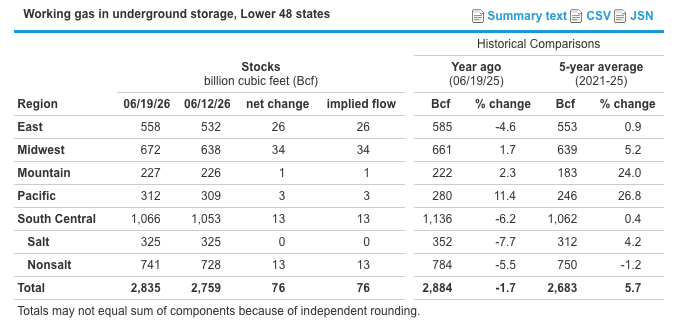
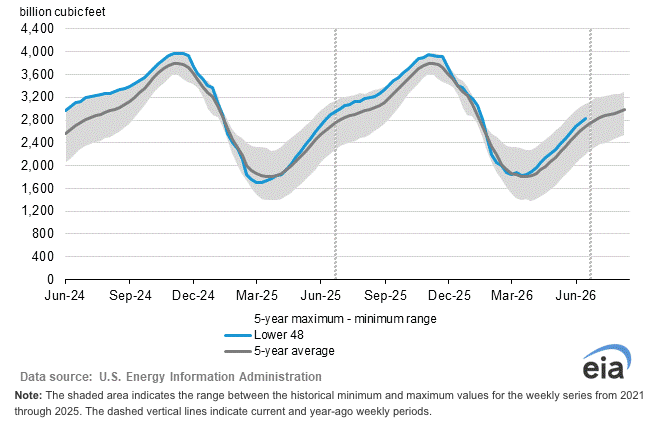
Total working gas in storage now stands at 2.835 Tcf, approximately 152 Bcf (5.7%) above the five-year average but 49 Bcf (1.7%) below year-ago levels. The storage surplus relative to the five-year average remains modest, while the year-over-year deficit has widened for the fourth consecutive week.
Looking ahead, warmer summer temperatures are expected to increase natural gas demand for power generation, which could lead to smaller storage injections in the coming weeks. Some analysts expect weekly injections to fall into the low-40 Bcf range by early July if heat persists.
For next week’s EIA report, market expectations center on a storage injection of 77–79 Bcf. If realized, that would exceed both the five-year average build of 64 Bcf and last year’s 61 Bcf injection for the comparable week, suggesting storage levels will likely remain comfortably above historical norms despite stronger seasonal demand.
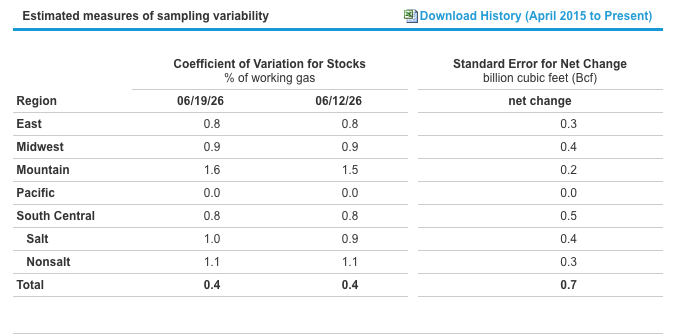
EIA Storage Report: According to the EIA, working natural gas in storage totaled 2,835 Bcf as of Friday, June 19, 2026, an increase of 76 Bcf from the previous week. Storage levels were 49 Bcf below this time last year but 152 Bcf above the five-year average of 2,683 Bcf. Overall, working gas inventories remain within the five-year historical range.
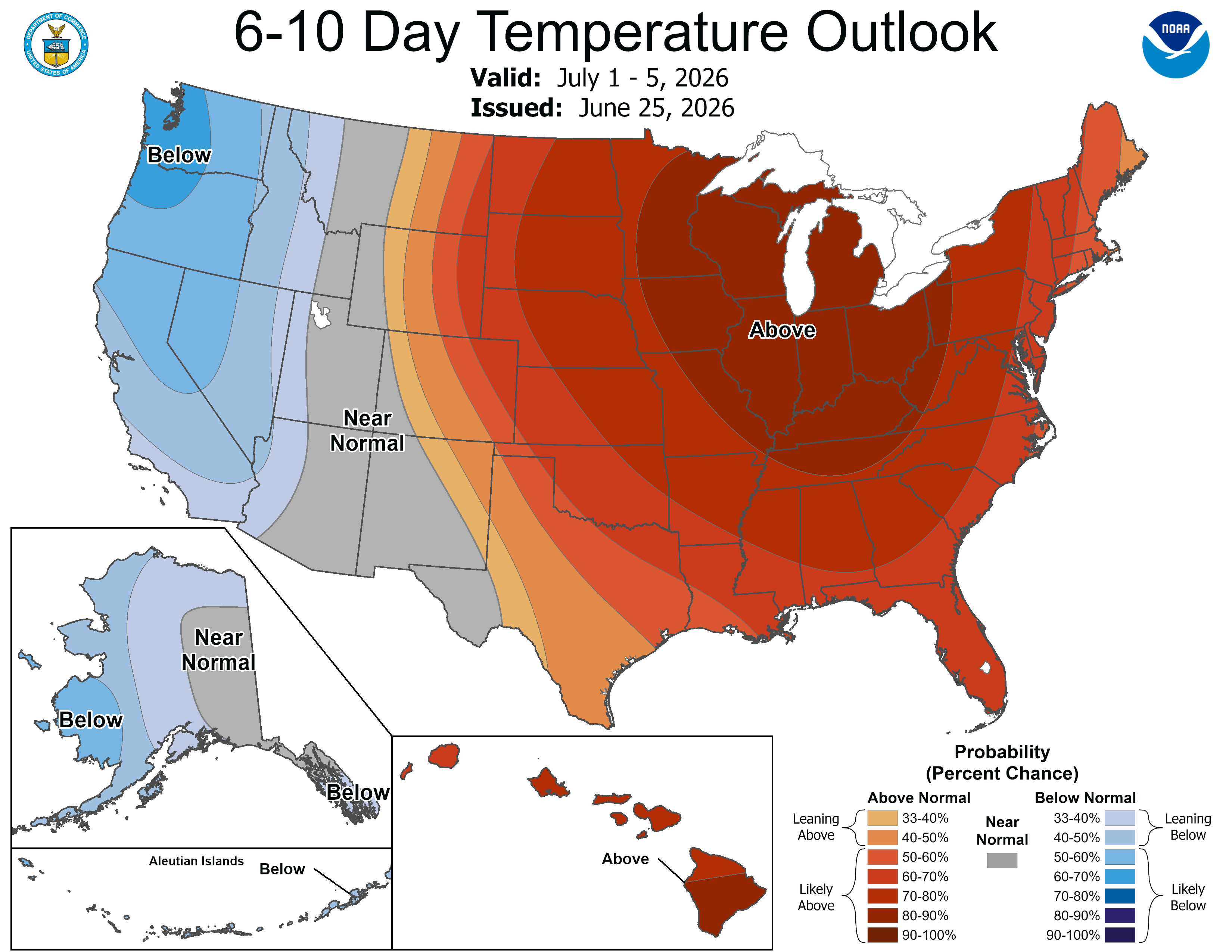
Weather: The outlook for July continues to favor above-normal temperatures across much of the U.S., particularly throughout the West, southern states, and much of the East Coast. The highest confidence for warmer-than-average conditions is across the interior West, while above-normal temperatures are also expected across the Southwest, Texas, Gulf Coast, and Southeast. In contrast, the Northern Plains, Great Lakes, and portions of the Midwest are forecast to experience a more variable pattern with near-normal temperatures.
While El Niño conditions have officially developed in the tropical Pacific, forecasters expect its influence on July weather to remain limited, as the event is still emerging and summer atmospheric patterns tend to weaken typical El Niño impacts.
Precipitation forecasts are less certain. Wetter-than-normal conditions are favored across the Southwest, Central and Southern Rockies, and parts of the Intermountain West as the summer monsoon becomes more active. Above-normal rainfall is also expected across portions of the Ohio, Tennessee, and Mid-Mississippi Valleys. Meanwhile, drier-than-normal conditions are favored across parts of the Northern Plains and Pacific Northwest.
Market Data:
June 26, 2026

Weekly Energy News
June 26, 2026
Market Update: Natural gas futures moved lower following Thursday’s EIA storage report, as the agency reported a 76 Bcf storage injection—slightly above market expectations. The July NYMEX contract initially fell to an intraday low near $3.20/MMBtu before recovering into the upper $3.20s later in the day.
Although market fundamentals strengthened during the second half of June, supported by higher LNG feed gas demand and increased pipeline exports, the larger-than-expected storage build tempered bullish sentiment. The reported injection was generally in line with the five-year average of 75 Bcf for this time of year but well below last year’s 96 Bcf increase.
July 2026 NYMEX closed Thursday at $3.343
· High for the day $3.363
· Low for the day $3.196
Early trading for the prompt month is trading at $3.324
· https://www.cmegroup.com/markets/energy/natural-gas/natural-gas.html
· https://www.fxempire.com/commodities/natural-gas
Total working gas in storage now stands at 2.835 Tcf, approximately 152 Bcf (5.7%) above the five-year average but 49 Bcf (1.7%) below year-ago levels. The storage surplus relative to the five-year average remains modest, while the year-over-year deficit has widened for the fourth consecutive week.
Looking ahead, warmer summer temperatures are expected to increase natural gas demand for power generation, which could lead to smaller storage injections in the coming weeks. Some analysts expect weekly injections to fall into the low-40 Bcf range by early July if heat persists.
For next week’s EIA report, market expectations center on a storage injection of 77–79 Bcf. If realized, that would exceed both the five-year average build of 64 Bcf and last year’s 61 Bcf injection for the comparable week, suggesting storage levels will likely remain comfortably above historical norms despite stronger seasonal demand.
EIA Storage Report: According to the EIA, working natural gas in storage totaled 2,835 Bcf as of Friday, June 19, 2026, an increase of 76 Bcf from the previous week. Storage levels were 49 Bcf below this time last year but 152 Bcf above the five-year average of 2,683 Bcf. Overall, working gas inventories remain within the five-year historical range.
Weather: The outlook for July continues to favor above-normal temperatures across much of the U.S., particularly throughout the West, southern states, and much of the East Coast. The highest confidence for warmer-than-average conditions is across the interior West, while above-normal temperatures are also expected across the Southwest, Texas, Gulf Coast, and Southeast. In contrast, the Northern Plains, Great Lakes, and portions of the Midwest are forecast to experience a more variable pattern with near-normal temperatures.
While El Niño conditions have officially developed in the tropical Pacific, forecasters expect its influence on July weather to remain limited, as the event is still emerging and summer atmospheric patterns tend to weaken typical El Niño impacts.
Precipitation forecasts are less certain. Wetter-than-normal conditions are favored across the Southwest, Central and Southern Rockies, and parts of the Intermountain West as the summer monsoon becomes more active. Above-normal rainfall is also expected across portions of the Ohio, Tennessee, and Mid-Mississippi Valleys. Meanwhile, drier-than-normal conditions are favored across parts of the Northern Plains and Pacific Northwest.
Market Data:
June 26, 2026
June 26, 2026
Weekly Energy News
Market Update: Natural gas futures moved lower following Thursday’s EIA storage report, as the agency reported a 76 Bcf storage injection—slightly above market expectations. The July NYMEX contract initially fell to an intraday low near $3.20/MMBtu before recovering into the upper $3.20s later in the day.
Although market fundamentals strengthened during the second half of June, supported by higher LNG feed gas demand and increased pipeline exports, the larger-than-expected storage build tempered bullish sentiment. The reported injection was generally in line with the five-year average of 75 Bcf for this time of year but well below last year’s 96 Bcf increase.
July 2026 NYMEX closed Thursday at $3.343
· High for the day $3.363
· Low for the day $3.196
Early trading for the prompt month is trading at $3.324
· https://www.cmegroup.com/markets/energy/natural-gas/natural-gas.html
· https://www.fxempire.com/commodities/natural-gas
Total working gas in storage now stands at 2.835 Tcf, approximately 152 Bcf (5.7%) above the five-year average but 49 Bcf (1.7%) below year-ago levels. The storage surplus relative to the five-year average remains modest, while the year-over-year deficit has widened for the fourth consecutive week.
Looking ahead, warmer summer temperatures are expected to increase natural gas demand for power generation, which could lead to smaller storage injections in the coming weeks. Some analysts expect weekly injections to fall into the low-40 Bcf range by early July if heat persists.
For next week’s EIA report, market expectations center on a storage injection of 77–79 Bcf. If realized, that would exceed both the five-year average build of 64 Bcf and last year’s 61 Bcf injection for the comparable week, suggesting storage levels will likely remain comfortably above historical norms despite stronger seasonal demand.
EIA Storage Report: According to the EIA, working natural gas in storage totaled 2,835 Bcf as of Friday, June 19, 2026, an increase of 76 Bcf from the previous week. Storage levels were 49 Bcf below this time last year but 152 Bcf above the five-year average of 2,683 Bcf. Overall, working gas inventories remain within the five-year historical range.
Weather: The outlook for July continues to favor above-normal temperatures across much of the U.S., particularly throughout the West, southern states, and much of the East Coast. The highest confidence for warmer-than-average conditions is across the interior West, while above-normal temperatures are also expected across the Southwest, Texas, Gulf Coast, and Southeast. In contrast, the Northern Plains, Great Lakes, and portions of the Midwest are forecast to experience a more variable pattern with near-normal temperatures.
While El Niño conditions have officially developed in the tropical Pacific, forecasters expect its influence on July weather to remain limited, as the event is still emerging and summer atmospheric patterns tend to weaken typical El Niño impacts.
Precipitation forecasts are less certain. Wetter-than-normal conditions are favored across the Southwest, Central and Southern Rockies, and parts of the Intermountain West as the summer monsoon becomes more active. Above-normal rainfall is also expected across portions of the Ohio, Tennessee, and Mid-Mississippi Valleys. Meanwhile, drier-than-normal conditions are favored across parts of the Northern Plains and Pacific Northwest.
June 26, 2026
Weekly Energy News
Market Update: Natural gas futures moved lower following Thursday’s EIA storage report, as the agency reported a 76 Bcf storage injection—slightly above market expectations. The July NYMEX contract initially fell to an intraday low near $3.20/MMBtu before recovering into the upper $3.20s later in the day.
Although market fundamentals strengthened during the second half of June, supported by higher LNG feed gas demand and increased pipeline exports, the larger-than-expected storage build tempered bullish sentiment. The reported injection was generally in line with the five-year average of 75 Bcf for this time of year but well below last year’s 96 Bcf increase.
July 2026 NYMEX closed Thursday at $3.343
· High for the day $3.363
· Low for the day $3.196
Early trading for the prompt month is trading at $3.324
· https://www.cmegroup.com/markets/energy/natural-gas/natural-gas.html
· https://www.fxempire.com/commodities/natural-gas
Total working gas in storage now stands at 2.835 Tcf, approximately 152 Bcf (5.7%) above the five-year average but 49 Bcf (1.7%) below year-ago levels. The storage surplus relative to the five-year average remains modest, while the year-over-year deficit has widened for the fourth consecutive week.
Looking ahead, warmer summer temperatures are expected to increase natural gas demand for power generation, which could lead to smaller storage injections in the coming weeks. Some analysts expect weekly injections to fall into the low-40 Bcf range by early July if heat persists.
For next week’s EIA report, market expectations center on a storage injection of 77–79 Bcf. If realized, that would exceed both the five-year average build of 64 Bcf and last year’s 61 Bcf injection for the comparable week, suggesting storage levels will likely remain comfortably above historical norms despite stronger seasonal demand.
EIA Storage Report: According to the EIA, working natural gas in storage totaled 2,835 Bcf as of Friday, June 19, 2026, an increase of 76 Bcf from the previous week. Storage levels were 49 Bcf below this time last year but 152 Bcf above the five-year average of 2,683 Bcf. Overall, working gas inventories remain within the five-year historical range.
Weather: The outlook for July continues to favor above-normal temperatures across much of the U.S., particularly throughout the West, southern states, and much of the East Coast. The highest confidence for warmer-than-average conditions is across the interior West, while above-normal temperatures are also expected across the Southwest, Texas, Gulf Coast, and Southeast. In contrast, the Northern Plains, Great Lakes, and portions of the Midwest are forecast to experience a more variable pattern with near-normal temperatures.
While El Niño conditions have officially developed in the tropical Pacific, forecasters expect its influence on July weather to remain limited, as the event is still emerging and summer atmospheric patterns tend to weaken typical El Niño impacts.
Precipitation forecasts are less certain. Wetter-than-normal conditions are favored across the Southwest, Central and Southern Rockies, and parts of the Intermountain West as the summer monsoon becomes more active. Above-normal rainfall is also expected across portions of the Ohio, Tennessee, and Mid-Mississippi Valleys. Meanwhile, drier-than-normal conditions are favored across parts of the Northern Plains and Pacific Northwest.
June 26, 2026
Weekly Energy News
Market Update: Natural gas futures moved lower following Thursday’s EIA storage report, as the agency reported a 76 Bcf storage injection—slightly above market expectations. The July NYMEX contract initially fell to an intraday low near $3.20/MMBtu before recovering into the upper $3.20s later in the day.
Although market fundamentals strengthened during the second half of June, supported by higher LNG feed gas demand and increased pipeline exports, the larger-than-expected storage build tempered bullish sentiment. The reported injection was generally in line with the five-year average of 75 Bcf for this time of year but well below last year’s 96 Bcf increase.
July 2026 NYMEX closed Thursday at $3.343
· High for the day $3.363
· Low for the day $3.196
Early trading for the prompt month is trading at $3.324
· https://www.cmegroup.com/markets/energy/natural-gas/natural-gas.html
· https://www.fxempire.com/commodities/natural-gas
Total working gas in storage now stands at 2.835 Tcf, approximately 152 Bcf (5.7%) above the five-year average but 49 Bcf (1.7%) below year-ago levels. The storage surplus relative to the five-year average remains modest, while the year-over-year deficit has widened for the fourth consecutive week.
Looking ahead, warmer summer temperatures are expected to increase natural gas demand for power generation, which could lead to smaller storage injections in the coming weeks. Some analysts expect weekly injections to fall into the low-40 Bcf range by early July if heat persists.
For next week’s EIA report, market expectations center on a storage injection of 77–79 Bcf. If realized, that would exceed both the five-year average build of 64 Bcf and last year’s 61 Bcf injection for the comparable week, suggesting storage levels will likely remain comfortably above historical norms despite stronger seasonal demand.
EIA Storage Report: According to the EIA, working natural gas in storage totaled 2,835 Bcf as of Friday, June 19, 2026, an increase of 76 Bcf from the previous week. Storage levels were 49 Bcf below this time last year but 152 Bcf above the five-year average of 2,683 Bcf. Overall, working gas inventories remain within the five-year historical range.
Weather: The outlook for July continues to favor above-normal temperatures across much of the U.S., particularly throughout the West, southern states, and much of the East Coast. The highest confidence for warmer-than-average conditions is across the interior West, while above-normal temperatures are also expected across the Southwest, Texas, Gulf Coast, and Southeast. In contrast, the Northern Plains, Great Lakes, and portions of the Midwest are forecast to experience a more variable pattern with near-normal temperatures.
While El Niño conditions have officially developed in the tropical Pacific, forecasters expect its influence on July weather to remain limited, as the event is still emerging and summer atmospheric patterns tend to weaken typical El Niño impacts.
Precipitation forecasts are less certain. Wetter-than-normal conditions are favored across the Southwest, Central and Southern Rockies, and parts of the Intermountain West as the summer monsoon becomes more active. Above-normal rainfall is also expected across portions of the Ohio, Tennessee, and Mid-Mississippi Valleys. Meanwhile, drier-than-normal conditions are favored across parts of the Northern Plains and Pacific Northwest.

June 26, 2026
Market Update: Natural gas futures moved lower following Thursday’s EIA storage report, as the agency reported a 76 Bcf storage injection—slightly above market expectations. The July NYMEX contract initially fell to an intraday low near $3.20/MMBtu before recovering into the upper $3.20s later in the day.
Although market fundamentals strengthened during the second half of June, supported by higher LNG feed gas demand and increased pipeline exports, the larger-than-expected storage build tempered bullish sentiment. The reported injection was generally in line with the five-year average of 75 Bcf for this time of year but well below last year’s 96 Bcf increase.
July 2026 NYMEX closed Thursday at $3.343
· High for the day $3.363
· Low for the day $3.196
Early trading for the prompt month is trading at $3.324
· https://www.cmegroup.com/markets/energy/natural-gas/natural-gas.html
· https://www.fxempire.com/commodities/natural-gas
Total working gas in storage now stands at 2.835 Tcf, approximately 152 Bcf (5.7%) above the five-year average but 49 Bcf (1.7%) below year-ago levels. The storage surplus relative to the five-year average remains modest, while the year-over-year deficit has widened for the fourth consecutive week.
Looking ahead, warmer summer temperatures are expected to increase natural gas demand for power generation, which could lead to smaller storage injections in the coming weeks. Some analysts expect weekly injections to fall into the low-40 Bcf range by early July if heat persists.
For next week’s EIA report, market expectations center on a storage injection of 77–79 Bcf. If realized, that would exceed both the five-year average build of 64 Bcf and last year’s 61 Bcf injection for the comparable week, suggesting storage levels will likely remain comfortably above historical norms despite stronger seasonal demand.
EIA Storage Report: According to the EIA, working natural gas in storage totaled 2,835 Bcf as of Friday, June 19, 2026, an increase of 76 Bcf from the previous week. Storage levels were 49 Bcf below this time last year but 152 Bcf above the five-year average of 2,683 Bcf. Overall, working gas inventories remain within the five-year historical range.
Weather: The outlook for July continues to favor above-normal temperatures across much of the U.S., particularly throughout the West, southern states, and much of the East Coast. The highest confidence for warmer-than-average conditions is across the interior West, while above-normal temperatures are also expected across the Southwest, Texas, Gulf Coast, and Southeast. In contrast, the Northern Plains, Great Lakes, and portions of the Midwest are forecast to experience a more variable pattern with near-normal temperatures.
While El Niño conditions have officially developed in the tropical Pacific, forecasters expect its influence on July weather to remain limited, as the event is still emerging and summer atmospheric patterns tend to weaken typical El Niño impacts.
Precipitation forecasts are less certain. Wetter-than-normal conditions are favored across the Southwest, Central and Southern Rockies, and parts of the Intermountain West as the summer monsoon becomes more active. Above-normal rainfall is also expected across portions of the Ohio, Tennessee, and Mid-Mississippi Valleys. Meanwhile, drier-than-normal conditions are favored across parts of the Northern Plains and Pacific Northwest.
June 26, 2026
Weekly Energy News
Market Update: Natural gas futures moved lower following Thursday’s EIA storage report, as the agency reported a 76 Bcf storage injection—slightly above market expectations. The July NYMEX contract initially fell to an intraday low near $3.20/MMBtu before recovering into the upper $3.20s later in the day.
Although market fundamentals strengthened during the second half of June, supported by higher LNG feed gas demand and increased pipeline exports, the larger-than-expected storage build tempered bullish sentiment. The reported injection was generally in line with the five-year average of 75 Bcf for this time of year but well below last year’s 96 Bcf increase.
July 2026 NYMEX closed Thursday at $3.343
· High for the day $3.363
· Low for the day $3.196
Early trading for the prompt month is trading at $3.324
· https://www.cmegroup.com/markets/energy/natural-gas/natural-gas.html
· https://www.fxempire.com/commodities/natural-gas
Total working gas in storage now stands at 2.835 Tcf, approximately 152 Bcf (5.7%) above the five-year average but 49 Bcf (1.7%) below year-ago levels. The storage surplus relative to the five-year average remains modest, while the year-over-year deficit has widened for the fourth consecutive week.
Looking ahead, warmer summer temperatures are expected to increase natural gas demand for power generation, which could lead to smaller storage injections in the coming weeks. Some analysts expect weekly injections to fall into the low-40 Bcf range by early July if heat persists.
For next week’s EIA report, market expectations center on a storage injection of 77–79 Bcf. If realized, that would exceed both the five-year average build of 64 Bcf and last year’s 61 Bcf injection for the comparable week, suggesting storage levels will likely remain comfortably above historical norms despite stronger seasonal demand.
EIA Storage Report: According to the EIA, working natural gas in storage totaled 2,835 Bcf as of Friday, June 19, 2026, an increase of 76 Bcf from the previous week. Storage levels were 49 Bcf below this time last year but 152 Bcf above the five-year average of 2,683 Bcf. Overall, working gas inventories remain within the five-year historical range.
Weather: The outlook for July continues to favor above-normal temperatures across much of the U.S., particularly throughout the West, southern states, and much of the East Coast. The highest confidence for warmer-than-average conditions is across the interior West, while above-normal temperatures are also expected across the Southwest, Texas, Gulf Coast, and Southeast. In contrast, the Northern Plains, Great Lakes, and portions of the Midwest are forecast to experience a more variable pattern with near-normal temperatures.
While El Niño conditions have officially developed in the tropical Pacific, forecasters expect its influence on July weather to remain limited, as the event is still emerging and summer atmospheric patterns tend to weaken typical El Niño impacts.
Precipitation forecasts are less certain. Wetter-than-normal conditions are favored across the Southwest, Central and Southern Rockies, and parts of the Intermountain West as the summer monsoon becomes more active. Above-normal rainfall is also expected across portions of the Ohio, Tennessee, and Mid-Mississippi Valleys. Meanwhile, drier-than-normal conditions are favored across parts of the Northern Plains and Pacific Northwest.
June 26, 2026
Weekly Energy News
Market Update: Natural gas futures moved lower following Thursday’s EIA storage report, as the agency reported a 76 Bcf storage injection—slightly above market expectations. The July NYMEX contract initially fell to an intraday low near $3.20/MMBtu before recovering into the upper $3.20s later in the day.
Although market fundamentals strengthened during the second half of June, supported by higher LNG feed gas demand and increased pipeline exports, the larger-than-expected storage build tempered bullish sentiment. The reported injection was generally in line with the five-year average of 75 Bcf for this time of year but well below last year’s 96 Bcf increase.
July 2026 NYMEX closed Thursday at $3.343
· High for the day $3.363
· Low for the day $3.196
Early trading for the prompt month is trading at $3.324
· https://www.cmegroup.com/markets/energy/natural-gas/natural-gas.html
· https://www.fxempire.com/commodities/natural-gas
Total working gas in storage now stands at 2.835 Tcf, approximately 152 Bcf (5.7%) above the five-year average but 49 Bcf (1.7%) below year-ago levels. The storage surplus relative to the five-year average remains modest, while the year-over-year deficit has widened for the fourth consecutive week.
Looking ahead, warmer summer temperatures are expected to increase natural gas demand for power generation, which could lead to smaller storage injections in the coming weeks. Some analysts expect weekly injections to fall into the low-40 Bcf range by early July if heat persists.
For next week’s EIA report, market expectations center on a storage injection of 77–79 Bcf. If realized, that would exceed both the five-year average build of 64 Bcf and last year’s 61 Bcf injection for the comparable week, suggesting storage levels will likely remain comfortably above historical norms despite stronger seasonal demand.
EIA Storage Report: According to the EIA, working natural gas in storage totaled 2,835 Bcf as of Friday, June 19, 2026, an increase of 76 Bcf from the previous week. Storage levels were 49 Bcf below this time last year but 152 Bcf above the five-year average of 2,683 Bcf. Overall, working gas inventories remain within the five-year historical range.
Weather: The outlook for July continues to favor above-normal temperatures across much of the U.S., particularly throughout the West, southern states, and much of the East Coast. The highest confidence for warmer-than-average conditions is across the interior West, while above-normal temperatures are also expected across the Southwest, Texas, Gulf Coast, and Southeast. In contrast, the Northern Plains, Great Lakes, and portions of the Midwest are forecast to experience a more variable pattern with near-normal temperatures.
While El Niño conditions have officially developed in the tropical Pacific, forecasters expect its influence on July weather to remain limited, as the event is still emerging and summer atmospheric patterns tend to weaken typical El Niño impacts.
Precipitation forecasts are less certain. Wetter-than-normal conditions are favored across the Southwest, Central and Southern Rockies, and parts of the Intermountain West as the summer monsoon becomes more active. Above-normal rainfall is also expected across portions of the Ohio, Tennessee, and Mid-Mississippi Valleys. Meanwhile, drier-than-normal conditions are favored across parts of the Northern Plains and Pacific Northwest.
Make Your Choice Gas Selection in Three Easy Steps
Click here to access our online tool, or call our Choice gas commodity experts at 1 (877) 790-4990.
Step 1: Enter your account number
- Your Black Hills Energy account number is located at the top right-hand corner of your bill.
Step 2: Review price options and make your selection
Step 3: Confirm your selection and enter your control number
- You received a control number in your 2026 Choice Gas selection packet mailed to you from Black Hills Energy. If you cannot locate this, you can retrieve your control number by calling 877-245-3506 or visit choicegas.com
Once enrolled, you will be removed from supplier marketing communications within 24 hours.


Sign Up for Our Energy Newsletters
Sign UpRecent Posts