July 24, 2026
Weekly Energy News
Market Update: Recent storage injections in the 30–40 Bcf range have done little to change the market's bearish outlook. Following the EIA's storage reports on July 16 and July 23, NYMEX natural gas futures remained largely rangebound, trading between the upper $2.80s and mid-$2.90s/MMBtu as traders continued to focus on broader supply and demand fundamentals.

Looking ahead, August weather will likely be the key driver for prices. While the longer-term outlook remains relatively soft, stronger-than-expected heat could boost cooling demand and provide near-term support for natural gas prices, particularly if production remains constrained.
Most analysts expect storage injections to stay modest through late July and early August, generally in the 30–45 Bcf range, as summer temperatures limit the amount of gas available for storage. S&P Global Commodity Insights' storage model projects the next EIA report could show an injection of approximately 28 Bcf, reflecting continued strong seasonal demand.
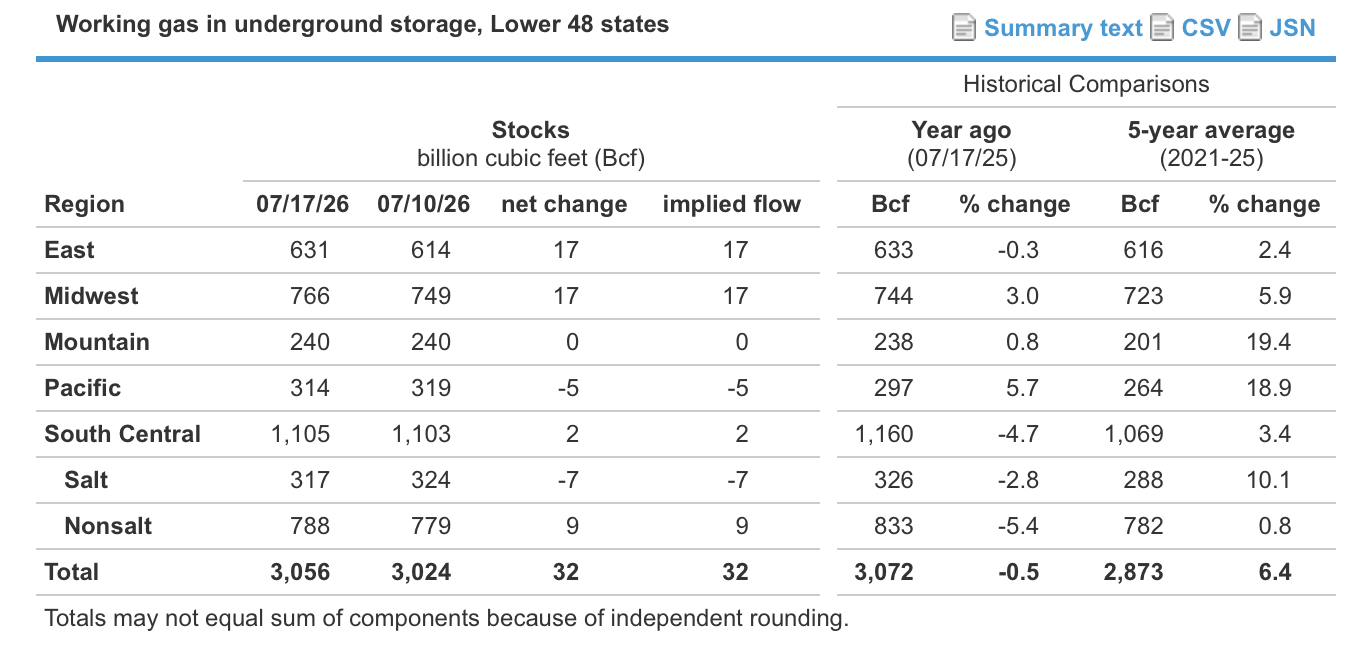
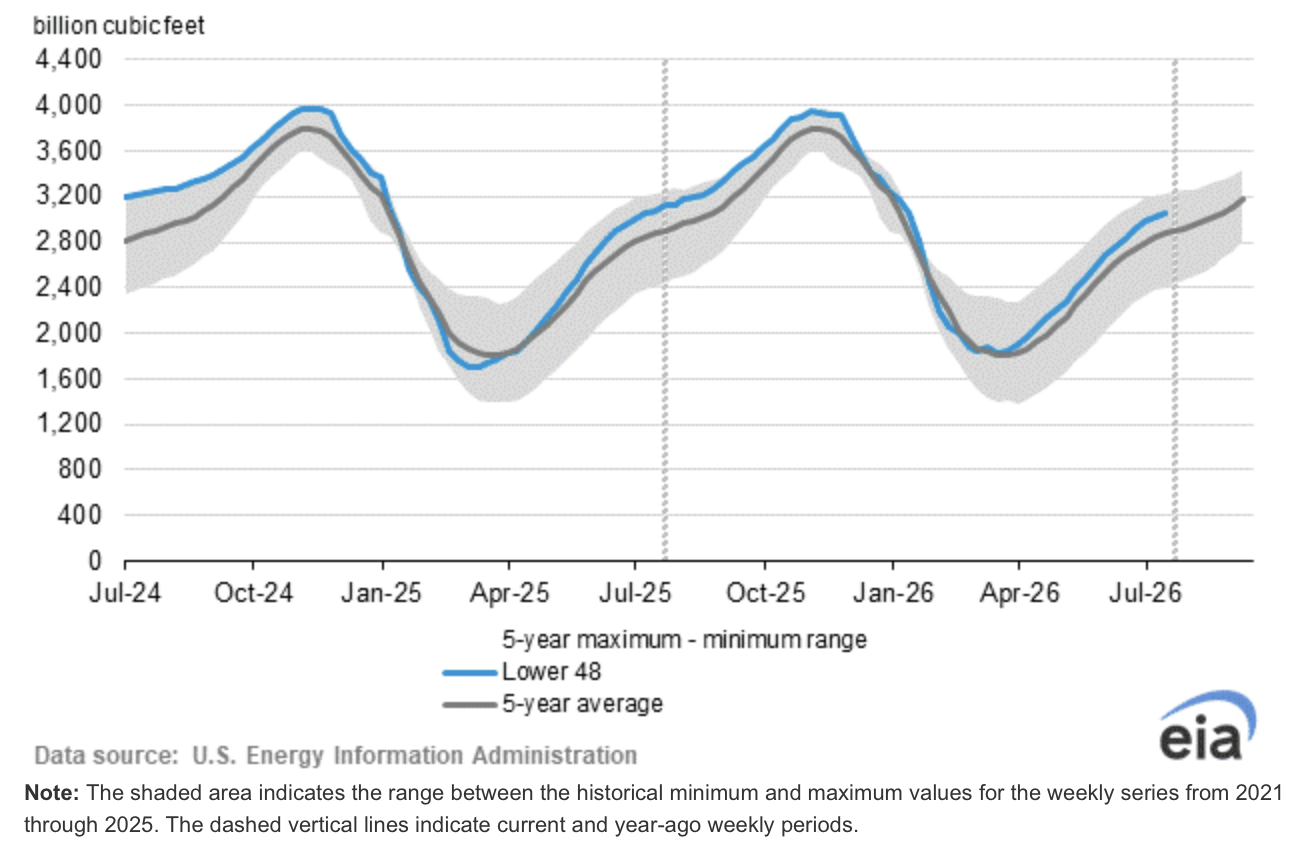
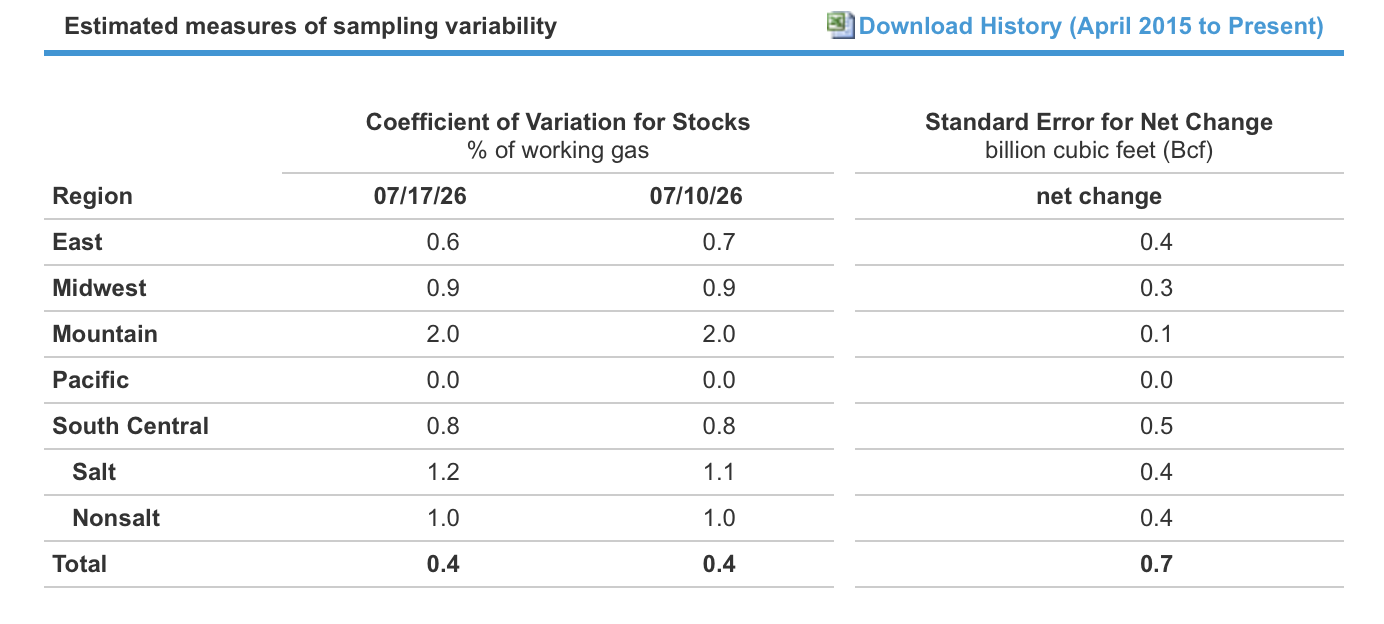
EIA Storage Report: As of July 17, 2026, the EIA reported 3,056 Bcf of working natural gas in storage, an increase of 32 Bcf from the previous week. Storage levels remain 16 Bcf below year-ago levels but are 183 Bcf above the five-year average of 2,873 Bcf. Overall inventories remain comfortably within the historical five-year range.
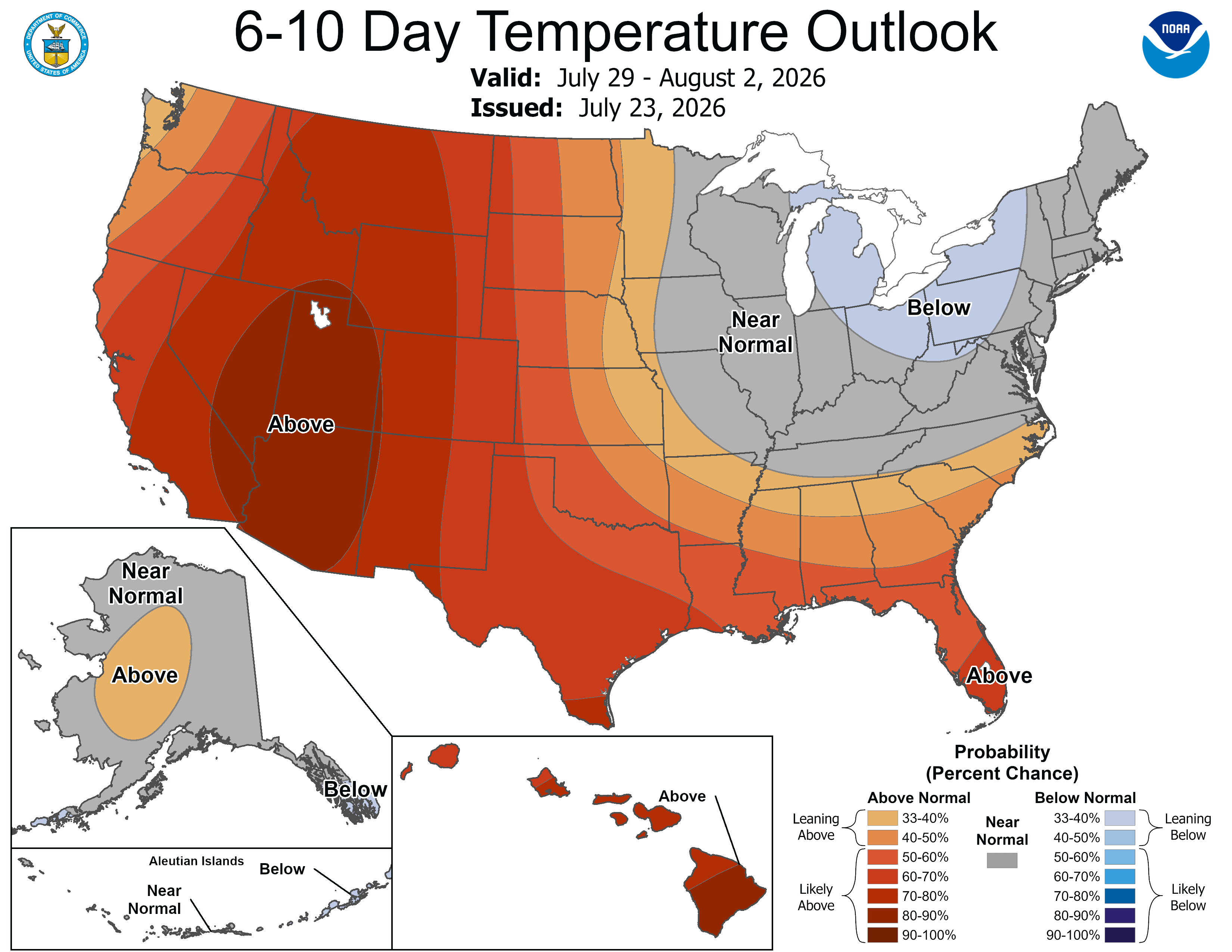
Weather: NOAA's 6–10 day outlook calls for above-normal temperatures across much of the western U.S., especially the Southwest and Great Basin, while cooler-than-normal conditions are expected in the Great Lakes and Northeast. Looking further ahead, NOAA's August outlook remains heavily influenced by a moderate El Niño, supporting warmer-than-normal temperatures across much of the eastern and south-central U.S., the Southeast, Mid-Atlantic, West Coast, and portions of the Pacific Northwest. The strongest signal for above-normal temperatures is in the Southeast, while parts of the Northern Plains may trend cooler than average.
On the precipitation side, an enhanced monsoon pattern is expected to bring above-normal rainfall to much of the West, including the Southwest, Rockies, and Great Basin. Wetter-than-normal conditions are also favored from the Northern Plains into the Mid-Mississippi Valley, while drier conditions are expected across portions of the Southeast and southern Mid-Atlantic. Overall, August is expected to be warmer than normal across much of the country, with increased precipitation in the West and continued dryness in parts of the Southeast.
Market Data:
July 24, 2026
Weekly Energy News
July 24, 2026
Market Update: Recent storage injections in the 30–40 Bcf range have done little to change the market's bearish outlook. Following the EIA's storage reports on July 16 and July 23, NYMEX natural gas futures remained largely rangebound, trading between the upper $2.80s and mid-$2.90s/MMBtu as traders continued to focus on broader supply and demand fundamentals.
Looking ahead, August weather will likely be the key driver for prices. While the longer-term outlook remains relatively soft, stronger-than-expected heat could boost cooling demand and provide near-term support for natural gas prices, particularly if production remains constrained.
Most analysts expect storage injections to stay modest through late July and early August, generally in the 30–45 Bcf range, as summer temperatures limit the amount of gas available for storage. S&P Global Commodity Insights' storage model projects the next EIA report could show an injection of approximately 28 Bcf, reflecting continued strong seasonal demand.
EIA Storage Report: As of July 17, 2026, the EIA reported 3,056 Bcf of working natural gas in storage, an increase of 32 Bcf from the previous week. Storage levels remain 16 Bcf below year-ago levels but are 183 Bcf above the five-year average of 2,873 Bcf. Overall inventories remain comfortably within the historical five-year range.
Weather: NOAA's 6–10 day outlook calls for above-normal temperatures across much of the western U.S., especially the Southwest and Great Basin, while cooler-than-normal conditions are expected in the Great Lakes and Northeast. Looking further ahead, NOAA's August outlook remains heavily influenced by a moderate El Niño, supporting warmer-than-normal temperatures across much of the eastern and south-central U.S., the Southeast, Mid-Atlantic, West Coast, and portions of the Pacific Northwest. The strongest signal for above-normal temperatures is in the Southeast, while parts of the Northern Plains may trend cooler than average.
On the precipitation side, an enhanced monsoon pattern is expected to bring above-normal rainfall to much of the West, including the Southwest, Rockies, and Great Basin. Wetter-than-normal conditions are also favored from the Northern Plains into the Mid-Mississippi Valley, while drier conditions are expected across portions of the Southeast and southern Mid-Atlantic. Overall, August is expected to be warmer than normal across much of the country, with increased precipitation in the West and continued dryness in parts of the Southeast.
Market Data:
July 24, 2026
July 24, 2026
Weekly Energy News
Market Update: Recent storage injections in the 30–40 Bcf range have done little to change the market's bearish outlook. Following the EIA's storage reports on July 16 and July 23, NYMEX natural gas futures remained largely rangebound, trading between the upper $2.80s and mid-$2.90s/MMBtu as traders continued to focus on broader supply and demand fundamentals.
Looking ahead, August weather will likely be the key driver for prices. While the longer-term outlook remains relatively soft, stronger-than-expected heat could boost cooling demand and provide near-term support for natural gas prices, particularly if production remains constrained.
Most analysts expect storage injections to stay modest through late July and early August, generally in the 30–45 Bcf range, as summer temperatures limit the amount of gas available for storage. S&P Global Commodity Insights' storage model projects the next EIA report could show an injection of approximately 28 Bcf, reflecting continued strong seasonal demand.
EIA Storage Report: As of July 17, 2026, the EIA reported 3,056 Bcf of working natural gas in storage, an increase of 32 Bcf from the previous week. Storage levels remain 16 Bcf below year-ago levels but are 183 Bcf above the five-year average of 2,873 Bcf. Overall inventories remain comfortably within the historical five-year range.
Weather: NOAA's 6–10 day outlook calls for above-normal temperatures across much of the western U.S., especially the Southwest and Great Basin, while cooler-than-normal conditions are expected in the Great Lakes and Northeast. Looking further ahead, NOAA's August outlook remains heavily influenced by a moderate El Niño, supporting warmer-than-normal temperatures across much of the eastern and south-central U.S., the Southeast, Mid-Atlantic, West Coast, and portions of the Pacific Northwest. The strongest signal for above-normal temperatures is in the Southeast, while parts of the Northern Plains may trend cooler than average.
On the precipitation side, an enhanced monsoon pattern is expected to bring above-normal rainfall to much of the West, including the Southwest, Rockies, and Great Basin. Wetter-than-normal conditions are also favored from the Northern Plains into the Mid-Mississippi Valley, while drier conditions are expected across portions of the Southeast and southern Mid-Atlantic. Overall, August is expected to be warmer than normal across much of the country, with increased precipitation in the West and continued dryness in parts of the Southeast.
July 24, 2026
Weekly Energy News
Market Update: Recent storage injections in the 30–40 Bcf range have done little to change the market's bearish outlook. Following the EIA's storage reports on July 16 and July 23, NYMEX natural gas futures remained largely rangebound, trading between the upper $2.80s and mid-$2.90s/MMBtu as traders continued to focus on broader supply and demand fundamentals.
Looking ahead, August weather will likely be the key driver for prices. While the longer-term outlook remains relatively soft, stronger-than-expected heat could boost cooling demand and provide near-term support for natural gas prices, particularly if production remains constrained.
Most analysts expect storage injections to stay modest through late July and early August, generally in the 30–45 Bcf range, as summer temperatures limit the amount of gas available for storage. S&P Global Commodity Insights' storage model projects the next EIA report could show an injection of approximately 28 Bcf, reflecting continued strong seasonal demand.
EIA Storage Report: As of July 17, 2026, the EIA reported 3,056 Bcf of working natural gas in storage, an increase of 32 Bcf from the previous week. Storage levels remain 16 Bcf below year-ago levels but are 183 Bcf above the five-year average of 2,873 Bcf. Overall inventories remain comfortably within the historical five-year range.
Weather: NOAA's 6–10 day outlook calls for above-normal temperatures across much of the western U.S., especially the Southwest and Great Basin, while cooler-than-normal conditions are expected in the Great Lakes and Northeast. Looking further ahead, NOAA's August outlook remains heavily influenced by a moderate El Niño, supporting warmer-than-normal temperatures across much of the eastern and south-central U.S., the Southeast, Mid-Atlantic, West Coast, and portions of the Pacific Northwest. The strongest signal for above-normal temperatures is in the Southeast, while parts of the Northern Plains may trend cooler than average.
On the precipitation side, an enhanced monsoon pattern is expected to bring above-normal rainfall to much of the West, including the Southwest, Rockies, and Great Basin. Wetter-than-normal conditions are also favored from the Northern Plains into the Mid-Mississippi Valley, while drier conditions are expected across portions of the Southeast and southern Mid-Atlantic. Overall, August is expected to be warmer than normal across much of the country, with increased precipitation in the West and continued dryness in parts of the Southeast.
July 24, 2026
Weekly Energy News
Market Update: Recent storage injections in the 30–40 Bcf range have done little to change the market's bearish outlook. Following the EIA's storage reports on July 16 and July 23, NYMEX natural gas futures remained largely rangebound, trading between the upper $2.80s and mid-$2.90s/MMBtu as traders continued to focus on broader supply and demand fundamentals.
Looking ahead, August weather will likely be the key driver for prices. While the longer-term outlook remains relatively soft, stronger-than-expected heat could boost cooling demand and provide near-term support for natural gas prices, particularly if production remains constrained.
Most analysts expect storage injections to stay modest through late July and early August, generally in the 30–45 Bcf range, as summer temperatures limit the amount of gas available for storage. S&P Global Commodity Insights' storage model projects the next EIA report could show an injection of approximately 28 Bcf, reflecting continued strong seasonal demand.
EIA Storage Report: As of July 17, 2026, the EIA reported 3,056 Bcf of working natural gas in storage, an increase of 32 Bcf from the previous week. Storage levels remain 16 Bcf below year-ago levels but are 183 Bcf above the five-year average of 2,873 Bcf. Overall inventories remain comfortably within the historical five-year range.
Weather: NOAA's 6–10 day outlook calls for above-normal temperatures across much of the western U.S., especially the Southwest and Great Basin, while cooler-than-normal conditions are expected in the Great Lakes and Northeast. Looking further ahead, NOAA's August outlook remains heavily influenced by a moderate El Niño, supporting warmer-than-normal temperatures across much of the eastern and south-central U.S., the Southeast, Mid-Atlantic, West Coast, and portions of the Pacific Northwest. The strongest signal for above-normal temperatures is in the Southeast, while parts of the Northern Plains may trend cooler than average.
On the precipitation side, an enhanced monsoon pattern is expected to bring above-normal rainfall to much of the West, including the Southwest, Rockies, and Great Basin. Wetter-than-normal conditions are also favored from the Northern Plains into the Mid-Mississippi Valley, while drier conditions are expected across portions of the Southeast and southern Mid-Atlantic. Overall, August is expected to be warmer than normal across much of the country, with increased precipitation in the West and continued dryness in parts of the Southeast.

July 24, 2026
Market Update: Recent storage injections in the 30–40 Bcf range have done little to change the market's bearish outlook. Following the EIA's storage reports on July 16 and July 23, NYMEX natural gas futures remained largely rangebound, trading between the upper $2.80s and mid-$2.90s/MMBtu as traders continued to focus on broader supply and demand fundamentals.
Looking ahead, August weather will likely be the key driver for prices. While the longer-term outlook remains relatively soft, stronger-than-expected heat could boost cooling demand and provide near-term support for natural gas prices, particularly if production remains constrained.
Most analysts expect storage injections to stay modest through late July and early August, generally in the 30–45 Bcf range, as summer temperatures limit the amount of gas available for storage. S&P Global Commodity Insights' storage model projects the next EIA report could show an injection of approximately 28 Bcf, reflecting continued strong seasonal demand.
EIA Storage Report: As of July 17, 2026, the EIA reported 3,056 Bcf of working natural gas in storage, an increase of 32 Bcf from the previous week. Storage levels remain 16 Bcf below year-ago levels but are 183 Bcf above the five-year average of 2,873 Bcf. Overall inventories remain comfortably within the historical five-year range.
Weather: NOAA's 6–10 day outlook calls for above-normal temperatures across much of the western U.S., especially the Southwest and Great Basin, while cooler-than-normal conditions are expected in the Great Lakes and Northeast. Looking further ahead, NOAA's August outlook remains heavily influenced by a moderate El Niño, supporting warmer-than-normal temperatures across much of the eastern and south-central U.S., the Southeast, Mid-Atlantic, West Coast, and portions of the Pacific Northwest. The strongest signal for above-normal temperatures is in the Southeast, while parts of the Northern Plains may trend cooler than average.
On the precipitation side, an enhanced monsoon pattern is expected to bring above-normal rainfall to much of the West, including the Southwest, Rockies, and Great Basin. Wetter-than-normal conditions are also favored from the Northern Plains into the Mid-Mississippi Valley, while drier conditions are expected across portions of the Southeast and southern Mid-Atlantic. Overall, August is expected to be warmer than normal across much of the country, with increased precipitation in the West and continued dryness in parts of the Southeast.
July 24, 2026
Weekly Energy News
Market Update: Recent storage injections in the 30–40 Bcf range have done little to change the market's bearish outlook. Following the EIA's storage reports on July 16 and July 23, NYMEX natural gas futures remained largely rangebound, trading between the upper $2.80s and mid-$2.90s/MMBtu as traders continued to focus on broader supply and demand fundamentals.
Looking ahead, August weather will likely be the key driver for prices. While the longer-term outlook remains relatively soft, stronger-than-expected heat could boost cooling demand and provide near-term support for natural gas prices, particularly if production remains constrained.
Most analysts expect storage injections to stay modest through late July and early August, generally in the 30–45 Bcf range, as summer temperatures limit the amount of gas available for storage. S&P Global Commodity Insights' storage model projects the next EIA report could show an injection of approximately 28 Bcf, reflecting continued strong seasonal demand.
EIA Storage Report: As of July 17, 2026, the EIA reported 3,056 Bcf of working natural gas in storage, an increase of 32 Bcf from the previous week. Storage levels remain 16 Bcf below year-ago levels but are 183 Bcf above the five-year average of 2,873 Bcf. Overall inventories remain comfortably within the historical five-year range.
Weather: NOAA's 6–10 day outlook calls for above-normal temperatures across much of the western U.S., especially the Southwest and Great Basin, while cooler-than-normal conditions are expected in the Great Lakes and Northeast. Looking further ahead, NOAA's August outlook remains heavily influenced by a moderate El Niño, supporting warmer-than-normal temperatures across much of the eastern and south-central U.S., the Southeast, Mid-Atlantic, West Coast, and portions of the Pacific Northwest. The strongest signal for above-normal temperatures is in the Southeast, while parts of the Northern Plains may trend cooler than average.
On the precipitation side, an enhanced monsoon pattern is expected to bring above-normal rainfall to much of the West, including the Southwest, Rockies, and Great Basin. Wetter-than-normal conditions are also favored from the Northern Plains into the Mid-Mississippi Valley, while drier conditions are expected across portions of the Southeast and southern Mid-Atlantic. Overall, August is expected to be warmer than normal across much of the country, with increased precipitation in the West and continued dryness in parts of the Southeast.
July 24, 2026
Weekly Energy News
Market Update: Recent storage injections in the 30–40 Bcf range have done little to change the market's bearish outlook. Following the EIA's storage reports on July 16 and July 23, NYMEX natural gas futures remained largely rangebound, trading between the upper $2.80s and mid-$2.90s/MMBtu as traders continued to focus on broader supply and demand fundamentals.
Looking ahead, August weather will likely be the key driver for prices. While the longer-term outlook remains relatively soft, stronger-than-expected heat could boost cooling demand and provide near-term support for natural gas prices, particularly if production remains constrained.
Most analysts expect storage injections to stay modest through late July and early August, generally in the 30–45 Bcf range, as summer temperatures limit the amount of gas available for storage. S&P Global Commodity Insights' storage model projects the next EIA report could show an injection of approximately 28 Bcf, reflecting continued strong seasonal demand.
EIA Storage Report: As of July 17, 2026, the EIA reported 3,056 Bcf of working natural gas in storage, an increase of 32 Bcf from the previous week. Storage levels remain 16 Bcf below year-ago levels but are 183 Bcf above the five-year average of 2,873 Bcf. Overall inventories remain comfortably within the historical five-year range.
Weather: NOAA's 6–10 day outlook calls for above-normal temperatures across much of the western U.S., especially the Southwest and Great Basin, while cooler-than-normal conditions are expected in the Great Lakes and Northeast. Looking further ahead, NOAA's August outlook remains heavily influenced by a moderate El Niño, supporting warmer-than-normal temperatures across much of the eastern and south-central U.S., the Southeast, Mid-Atlantic, West Coast, and portions of the Pacific Northwest. The strongest signal for above-normal temperatures is in the Southeast, while parts of the Northern Plains may trend cooler than average.
On the precipitation side, an enhanced monsoon pattern is expected to bring above-normal rainfall to much of the West, including the Southwest, Rockies, and Great Basin. Wetter-than-normal conditions are also favored from the Northern Plains into the Mid-Mississippi Valley, while drier conditions are expected across portions of the Southeast and southern Mid-Atlantic. Overall, August is expected to be warmer than normal across much of the country, with increased precipitation in the West and continued dryness in parts of the Southeast.
Make Your Choice Gas Selection in Three Easy Steps
Click here to access our online tool, or call our Choice gas commodity experts at 1 (877) 790-4990.
Step 1: Enter your account number
- Your Black Hills Energy account number is located at the top right-hand corner of your bill.
Step 2: Review price options and make your selection
Step 3: Confirm your selection and enter your control number
- You received a control number in your 2026 Choice Gas selection packet mailed to you from Black Hills Energy. If you cannot locate this, you can retrieve your control number by calling 877-245-3506 or visit choicegas.com
Once enrolled, you will be removed from supplier marketing communications within 24 hours.


Sign Up for Our Energy Newsletters
Sign UpRecent Posts