June 10, 2026
June 2026 – Energy News
Summer is here, and with it comes rising demand for natural gas to power air conditioning across the country. Weather forecasters at the National Oceanic and Atmospheric Administration (NOAA) are predicting an 80 percent chance of El Nino conditions developing this summer — a pattern that typically brings hotter-than-normal temperatures and drives up electricity use. On the global side, disruptions near the Strait of Hormuz continue to tighten the supply of liquefied natural gas (LNG) worldwide, keeping prices high overseas and demand for American LNG exports strong.
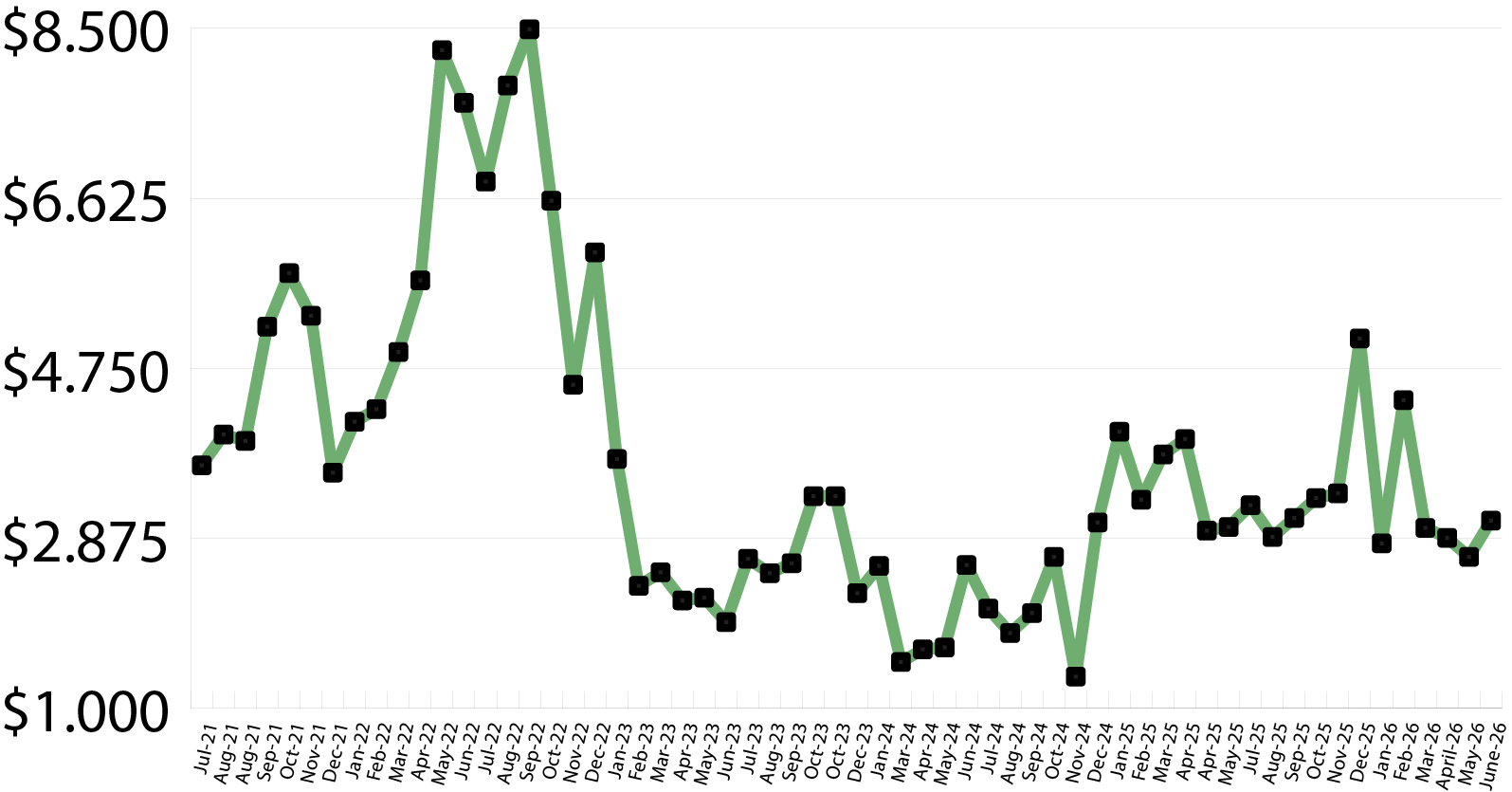
Natural gas futures on the NYMEX exchange for July 2026 are trading around $3.30 per million BTU (MMBtu) as of early June — the highest level in about four months. The U.S. Energy Information Administration (EIA) expects prices to average $2.83/MMBtu this quarter and $3.50/MMBtu for the full year.
Domestic Demand
Heating demand has dropped off as expected this spring, but cooling demand is quickly taking its place. With summer just beginning, utilities are burning more natural gas to generate electricity for air conditioning — and that trend is expected to strengthen.
NOAA is forecasting an 80 percent chance of El Nino this summer, with some models suggesting it could be a strong event. El Nino years tend to bring above-normal heat across much of the U.S., which would push power use — and natural gas demand — significantly higher than average. The South, Southeast, and Midwest would likely feel the biggest impact.
The EIA projects total U.S. natural gas consumption will average about 91.2 billion cubic feet per day (Bcf/d) in 2026, roughly flat compared to last year. However, a hotter summer could push actual usage above that estimate.
International Demand
Global demand for U.S. LNG remains very strong. The ongoing closure of the Strait of Hormuz — a key shipping route for LNG from the Middle East — has forced buyers in Europe and Asia to look elsewhere. That has kept American LNG export terminals running near full capacity.
U.S. LNG exports hit 18.5 Bcf/d in March 2026, the highest monthly total on record according to EIA's Natural Gas Monthly report. They eased to 17.6 Bcf/d in April as global weather warmed and spot demand cooled, but remain well above historical norms. Europe is the largest buyer, as countries there continue refilling storage after a tough winter. Asian buyers are also competing for available cargoes.
New export capacity is also coming online. Golden Pass LNG — the ninth U.S. LNG export terminal — shipped its first cargo on April 22, adding about 0.7 Bcf/d of capacity. A new unit at Corpus Christi is also being commissioned for this summer. One note: ExxonMobil has announced delays to two additional units at Golden Pass, which trims the longer-term export outlook slightly. The EIA currently forecasts U.S. LNG exports will average 17.0 Bcf/d in 2026 and 18.2 Bcf/d in 2027.
Production & Supply
U.S. natural gas production continues to grow. Output across the Lower 48 states averaged 117.2 Bcf/d in the first quarter of 2026, up 4 percent from the same period last year. The EIA expects production to keep climbing, reaching an average of 118.9 Bcf/d for all of 2026 and 124.0 Bcf/d in 2027.
Most of the growth is coming from the Permian Basin in West Texas, where producers are pulling up more natural gas alongside oil. However, the region still lacks enough pipeline capacity to move all that gas out, which is pushing local prices — at the Waha Hub — into negative territory. That problem is expected to ease later this year as new pipelines come online.
Storage levels are healthy heading into summer. According to EIA's storage report released June 4, working gas stood at 2,578 billion cubic feet (Bcf) as of the week ending May 29 — a 95 Bcf injection from the prior week and 138 Bcf above the five-year average of 2,440 Bcf. Inventories are right in line with last year at this time, running just 3 Bcf below year-ago levels. The EIA expects storage to finish the injection season in late October about 7 percent above the five-year average, which provides a solid buffer heading into winter.
One more thing to keep an eye on: the Atlantic hurricane season. While El Nino years tend to produce fewer Atlantic storms, hurricanes can still strike the Gulf Coast and disrupt natural gas production, pipelines, and LNG export terminals. Any major storm activity this summer could tighten supply at a time when demand is already elevated.
If you have any questions about the information in this newsletter or would like to talk to someone about your natural gas, please call your sales representative.
Market Data:
June 10, 2026

June 2026 – Energy News
June 10, 2026
Summer is here, and with it comes rising demand for natural gas to power air conditioning across the country. Weather forecasters at the National Oceanic and Atmospheric Administration (NOAA) are predicting an 80 percent chance of El Nino conditions developing this summer — a pattern that typically brings hotter-than-normal temperatures and drives up electricity use. On the global side, disruptions near the Strait of Hormuz continue to tighten the supply of liquefied natural gas (LNG) worldwide, keeping prices high overseas and demand for American LNG exports strong.
Natural gas futures on the NYMEX exchange for July 2026 are trading around $3.30 per million BTU (MMBtu) as of early June — the highest level in about four months. The U.S. Energy Information Administration (EIA) expects prices to average $2.83/MMBtu this quarter and $3.50/MMBtu for the full year.
Domestic Demand
Heating demand has dropped off as expected this spring, but cooling demand is quickly taking its place. With summer just beginning, utilities are burning more natural gas to generate electricity for air conditioning — and that trend is expected to strengthen.
NOAA is forecasting an 80 percent chance of El Nino this summer, with some models suggesting it could be a strong event. El Nino years tend to bring above-normal heat across much of the U.S., which would push power use — and natural gas demand — significantly higher than average. The South, Southeast, and Midwest would likely feel the biggest impact.
The EIA projects total U.S. natural gas consumption will average about 91.2 billion cubic feet per day (Bcf/d) in 2026, roughly flat compared to last year. However, a hotter summer could push actual usage above that estimate.
International Demand
Global demand for U.S. LNG remains very strong. The ongoing closure of the Strait of Hormuz — a key shipping route for LNG from the Middle East — has forced buyers in Europe and Asia to look elsewhere. That has kept American LNG export terminals running near full capacity.
U.S. LNG exports hit 18.5 Bcf/d in March 2026, the highest monthly total on record according to EIA's Natural Gas Monthly report. They eased to 17.6 Bcf/d in April as global weather warmed and spot demand cooled, but remain well above historical norms. Europe is the largest buyer, as countries there continue refilling storage after a tough winter. Asian buyers are also competing for available cargoes.
New export capacity is also coming online. Golden Pass LNG — the ninth U.S. LNG export terminal — shipped its first cargo on April 22, adding about 0.7 Bcf/d of capacity. A new unit at Corpus Christi is also being commissioned for this summer. One note: ExxonMobil has announced delays to two additional units at Golden Pass, which trims the longer-term export outlook slightly. The EIA currently forecasts U.S. LNG exports will average 17.0 Bcf/d in 2026 and 18.2 Bcf/d in 2027.
Production & Supply
U.S. natural gas production continues to grow. Output across the Lower 48 states averaged 117.2 Bcf/d in the first quarter of 2026, up 4 percent from the same period last year. The EIA expects production to keep climbing, reaching an average of 118.9 Bcf/d for all of 2026 and 124.0 Bcf/d in 2027.
Most of the growth is coming from the Permian Basin in West Texas, where producers are pulling up more natural gas alongside oil. However, the region still lacks enough pipeline capacity to move all that gas out, which is pushing local prices — at the Waha Hub — into negative territory. That problem is expected to ease later this year as new pipelines come online.
Storage levels are healthy heading into summer. According to EIA's storage report released June 4, working gas stood at 2,578 billion cubic feet (Bcf) as of the week ending May 29 — a 95 Bcf injection from the prior week and 138 Bcf above the five-year average of 2,440 Bcf. Inventories are right in line with last year at this time, running just 3 Bcf below year-ago levels. The EIA expects storage to finish the injection season in late October about 7 percent above the five-year average, which provides a solid buffer heading into winter.
One more thing to keep an eye on: the Atlantic hurricane season. While El Nino years tend to produce fewer Atlantic storms, hurricanes can still strike the Gulf Coast and disrupt natural gas production, pipelines, and LNG export terminals. Any major storm activity this summer could tighten supply at a time when demand is already elevated.
If you have any questions about the information in this newsletter or would like to talk to someone about your natural gas, please call your sales representative.
Market Data:
June 10, 2026
June 10, 2026
June 2026 – Energy News
Summer is here, and with it comes rising demand for natural gas to power air conditioning across the country. Weather forecasters at the National Oceanic and Atmospheric Administration (NOAA) are predicting an 80 percent chance of El Nino conditions developing this summer — a pattern that typically brings hotter-than-normal temperatures and drives up electricity use. On the global side, disruptions near the Strait of Hormuz continue to tighten the supply of liquefied natural gas (LNG) worldwide, keeping prices high overseas and demand for American LNG exports strong.
Natural gas futures on the NYMEX exchange for July 2026 are trading around $3.30 per million BTU (MMBtu) as of early June — the highest level in about four months. The U.S. Energy Information Administration (EIA) expects prices to average $2.83/MMBtu this quarter and $3.50/MMBtu for the full year.
Domestic Demand
Heating demand has dropped off as expected this spring, but cooling demand is quickly taking its place. With summer just beginning, utilities are burning more natural gas to generate electricity for air conditioning — and that trend is expected to strengthen.
NOAA is forecasting an 80 percent chance of El Nino this summer, with some models suggesting it could be a strong event. El Nino years tend to bring above-normal heat across much of the U.S., which would push power use — and natural gas demand — significantly higher than average. The South, Southeast, and Midwest would likely feel the biggest impact.
The EIA projects total U.S. natural gas consumption will average about 91.2 billion cubic feet per day (Bcf/d) in 2026, roughly flat compared to last year. However, a hotter summer could push actual usage above that estimate.
International Demand
Global demand for U.S. LNG remains very strong. The ongoing closure of the Strait of Hormuz — a key shipping route for LNG from the Middle East — has forced buyers in Europe and Asia to look elsewhere. That has kept American LNG export terminals running near full capacity.
U.S. LNG exports hit 18.5 Bcf/d in March 2026, the highest monthly total on record according to EIA's Natural Gas Monthly report. They eased to 17.6 Bcf/d in April as global weather warmed and spot demand cooled, but remain well above historical norms. Europe is the largest buyer, as countries there continue refilling storage after a tough winter. Asian buyers are also competing for available cargoes.
New export capacity is also coming online. Golden Pass LNG — the ninth U.S. LNG export terminal — shipped its first cargo on April 22, adding about 0.7 Bcf/d of capacity. A new unit at Corpus Christi is also being commissioned for this summer. One note: ExxonMobil has announced delays to two additional units at Golden Pass, which trims the longer-term export outlook slightly. The EIA currently forecasts U.S. LNG exports will average 17.0 Bcf/d in 2026 and 18.2 Bcf/d in 2027.
Production & Supply
U.S. natural gas production continues to grow. Output across the Lower 48 states averaged 117.2 Bcf/d in the first quarter of 2026, up 4 percent from the same period last year. The EIA expects production to keep climbing, reaching an average of 118.9 Bcf/d for all of 2026 and 124.0 Bcf/d in 2027.
Most of the growth is coming from the Permian Basin in West Texas, where producers are pulling up more natural gas alongside oil. However, the region still lacks enough pipeline capacity to move all that gas out, which is pushing local prices — at the Waha Hub — into negative territory. That problem is expected to ease later this year as new pipelines come online.
Storage levels are healthy heading into summer. According to EIA's storage report released June 4, working gas stood at 2,578 billion cubic feet (Bcf) as of the week ending May 29 — a 95 Bcf injection from the prior week and 138 Bcf above the five-year average of 2,440 Bcf. Inventories are right in line with last year at this time, running just 3 Bcf below year-ago levels. The EIA expects storage to finish the injection season in late October about 7 percent above the five-year average, which provides a solid buffer heading into winter.
One more thing to keep an eye on: the Atlantic hurricane season. While El Nino years tend to produce fewer Atlantic storms, hurricanes can still strike the Gulf Coast and disrupt natural gas production, pipelines, and LNG export terminals. Any major storm activity this summer could tighten supply at a time when demand is already elevated.
If you have any questions about the information in this newsletter or would like to talk to someone about your natural gas, please call your sales representative.
June 10, 2026
June 2026 – Energy News
Summer is here, and with it comes rising demand for natural gas to power air conditioning across the country. Weather forecasters at the National Oceanic and Atmospheric Administration (NOAA) are predicting an 80 percent chance of El Nino conditions developing this summer — a pattern that typically brings hotter-than-normal temperatures and drives up electricity use. On the global side, disruptions near the Strait of Hormuz continue to tighten the supply of liquefied natural gas (LNG) worldwide, keeping prices high overseas and demand for American LNG exports strong.
Natural gas futures on the NYMEX exchange for July 2026 are trading around $3.30 per million BTU (MMBtu) as of early June — the highest level in about four months. The U.S. Energy Information Administration (EIA) expects prices to average $2.83/MMBtu this quarter and $3.50/MMBtu for the full year.
Domestic Demand
Heating demand has dropped off as expected this spring, but cooling demand is quickly taking its place. With summer just beginning, utilities are burning more natural gas to generate electricity for air conditioning — and that trend is expected to strengthen.
NOAA is forecasting an 80 percent chance of El Nino this summer, with some models suggesting it could be a strong event. El Nino years tend to bring above-normal heat across much of the U.S., which would push power use — and natural gas demand — significantly higher than average. The South, Southeast, and Midwest would likely feel the biggest impact.
The EIA projects total U.S. natural gas consumption will average about 91.2 billion cubic feet per day (Bcf/d) in 2026, roughly flat compared to last year. However, a hotter summer could push actual usage above that estimate.
International Demand
Global demand for U.S. LNG remains very strong. The ongoing closure of the Strait of Hormuz — a key shipping route for LNG from the Middle East — has forced buyers in Europe and Asia to look elsewhere. That has kept American LNG export terminals running near full capacity.
U.S. LNG exports hit 18.5 Bcf/d in March 2026, the highest monthly total on record according to EIA's Natural Gas Monthly report. They eased to 17.6 Bcf/d in April as global weather warmed and spot demand cooled, but remain well above historical norms. Europe is the largest buyer, as countries there continue refilling storage after a tough winter. Asian buyers are also competing for available cargoes.
New export capacity is also coming online. Golden Pass LNG — the ninth U.S. LNG export terminal — shipped its first cargo on April 22, adding about 0.7 Bcf/d of capacity. A new unit at Corpus Christi is also being commissioned for this summer. One note: ExxonMobil has announced delays to two additional units at Golden Pass, which trims the longer-term export outlook slightly. The EIA currently forecasts U.S. LNG exports will average 17.0 Bcf/d in 2026 and 18.2 Bcf/d in 2027.
Production & Supply
U.S. natural gas production continues to grow. Output across the Lower 48 states averaged 117.2 Bcf/d in the first quarter of 2026, up 4 percent from the same period last year. The EIA expects production to keep climbing, reaching an average of 118.9 Bcf/d for all of 2026 and 124.0 Bcf/d in 2027.
Most of the growth is coming from the Permian Basin in West Texas, where producers are pulling up more natural gas alongside oil. However, the region still lacks enough pipeline capacity to move all that gas out, which is pushing local prices — at the Waha Hub — into negative territory. That problem is expected to ease later this year as new pipelines come online.
Storage levels are healthy heading into summer. According to EIA's storage report released June 4, working gas stood at 2,578 billion cubic feet (Bcf) as of the week ending May 29 — a 95 Bcf injection from the prior week and 138 Bcf above the five-year average of 2,440 Bcf. Inventories are right in line with last year at this time, running just 3 Bcf below year-ago levels. The EIA expects storage to finish the injection season in late October about 7 percent above the five-year average, which provides a solid buffer heading into winter.
One more thing to keep an eye on: the Atlantic hurricane season. While El Nino years tend to produce fewer Atlantic storms, hurricanes can still strike the Gulf Coast and disrupt natural gas production, pipelines, and LNG export terminals. Any major storm activity this summer could tighten supply at a time when demand is already elevated.
If you have any questions about the information in this newsletter or would like to talk to someone about your natural gas, please call your sales representative.
June 10, 2026
June 2026 – Energy News
Summer is here, and with it comes rising demand for natural gas to power air conditioning across the country. Weather forecasters at the National Oceanic and Atmospheric Administration (NOAA) are predicting an 80 percent chance of El Nino conditions developing this summer — a pattern that typically brings hotter-than-normal temperatures and drives up electricity use. On the global side, disruptions near the Strait of Hormuz continue to tighten the supply of liquefied natural gas (LNG) worldwide, keeping prices high overseas and demand for American LNG exports strong.
Natural gas futures on the NYMEX exchange for July 2026 are trading around $3.30 per million BTU (MMBtu) as of early June — the highest level in about four months. The U.S. Energy Information Administration (EIA) expects prices to average $2.83/MMBtu this quarter and $3.50/MMBtu for the full year.
Domestic Demand
Heating demand has dropped off as expected this spring, but cooling demand is quickly taking its place. With summer just beginning, utilities are burning more natural gas to generate electricity for air conditioning — and that trend is expected to strengthen.
NOAA is forecasting an 80 percent chance of El Nino this summer, with some models suggesting it could be a strong event. El Nino years tend to bring above-normal heat across much of the U.S., which would push power use — and natural gas demand — significantly higher than average. The South, Southeast, and Midwest would likely feel the biggest impact.
The EIA projects total U.S. natural gas consumption will average about 91.2 billion cubic feet per day (Bcf/d) in 2026, roughly flat compared to last year. However, a hotter summer could push actual usage above that estimate.
International Demand
Global demand for U.S. LNG remains very strong. The ongoing closure of the Strait of Hormuz — a key shipping route for LNG from the Middle East — has forced buyers in Europe and Asia to look elsewhere. That has kept American LNG export terminals running near full capacity.
U.S. LNG exports hit 18.5 Bcf/d in March 2026, the highest monthly total on record according to EIA's Natural Gas Monthly report. They eased to 17.6 Bcf/d in April as global weather warmed and spot demand cooled, but remain well above historical norms. Europe is the largest buyer, as countries there continue refilling storage after a tough winter. Asian buyers are also competing for available cargoes.
New export capacity is also coming online. Golden Pass LNG — the ninth U.S. LNG export terminal — shipped its first cargo on April 22, adding about 0.7 Bcf/d of capacity. A new unit at Corpus Christi is also being commissioned for this summer. One note: ExxonMobil has announced delays to two additional units at Golden Pass, which trims the longer-term export outlook slightly. The EIA currently forecasts U.S. LNG exports will average 17.0 Bcf/d in 2026 and 18.2 Bcf/d in 2027.
Production & Supply
U.S. natural gas production continues to grow. Output across the Lower 48 states averaged 117.2 Bcf/d in the first quarter of 2026, up 4 percent from the same period last year. The EIA expects production to keep climbing, reaching an average of 118.9 Bcf/d for all of 2026 and 124.0 Bcf/d in 2027.
Most of the growth is coming from the Permian Basin in West Texas, where producers are pulling up more natural gas alongside oil. However, the region still lacks enough pipeline capacity to move all that gas out, which is pushing local prices — at the Waha Hub — into negative territory. That problem is expected to ease later this year as new pipelines come online.
Storage levels are healthy heading into summer. According to EIA's storage report released June 4, working gas stood at 2,578 billion cubic feet (Bcf) as of the week ending May 29 — a 95 Bcf injection from the prior week and 138 Bcf above the five-year average of 2,440 Bcf. Inventories are right in line with last year at this time, running just 3 Bcf below year-ago levels. The EIA expects storage to finish the injection season in late October about 7 percent above the five-year average, which provides a solid buffer heading into winter.
One more thing to keep an eye on: the Atlantic hurricane season. While El Nino years tend to produce fewer Atlantic storms, hurricanes can still strike the Gulf Coast and disrupt natural gas production, pipelines, and LNG export terminals. Any major storm activity this summer could tighten supply at a time when demand is already elevated.
If you have any questions about the information in this newsletter or would like to talk to someone about your natural gas, please call your sales representative.

June 10, 2026
Summer is here, and with it comes rising demand for natural gas to power air conditioning across the country. Weather forecasters at the National Oceanic and Atmospheric Administration (NOAA) are predicting an 80 percent chance of El Nino conditions developing this summer — a pattern that typically brings hotter-than-normal temperatures and drives up electricity use. On the global side, disruptions near the Strait of Hormuz continue to tighten the supply of liquefied natural gas (LNG) worldwide, keeping prices high overseas and demand for American LNG exports strong.
Natural gas futures on the NYMEX exchange for July 2026 are trading around $3.30 per million BTU (MMBtu) as of early June — the highest level in about four months. The U.S. Energy Information Administration (EIA) expects prices to average $2.83/MMBtu this quarter and $3.50/MMBtu for the full year.
Domestic Demand
Heating demand has dropped off as expected this spring, but cooling demand is quickly taking its place. With summer just beginning, utilities are burning more natural gas to generate electricity for air conditioning — and that trend is expected to strengthen.
NOAA is forecasting an 80 percent chance of El Nino this summer, with some models suggesting it could be a strong event. El Nino years tend to bring above-normal heat across much of the U.S., which would push power use — and natural gas demand — significantly higher than average. The South, Southeast, and Midwest would likely feel the biggest impact.
The EIA projects total U.S. natural gas consumption will average about 91.2 billion cubic feet per day (Bcf/d) in 2026, roughly flat compared to last year. However, a hotter summer could push actual usage above that estimate.
International Demand
Global demand for U.S. LNG remains very strong. The ongoing closure of the Strait of Hormuz — a key shipping route for LNG from the Middle East — has forced buyers in Europe and Asia to look elsewhere. That has kept American LNG export terminals running near full capacity.
U.S. LNG exports hit 18.5 Bcf/d in March 2026, the highest monthly total on record according to EIA's Natural Gas Monthly report. They eased to 17.6 Bcf/d in April as global weather warmed and spot demand cooled, but remain well above historical norms. Europe is the largest buyer, as countries there continue refilling storage after a tough winter. Asian buyers are also competing for available cargoes.
New export capacity is also coming online. Golden Pass LNG — the ninth U.S. LNG export terminal — shipped its first cargo on April 22, adding about 0.7 Bcf/d of capacity. A new unit at Corpus Christi is also being commissioned for this summer. One note: ExxonMobil has announced delays to two additional units at Golden Pass, which trims the longer-term export outlook slightly. The EIA currently forecasts U.S. LNG exports will average 17.0 Bcf/d in 2026 and 18.2 Bcf/d in 2027.
Production & Supply
U.S. natural gas production continues to grow. Output across the Lower 48 states averaged 117.2 Bcf/d in the first quarter of 2026, up 4 percent from the same period last year. The EIA expects production to keep climbing, reaching an average of 118.9 Bcf/d for all of 2026 and 124.0 Bcf/d in 2027.
Most of the growth is coming from the Permian Basin in West Texas, where producers are pulling up more natural gas alongside oil. However, the region still lacks enough pipeline capacity to move all that gas out, which is pushing local prices — at the Waha Hub — into negative territory. That problem is expected to ease later this year as new pipelines come online.
Storage levels are healthy heading into summer. According to EIA's storage report released June 4, working gas stood at 2,578 billion cubic feet (Bcf) as of the week ending May 29 — a 95 Bcf injection from the prior week and 138 Bcf above the five-year average of 2,440 Bcf. Inventories are right in line with last year at this time, running just 3 Bcf below year-ago levels. The EIA expects storage to finish the injection season in late October about 7 percent above the five-year average, which provides a solid buffer heading into winter.
One more thing to keep an eye on: the Atlantic hurricane season. While El Nino years tend to produce fewer Atlantic storms, hurricanes can still strike the Gulf Coast and disrupt natural gas production, pipelines, and LNG export terminals. Any major storm activity this summer could tighten supply at a time when demand is already elevated.
If you have any questions about the information in this newsletter or would like to talk to someone about your natural gas, please call your sales representative.
June 10, 2026
June 2026 – Energy News
Summer is here, and with it comes rising demand for natural gas to power air conditioning across the country. Weather forecasters at the National Oceanic and Atmospheric Administration (NOAA) are predicting an 80 percent chance of El Nino conditions developing this summer — a pattern that typically brings hotter-than-normal temperatures and drives up electricity use. On the global side, disruptions near the Strait of Hormuz continue to tighten the supply of liquefied natural gas (LNG) worldwide, keeping prices high overseas and demand for American LNG exports strong.
Natural gas futures on the NYMEX exchange for July 2026 are trading around $3.30 per million BTU (MMBtu) as of early June — the highest level in about four months. The U.S. Energy Information Administration (EIA) expects prices to average $2.83/MMBtu this quarter and $3.50/MMBtu for the full year.
Domestic Demand
Heating demand has dropped off as expected this spring, but cooling demand is quickly taking its place. With summer just beginning, utilities are burning more natural gas to generate electricity for air conditioning — and that trend is expected to strengthen.
NOAA is forecasting an 80 percent chance of El Nino this summer, with some models suggesting it could be a strong event. El Nino years tend to bring above-normal heat across much of the U.S., which would push power use — and natural gas demand — significantly higher than average. The South, Southeast, and Midwest would likely feel the biggest impact.
The EIA projects total U.S. natural gas consumption will average about 91.2 billion cubic feet per day (Bcf/d) in 2026, roughly flat compared to last year. However, a hotter summer could push actual usage above that estimate.
International Demand
Global demand for U.S. LNG remains very strong. The ongoing closure of the Strait of Hormuz — a key shipping route for LNG from the Middle East — has forced buyers in Europe and Asia to look elsewhere. That has kept American LNG export terminals running near full capacity.
U.S. LNG exports hit 18.5 Bcf/d in March 2026, the highest monthly total on record according to EIA's Natural Gas Monthly report. They eased to 17.6 Bcf/d in April as global weather warmed and spot demand cooled, but remain well above historical norms. Europe is the largest buyer, as countries there continue refilling storage after a tough winter. Asian buyers are also competing for available cargoes.
New export capacity is also coming online. Golden Pass LNG — the ninth U.S. LNG export terminal — shipped its first cargo on April 22, adding about 0.7 Bcf/d of capacity. A new unit at Corpus Christi is also being commissioned for this summer. One note: ExxonMobil has announced delays to two additional units at Golden Pass, which trims the longer-term export outlook slightly. The EIA currently forecasts U.S. LNG exports will average 17.0 Bcf/d in 2026 and 18.2 Bcf/d in 2027.
Production & Supply
U.S. natural gas production continues to grow. Output across the Lower 48 states averaged 117.2 Bcf/d in the first quarter of 2026, up 4 percent from the same period last year. The EIA expects production to keep climbing, reaching an average of 118.9 Bcf/d for all of 2026 and 124.0 Bcf/d in 2027.
Most of the growth is coming from the Permian Basin in West Texas, where producers are pulling up more natural gas alongside oil. However, the region still lacks enough pipeline capacity to move all that gas out, which is pushing local prices — at the Waha Hub — into negative territory. That problem is expected to ease later this year as new pipelines come online.
Storage levels are healthy heading into summer. According to EIA's storage report released June 4, working gas stood at 2,578 billion cubic feet (Bcf) as of the week ending May 29 — a 95 Bcf injection from the prior week and 138 Bcf above the five-year average of 2,440 Bcf. Inventories are right in line with last year at this time, running just 3 Bcf below year-ago levels. The EIA expects storage to finish the injection season in late October about 7 percent above the five-year average, which provides a solid buffer heading into winter.
One more thing to keep an eye on: the Atlantic hurricane season. While El Nino years tend to produce fewer Atlantic storms, hurricanes can still strike the Gulf Coast and disrupt natural gas production, pipelines, and LNG export terminals. Any major storm activity this summer could tighten supply at a time when demand is already elevated.
If you have any questions about the information in this newsletter or would like to talk to someone about your natural gas, please call your sales representative.
June 10, 2026
June 2026 – Energy News
Summer is here, and with it comes rising demand for natural gas to power air conditioning across the country. Weather forecasters at the National Oceanic and Atmospheric Administration (NOAA) are predicting an 80 percent chance of El Nino conditions developing this summer — a pattern that typically brings hotter-than-normal temperatures and drives up electricity use. On the global side, disruptions near the Strait of Hormuz continue to tighten the supply of liquefied natural gas (LNG) worldwide, keeping prices high overseas and demand for American LNG exports strong.
Natural gas futures on the NYMEX exchange for July 2026 are trading around $3.30 per million BTU (MMBtu) as of early June — the highest level in about four months. The U.S. Energy Information Administration (EIA) expects prices to average $2.83/MMBtu this quarter and $3.50/MMBtu for the full year.
Domestic Demand
Heating demand has dropped off as expected this spring, but cooling demand is quickly taking its place. With summer just beginning, utilities are burning more natural gas to generate electricity for air conditioning — and that trend is expected to strengthen.
NOAA is forecasting an 80 percent chance of El Nino this summer, with some models suggesting it could be a strong event. El Nino years tend to bring above-normal heat across much of the U.S., which would push power use — and natural gas demand — significantly higher than average. The South, Southeast, and Midwest would likely feel the biggest impact.
The EIA projects total U.S. natural gas consumption will average about 91.2 billion cubic feet per day (Bcf/d) in 2026, roughly flat compared to last year. However, a hotter summer could push actual usage above that estimate.
International Demand
Global demand for U.S. LNG remains very strong. The ongoing closure of the Strait of Hormuz — a key shipping route for LNG from the Middle East — has forced buyers in Europe and Asia to look elsewhere. That has kept American LNG export terminals running near full capacity.
U.S. LNG exports hit 18.5 Bcf/d in March 2026, the highest monthly total on record according to EIA's Natural Gas Monthly report. They eased to 17.6 Bcf/d in April as global weather warmed and spot demand cooled, but remain well above historical norms. Europe is the largest buyer, as countries there continue refilling storage after a tough winter. Asian buyers are also competing for available cargoes.
New export capacity is also coming online. Golden Pass LNG — the ninth U.S. LNG export terminal — shipped its first cargo on April 22, adding about 0.7 Bcf/d of capacity. A new unit at Corpus Christi is also being commissioned for this summer. One note: ExxonMobil has announced delays to two additional units at Golden Pass, which trims the longer-term export outlook slightly. The EIA currently forecasts U.S. LNG exports will average 17.0 Bcf/d in 2026 and 18.2 Bcf/d in 2027.
Production & Supply
U.S. natural gas production continues to grow. Output across the Lower 48 states averaged 117.2 Bcf/d in the first quarter of 2026, up 4 percent from the same period last year. The EIA expects production to keep climbing, reaching an average of 118.9 Bcf/d for all of 2026 and 124.0 Bcf/d in 2027.
Most of the growth is coming from the Permian Basin in West Texas, where producers are pulling up more natural gas alongside oil. However, the region still lacks enough pipeline capacity to move all that gas out, which is pushing local prices — at the Waha Hub — into negative territory. That problem is expected to ease later this year as new pipelines come online.
Storage levels are healthy heading into summer. According to EIA's storage report released June 4, working gas stood at 2,578 billion cubic feet (Bcf) as of the week ending May 29 — a 95 Bcf injection from the prior week and 138 Bcf above the five-year average of 2,440 Bcf. Inventories are right in line with last year at this time, running just 3 Bcf below year-ago levels. The EIA expects storage to finish the injection season in late October about 7 percent above the five-year average, which provides a solid buffer heading into winter.
One more thing to keep an eye on: the Atlantic hurricane season. While El Nino years tend to produce fewer Atlantic storms, hurricanes can still strike the Gulf Coast and disrupt natural gas production, pipelines, and LNG export terminals. Any major storm activity this summer could tighten supply at a time when demand is already elevated.
If you have any questions about the information in this newsletter or would like to talk to someone about your natural gas, please call your sales representative.
Make Your Choice Gas Selection in Three Easy Steps
Click here to access our online tool, or call our Choice gas commodity experts at 1 (877) 790-4990.
Step 1: Enter your account number
- Your Black Hills Energy account number is located at the top right-hand corner of your bill.
Step 2: Review price options and make your selection
Step 3: Confirm your selection and enter your control number
- You received a control number in your 2026 Choice Gas selection packet mailed to you from Black Hills Energy. If you cannot locate this, you can retrieve your control number by calling 877-245-3506 or visit choicegas.com
Once enrolled, you will be removed from supplier marketing communications within 24 hours.


Sign Up for Our Energy Newsletters
Sign UpRecent Posts