January 9, 2026
Weekly Energy News January 9, 2026
Market Commentary:
After experiencing a midweek recovery, natural gas futures for the prompt month on the NYMEX dropped significantly during the early hours of January 8, settling in the mid-$3.40s/MMBtu range. Following the release of the EIA storage report at 10:30 a.m. ET, the February contract saw an additional decline of 5 to 6 cents, bringing it down to around $3.40/MMBtu, based on CME Group figures.
During the overnight session, February gas prices reached as high as the low $3.60s/MMBtu, building on the prior January 6 settlement of $3.52/MMBtu, driven by growing worries over predictions of a colder second half of January.
February 2026 NYMEX Settlement (Thursday): $3.407/MMBtu (Down $0.118)
• Intraday High: $3.634
• Intraday Low: $3.355
Early prompt-month trading: $3.318/MMBtu
• CME: https://www.cmegroup.com/markets/energy/natural-gas/natural-gas.html
• FX Empire: https://www.fxempire.com/commodities/natural-gas
EIA Storage Update:
On January 8, the US Energy Information Administration (EIA) reported a withdrawal of 119 billion cubic feet (Bcf) from natural gas storage for the week ending January 2. This figure was in line with market expectations, being only 2 Bcf short of the consensus forecast from the Platts gas storage survey, which had predicted a withdrawal of 121 Bcf. Historically, this estimate appears bullish, as the average withdrawal for the same week over the past five years has been 92 Bcf, while just two years prior, in 2025, the withdrawal was only 51 Bcf. The latest report from the EIA significantly reduced the surplus in US natural gas inventories and highlighted a larger deficit compared to the previous year's stock levels. As of January 2, natural gas in US storage was recorded at 3.256 trillion cubic feet (Tcf), which is 31 Bcf, or roughly 1 percent, above the five-year average. Additionally, stocks were 123 Bcf, or about 3.6 percent, lower than the same period last year, according to EIA data.
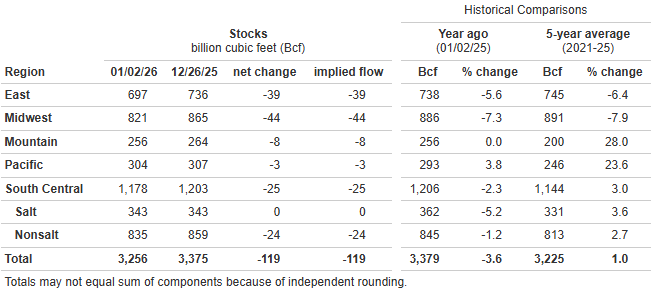
Working gas in storage was 3,256 Bcf as of Friday, January 2, 2026, according to EIA estimates. This represents a net decrease of 119 Bcf from the previous week. Stocks were 123 Bcf less than last year at this time and 31 Bcf above the five-year average of 3,225 Bcf. At 3,256 Bcf, total working gas is within the five-year historical range.
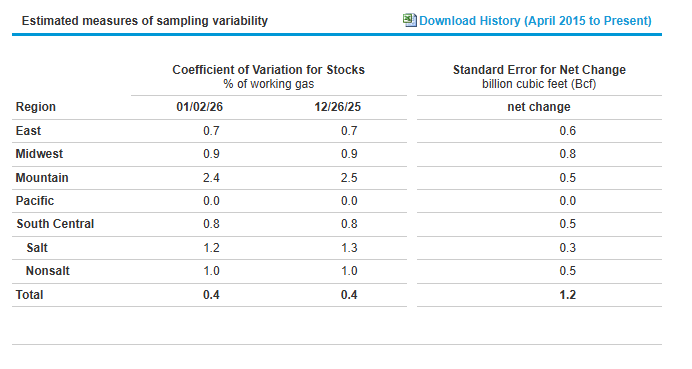
For information on sampling error in this report, see Estimated Measures of Sampling Variability table below.

Note: The shaded area indicates the range between the historical minimum and maximum values for the weekly series from 2021 through 2025. The dashed vertical lines indicate current and year-ago weekly periods.
Weather Outlook:
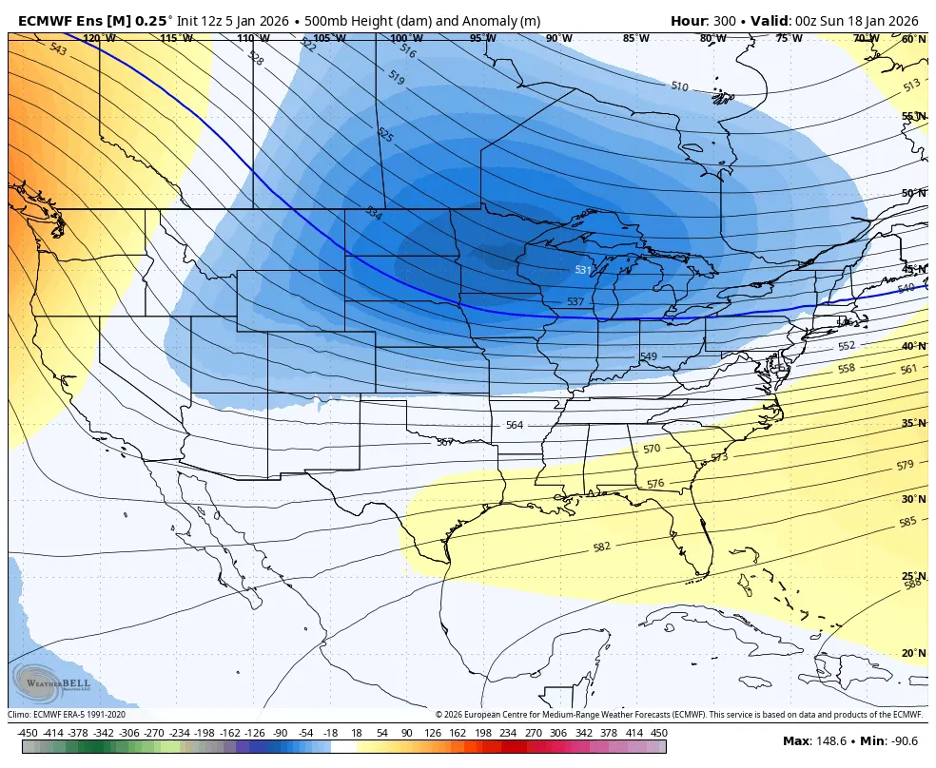
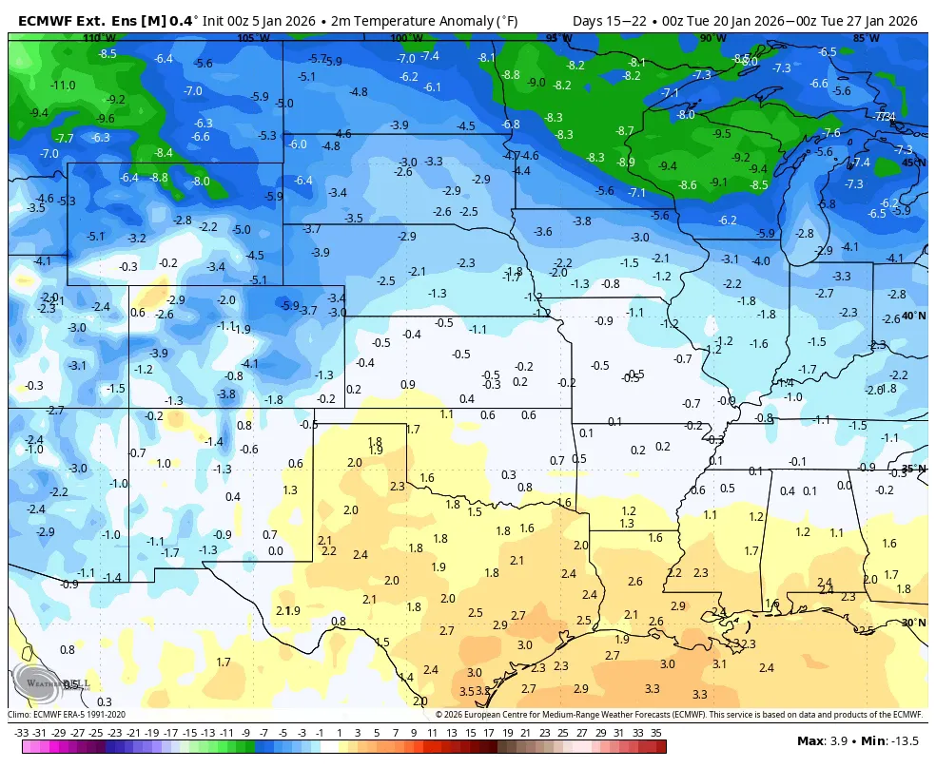
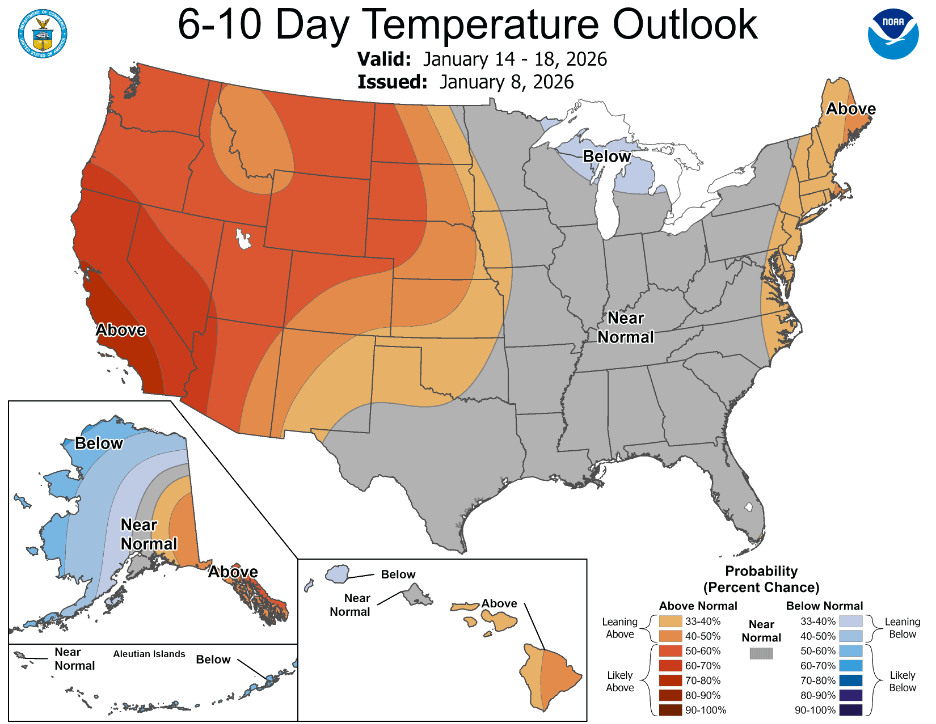
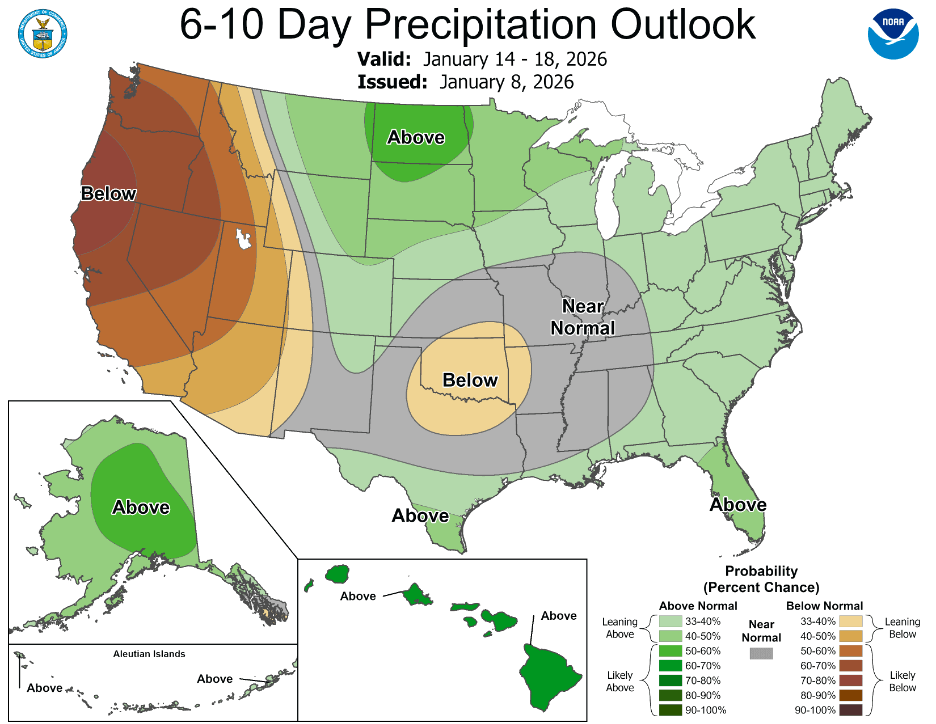
The Euro models are forecasting cooler-than-normal temperatures toward the end of the month. Meanwhile, the National Oceanic and Atmospheric Administration (NOAA) predicts that warmer conditions will occur around the middle of the month. However, there is some uncertainty about the arrival of the cooler temperatures, which could impact NOAA's mid-January predictions.
A neutral to slightly negative Pacific–North American (PNA) pattern is developing. This indicates that the jet stream is close to average but is becoming more zonal and trending slightly cooler. As a result, the U.S. may see more changeable and unsettled weather in the western U.S., while the eastern U.S. experiences generally milder, near-normal conditions. Additionally, a polar vortex could develop, which might dominate the weather patterns in the U.S. and lead to significantly colder conditions sooner than NOAA has predicted.
Source: MidwestWeather.com
Market Data:
January 9, 2026

Weekly Energy News January 9, 2026
January 9, 2026
Market Commentary:
After experiencing a midweek recovery, natural gas futures for the prompt month on the NYMEX dropped significantly during the early hours of January 8, settling in the mid-$3.40s/MMBtu range. Following the release of the EIA storage report at 10:30 a.m. ET, the February contract saw an additional decline of 5 to 6 cents, bringing it down to around $3.40/MMBtu, based on CME Group figures.
During the overnight session, February gas prices reached as high as the low $3.60s/MMBtu, building on the prior January 6 settlement of $3.52/MMBtu, driven by growing worries over predictions of a colder second half of January.
February 2026 NYMEX Settlement (Thursday): $3.407/MMBtu (Down $0.118)
• Intraday High: $3.634
• Intraday Low: $3.355
Early prompt-month trading: $3.318/MMBtu
• CME: https://www.cmegroup.com/markets/energy/natural-gas/natural-gas.html
• FX Empire: https://www.fxempire.com/commodities/natural-gas
EIA Storage Update:
On January 8, the US Energy Information Administration (EIA) reported a withdrawal of 119 billion cubic feet (Bcf) from natural gas storage for the week ending January 2. This figure was in line with market expectations, being only 2 Bcf short of the consensus forecast from the Platts gas storage survey, which had predicted a withdrawal of 121 Bcf. Historically, this estimate appears bullish, as the average withdrawal for the same week over the past five years has been 92 Bcf, while just two years prior, in 2025, the withdrawal was only 51 Bcf. The latest report from the EIA significantly reduced the surplus in US natural gas inventories and highlighted a larger deficit compared to the previous year's stock levels. As of January 2, natural gas in US storage was recorded at 3.256 trillion cubic feet (Tcf), which is 31 Bcf, or roughly 1 percent, above the five-year average. Additionally, stocks were 123 Bcf, or about 3.6 percent, lower than the same period last year, according to EIA data.
Working gas in storage was 3,256 Bcf as of Friday, January 2, 2026, according to EIA estimates. This represents a net decrease of 119 Bcf from the previous week. Stocks were 123 Bcf less than last year at this time and 31 Bcf above the five-year average of 3,225 Bcf. At 3,256 Bcf, total working gas is within the five-year historical range.
For information on sampling error in this report, see Estimated Measures of Sampling Variability table below.
Note: The shaded area indicates the range between the historical minimum and maximum values for the weekly series from 2021 through 2025. The dashed vertical lines indicate current and year-ago weekly periods.
Weather Outlook:
The Euro models are forecasting cooler-than-normal temperatures toward the end of the month. Meanwhile, the National Oceanic and Atmospheric Administration (NOAA) predicts that warmer conditions will occur around the middle of the month. However, there is some uncertainty about the arrival of the cooler temperatures, which could impact NOAA's mid-January predictions.
A neutral to slightly negative Pacific–North American (PNA) pattern is developing. This indicates that the jet stream is close to average but is becoming more zonal and trending slightly cooler. As a result, the U.S. may see more changeable and unsettled weather in the western U.S., while the eastern U.S. experiences generally milder, near-normal conditions. Additionally, a polar vortex could develop, which might dominate the weather patterns in the U.S. and lead to significantly colder conditions sooner than NOAA has predicted.
Source: MidwestWeather.com
Market Data:
January 9, 2026
January 9, 2026
Weekly Energy News January 9, 2026
Market Commentary:
After experiencing a midweek recovery, natural gas futures for the prompt month on the NYMEX dropped significantly during the early hours of January 8, settling in the mid-$3.40s/MMBtu range. Following the release of the EIA storage report at 10:30 a.m. ET, the February contract saw an additional decline of 5 to 6 cents, bringing it down to around $3.40/MMBtu, based on CME Group figures.
During the overnight session, February gas prices reached as high as the low $3.60s/MMBtu, building on the prior January 6 settlement of $3.52/MMBtu, driven by growing worries over predictions of a colder second half of January.
February 2026 NYMEX Settlement (Thursday): $3.407/MMBtu (Down $0.118)
• Intraday High: $3.634
• Intraday Low: $3.355
Early prompt-month trading: $3.318/MMBtu
• CME: https://www.cmegroup.com/markets/energy/natural-gas/natural-gas.html
• FX Empire: https://www.fxempire.com/commodities/natural-gas
EIA Storage Update:
On January 8, the US Energy Information Administration (EIA) reported a withdrawal of 119 billion cubic feet (Bcf) from natural gas storage for the week ending January 2. This figure was in line with market expectations, being only 2 Bcf short of the consensus forecast from the Platts gas storage survey, which had predicted a withdrawal of 121 Bcf. Historically, this estimate appears bullish, as the average withdrawal for the same week over the past five years has been 92 Bcf, while just two years prior, in 2025, the withdrawal was only 51 Bcf. The latest report from the EIA significantly reduced the surplus in US natural gas inventories and highlighted a larger deficit compared to the previous year's stock levels. As of January 2, natural gas in US storage was recorded at 3.256 trillion cubic feet (Tcf), which is 31 Bcf, or roughly 1 percent, above the five-year average. Additionally, stocks were 123 Bcf, or about 3.6 percent, lower than the same period last year, according to EIA data.
Working gas in storage was 3,256 Bcf as of Friday, January 2, 2026, according to EIA estimates. This represents a net decrease of 119 Bcf from the previous week. Stocks were 123 Bcf less than last year at this time and 31 Bcf above the five-year average of 3,225 Bcf. At 3,256 Bcf, total working gas is within the five-year historical range.
For information on sampling error in this report, see Estimated Measures of Sampling Variability table below.
Note: The shaded area indicates the range between the historical minimum and maximum values for the weekly series from 2021 through 2025. The dashed vertical lines indicate current and year-ago weekly periods.
Weather Outlook:
The Euro models are forecasting cooler-than-normal temperatures toward the end of the month. Meanwhile, the National Oceanic and Atmospheric Administration (NOAA) predicts that warmer conditions will occur around the middle of the month. However, there is some uncertainty about the arrival of the cooler temperatures, which could impact NOAA's mid-January predictions.
A neutral to slightly negative Pacific–North American (PNA) pattern is developing. This indicates that the jet stream is close to average but is becoming more zonal and trending slightly cooler. As a result, the U.S. may see more changeable and unsettled weather in the western U.S., while the eastern U.S. experiences generally milder, near-normal conditions. Additionally, a polar vortex could develop, which might dominate the weather patterns in the U.S. and lead to significantly colder conditions sooner than NOAA has predicted.
Source: MidwestWeather.com
January 9, 2026
Weekly Energy News January 9, 2026
Market Commentary:
After experiencing a midweek recovery, natural gas futures for the prompt month on the NYMEX dropped significantly during the early hours of January 8, settling in the mid-$3.40s/MMBtu range. Following the release of the EIA storage report at 10:30 a.m. ET, the February contract saw an additional decline of 5 to 6 cents, bringing it down to around $3.40/MMBtu, based on CME Group figures.
During the overnight session, February gas prices reached as high as the low $3.60s/MMBtu, building on the prior January 6 settlement of $3.52/MMBtu, driven by growing worries over predictions of a colder second half of January.
February 2026 NYMEX Settlement (Thursday): $3.407/MMBtu (Down $0.118)
• Intraday High: $3.634
• Intraday Low: $3.355
Early prompt-month trading: $3.318/MMBtu
• CME: https://www.cmegroup.com/markets/energy/natural-gas/natural-gas.html
• FX Empire: https://www.fxempire.com/commodities/natural-gas
EIA Storage Update:
On January 8, the US Energy Information Administration (EIA) reported a withdrawal of 119 billion cubic feet (Bcf) from natural gas storage for the week ending January 2. This figure was in line with market expectations, being only 2 Bcf short of the consensus forecast from the Platts gas storage survey, which had predicted a withdrawal of 121 Bcf. Historically, this estimate appears bullish, as the average withdrawal for the same week over the past five years has been 92 Bcf, while just two years prior, in 2025, the withdrawal was only 51 Bcf. The latest report from the EIA significantly reduced the surplus in US natural gas inventories and highlighted a larger deficit compared to the previous year's stock levels. As of January 2, natural gas in US storage was recorded at 3.256 trillion cubic feet (Tcf), which is 31 Bcf, or roughly 1 percent, above the five-year average. Additionally, stocks were 123 Bcf, or about 3.6 percent, lower than the same period last year, according to EIA data.
Working gas in storage was 3,256 Bcf as of Friday, January 2, 2026, according to EIA estimates. This represents a net decrease of 119 Bcf from the previous week. Stocks were 123 Bcf less than last year at this time and 31 Bcf above the five-year average of 3,225 Bcf. At 3,256 Bcf, total working gas is within the five-year historical range.
For information on sampling error in this report, see Estimated Measures of Sampling Variability table below.
Note: The shaded area indicates the range between the historical minimum and maximum values for the weekly series from 2021 through 2025. The dashed vertical lines indicate current and year-ago weekly periods.
Weather Outlook:
The Euro models are forecasting cooler-than-normal temperatures toward the end of the month. Meanwhile, the National Oceanic and Atmospheric Administration (NOAA) predicts that warmer conditions will occur around the middle of the month. However, there is some uncertainty about the arrival of the cooler temperatures, which could impact NOAA's mid-January predictions.
A neutral to slightly negative Pacific–North American (PNA) pattern is developing. This indicates that the jet stream is close to average but is becoming more zonal and trending slightly cooler. As a result, the U.S. may see more changeable and unsettled weather in the western U.S., while the eastern U.S. experiences generally milder, near-normal conditions. Additionally, a polar vortex could develop, which might dominate the weather patterns in the U.S. and lead to significantly colder conditions sooner than NOAA has predicted.
Source: MidwestWeather.com
January 9, 2026
Weekly Energy News January 9, 2026
Market Commentary:
After experiencing a midweek recovery, natural gas futures for the prompt month on the NYMEX dropped significantly during the early hours of January 8, settling in the mid-$3.40s/MMBtu range. Following the release of the EIA storage report at 10:30 a.m. ET, the February contract saw an additional decline of 5 to 6 cents, bringing it down to around $3.40/MMBtu, based on CME Group figures.
During the overnight session, February gas prices reached as high as the low $3.60s/MMBtu, building on the prior January 6 settlement of $3.52/MMBtu, driven by growing worries over predictions of a colder second half of January.
February 2026 NYMEX Settlement (Thursday): $3.407/MMBtu (Down $0.118)
• Intraday High: $3.634
• Intraday Low: $3.355
Early prompt-month trading: $3.318/MMBtu
• CME: https://www.cmegroup.com/markets/energy/natural-gas/natural-gas.html
• FX Empire: https://www.fxempire.com/commodities/natural-gas
EIA Storage Update:
On January 8, the US Energy Information Administration (EIA) reported a withdrawal of 119 billion cubic feet (Bcf) from natural gas storage for the week ending January 2. This figure was in line with market expectations, being only 2 Bcf short of the consensus forecast from the Platts gas storage survey, which had predicted a withdrawal of 121 Bcf. Historically, this estimate appears bullish, as the average withdrawal for the same week over the past five years has been 92 Bcf, while just two years prior, in 2025, the withdrawal was only 51 Bcf. The latest report from the EIA significantly reduced the surplus in US natural gas inventories and highlighted a larger deficit compared to the previous year's stock levels. As of January 2, natural gas in US storage was recorded at 3.256 trillion cubic feet (Tcf), which is 31 Bcf, or roughly 1 percent, above the five-year average. Additionally, stocks were 123 Bcf, or about 3.6 percent, lower than the same period last year, according to EIA data.
Working gas in storage was 3,256 Bcf as of Friday, January 2, 2026, according to EIA estimates. This represents a net decrease of 119 Bcf from the previous week. Stocks were 123 Bcf less than last year at this time and 31 Bcf above the five-year average of 3,225 Bcf. At 3,256 Bcf, total working gas is within the five-year historical range.
For information on sampling error in this report, see Estimated Measures of Sampling Variability table below.
Note: The shaded area indicates the range between the historical minimum and maximum values for the weekly series from 2021 through 2025. The dashed vertical lines indicate current and year-ago weekly periods.
Weather Outlook:
The Euro models are forecasting cooler-than-normal temperatures toward the end of the month. Meanwhile, the National Oceanic and Atmospheric Administration (NOAA) predicts that warmer conditions will occur around the middle of the month. However, there is some uncertainty about the arrival of the cooler temperatures, which could impact NOAA's mid-January predictions.
A neutral to slightly negative Pacific–North American (PNA) pattern is developing. This indicates that the jet stream is close to average but is becoming more zonal and trending slightly cooler. As a result, the U.S. may see more changeable and unsettled weather in the western U.S., while the eastern U.S. experiences generally milder, near-normal conditions. Additionally, a polar vortex could develop, which might dominate the weather patterns in the U.S. and lead to significantly colder conditions sooner than NOAA has predicted.
Source: MidwestWeather.com

January 9, 2026
Market Commentary:
After experiencing a midweek recovery, natural gas futures for the prompt month on the NYMEX dropped significantly during the early hours of January 8, settling in the mid-$3.40s/MMBtu range. Following the release of the EIA storage report at 10:30 a.m. ET, the February contract saw an additional decline of 5 to 6 cents, bringing it down to around $3.40/MMBtu, based on CME Group figures.
During the overnight session, February gas prices reached as high as the low $3.60s/MMBtu, building on the prior January 6 settlement of $3.52/MMBtu, driven by growing worries over predictions of a colder second half of January.
February 2026 NYMEX Settlement (Thursday): $3.407/MMBtu (Down $0.118)
• Intraday High: $3.634
• Intraday Low: $3.355
Early prompt-month trading: $3.318/MMBtu
• CME: https://www.cmegroup.com/markets/energy/natural-gas/natural-gas.html
• FX Empire: https://www.fxempire.com/commodities/natural-gas
EIA Storage Update:
On January 8, the US Energy Information Administration (EIA) reported a withdrawal of 119 billion cubic feet (Bcf) from natural gas storage for the week ending January 2. This figure was in line with market expectations, being only 2 Bcf short of the consensus forecast from the Platts gas storage survey, which had predicted a withdrawal of 121 Bcf. Historically, this estimate appears bullish, as the average withdrawal for the same week over the past five years has been 92 Bcf, while just two years prior, in 2025, the withdrawal was only 51 Bcf. The latest report from the EIA significantly reduced the surplus in US natural gas inventories and highlighted a larger deficit compared to the previous year's stock levels. As of January 2, natural gas in US storage was recorded at 3.256 trillion cubic feet (Tcf), which is 31 Bcf, or roughly 1 percent, above the five-year average. Additionally, stocks were 123 Bcf, or about 3.6 percent, lower than the same period last year, according to EIA data.
Working gas in storage was 3,256 Bcf as of Friday, January 2, 2026, according to EIA estimates. This represents a net decrease of 119 Bcf from the previous week. Stocks were 123 Bcf less than last year at this time and 31 Bcf above the five-year average of 3,225 Bcf. At 3,256 Bcf, total working gas is within the five-year historical range.
For information on sampling error in this report, see Estimated Measures of Sampling Variability table below.
Note: The shaded area indicates the range between the historical minimum and maximum values for the weekly series from 2021 through 2025. The dashed vertical lines indicate current and year-ago weekly periods.
Weather Outlook:
The Euro models are forecasting cooler-than-normal temperatures toward the end of the month. Meanwhile, the National Oceanic and Atmospheric Administration (NOAA) predicts that warmer conditions will occur around the middle of the month. However, there is some uncertainty about the arrival of the cooler temperatures, which could impact NOAA's mid-January predictions.
A neutral to slightly negative Pacific–North American (PNA) pattern is developing. This indicates that the jet stream is close to average but is becoming more zonal and trending slightly cooler. As a result, the U.S. may see more changeable and unsettled weather in the western U.S., while the eastern U.S. experiences generally milder, near-normal conditions. Additionally, a polar vortex could develop, which might dominate the weather patterns in the U.S. and lead to significantly colder conditions sooner than NOAA has predicted.
Source: MidwestWeather.com
January 9, 2026
Weekly Energy News January 9, 2026
Market Commentary:
After experiencing a midweek recovery, natural gas futures for the prompt month on the NYMEX dropped significantly during the early hours of January 8, settling in the mid-$3.40s/MMBtu range. Following the release of the EIA storage report at 10:30 a.m. ET, the February contract saw an additional decline of 5 to 6 cents, bringing it down to around $3.40/MMBtu, based on CME Group figures.
During the overnight session, February gas prices reached as high as the low $3.60s/MMBtu, building on the prior January 6 settlement of $3.52/MMBtu, driven by growing worries over predictions of a colder second half of January.
February 2026 NYMEX Settlement (Thursday): $3.407/MMBtu (Down $0.118)
• Intraday High: $3.634
• Intraday Low: $3.355
Early prompt-month trading: $3.318/MMBtu
• CME: https://www.cmegroup.com/markets/energy/natural-gas/natural-gas.html
• FX Empire: https://www.fxempire.com/commodities/natural-gas
EIA Storage Update:
On January 8, the US Energy Information Administration (EIA) reported a withdrawal of 119 billion cubic feet (Bcf) from natural gas storage for the week ending January 2. This figure was in line with market expectations, being only 2 Bcf short of the consensus forecast from the Platts gas storage survey, which had predicted a withdrawal of 121 Bcf. Historically, this estimate appears bullish, as the average withdrawal for the same week over the past five years has been 92 Bcf, while just two years prior, in 2025, the withdrawal was only 51 Bcf. The latest report from the EIA significantly reduced the surplus in US natural gas inventories and highlighted a larger deficit compared to the previous year's stock levels. As of January 2, natural gas in US storage was recorded at 3.256 trillion cubic feet (Tcf), which is 31 Bcf, or roughly 1 percent, above the five-year average. Additionally, stocks were 123 Bcf, or about 3.6 percent, lower than the same period last year, according to EIA data.
Working gas in storage was 3,256 Bcf as of Friday, January 2, 2026, according to EIA estimates. This represents a net decrease of 119 Bcf from the previous week. Stocks were 123 Bcf less than last year at this time and 31 Bcf above the five-year average of 3,225 Bcf. At 3,256 Bcf, total working gas is within the five-year historical range.
For information on sampling error in this report, see Estimated Measures of Sampling Variability table below.
Note: The shaded area indicates the range between the historical minimum and maximum values for the weekly series from 2021 through 2025. The dashed vertical lines indicate current and year-ago weekly periods.
Weather Outlook:
The Euro models are forecasting cooler-than-normal temperatures toward the end of the month. Meanwhile, the National Oceanic and Atmospheric Administration (NOAA) predicts that warmer conditions will occur around the middle of the month. However, there is some uncertainty about the arrival of the cooler temperatures, which could impact NOAA's mid-January predictions.
A neutral to slightly negative Pacific–North American (PNA) pattern is developing. This indicates that the jet stream is close to average but is becoming more zonal and trending slightly cooler. As a result, the U.S. may see more changeable and unsettled weather in the western U.S., while the eastern U.S. experiences generally milder, near-normal conditions. Additionally, a polar vortex could develop, which might dominate the weather patterns in the U.S. and lead to significantly colder conditions sooner than NOAA has predicted.
Source: MidwestWeather.com
January 9, 2026
Weekly Energy News January 9, 2026
Market Commentary:
After experiencing a midweek recovery, natural gas futures for the prompt month on the NYMEX dropped significantly during the early hours of January 8, settling in the mid-$3.40s/MMBtu range. Following the release of the EIA storage report at 10:30 a.m. ET, the February contract saw an additional decline of 5 to 6 cents, bringing it down to around $3.40/MMBtu, based on CME Group figures.
During the overnight session, February gas prices reached as high as the low $3.60s/MMBtu, building on the prior January 6 settlement of $3.52/MMBtu, driven by growing worries over predictions of a colder second half of January.
February 2026 NYMEX Settlement (Thursday): $3.407/MMBtu (Down $0.118)
• Intraday High: $3.634
• Intraday Low: $3.355
Early prompt-month trading: $3.318/MMBtu
• CME: https://www.cmegroup.com/markets/energy/natural-gas/natural-gas.html
• FX Empire: https://www.fxempire.com/commodities/natural-gas
EIA Storage Update:
On January 8, the US Energy Information Administration (EIA) reported a withdrawal of 119 billion cubic feet (Bcf) from natural gas storage for the week ending January 2. This figure was in line with market expectations, being only 2 Bcf short of the consensus forecast from the Platts gas storage survey, which had predicted a withdrawal of 121 Bcf. Historically, this estimate appears bullish, as the average withdrawal for the same week over the past five years has been 92 Bcf, while just two years prior, in 2025, the withdrawal was only 51 Bcf. The latest report from the EIA significantly reduced the surplus in US natural gas inventories and highlighted a larger deficit compared to the previous year's stock levels. As of January 2, natural gas in US storage was recorded at 3.256 trillion cubic feet (Tcf), which is 31 Bcf, or roughly 1 percent, above the five-year average. Additionally, stocks were 123 Bcf, or about 3.6 percent, lower than the same period last year, according to EIA data.
Working gas in storage was 3,256 Bcf as of Friday, January 2, 2026, according to EIA estimates. This represents a net decrease of 119 Bcf from the previous week. Stocks were 123 Bcf less than last year at this time and 31 Bcf above the five-year average of 3,225 Bcf. At 3,256 Bcf, total working gas is within the five-year historical range.
For information on sampling error in this report, see Estimated Measures of Sampling Variability table below.
Note: The shaded area indicates the range between the historical minimum and maximum values for the weekly series from 2021 through 2025. The dashed vertical lines indicate current and year-ago weekly periods.
Weather Outlook:
The Euro models are forecasting cooler-than-normal temperatures toward the end of the month. Meanwhile, the National Oceanic and Atmospheric Administration (NOAA) predicts that warmer conditions will occur around the middle of the month. However, there is some uncertainty about the arrival of the cooler temperatures, which could impact NOAA's mid-January predictions.
A neutral to slightly negative Pacific–North American (PNA) pattern is developing. This indicates that the jet stream is close to average but is becoming more zonal and trending slightly cooler. As a result, the U.S. may see more changeable and unsettled weather in the western U.S., while the eastern U.S. experiences generally milder, near-normal conditions. Additionally, a polar vortex could develop, which might dominate the weather patterns in the U.S. and lead to significantly colder conditions sooner than NOAA has predicted.
Source: MidwestWeather.com
Make Your Choice Gas Selection in Three Easy Steps
Click here to access our online tool, or call our Choice gas commodity experts at 1 (877) 790-4990.
Step 1: Enter your account number
- Your Black Hills Energy account number is located at the top right-hand corner of your bill.
Step 2: Review price options and make your selection
Step 3: Confirm your selection and enter your control number
- You received a control number in your 2026 Choice Gas selection packet mailed to you from Black Hills Energy. If you cannot locate this, you can retrieve your control number by calling 877-245-3506 or visit choicegas.com
Once enrolled, you will be removed from supplier marketing communications within 24 hours.


Sign Up for Our Energy Newsletters
Sign UpRecent Posts