February 6, 2026
Weekly Energy News
Market Commentary: Market conditions in the U.S. have improved a lot. However, on February 5th, spot market prices were still volatile in some areas, especially in the eastern part of the Lower 48 states, as they prepared for colder weather. Analysts from EBW Analytics warned that "the market may soften in the second half of February," which could lessen any short-term benefits from the expected cold weather over the weekend, as the effects of the weather fade next week. They also mentioned that while the outlook for March looks good, but natural gas prices may keep changing as the market tries to find stability after recent ups and downs.
MAR26’ NYMEX closed Thursday at $3.509 (up $0.044)
• High for the day $3.573
• Low for the day $3.328
Early trading for the prompt month is trading at $3.593
• https://www.cmegroup.com/markets/energy/natural-gas/natural-gas.html
• https://www.fxempire.com/commodities/natural-gas
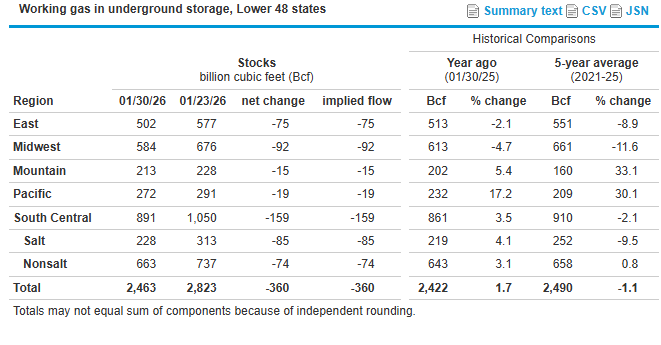
EIA Storage: During the week ending January 30th, the U.S. natural gas sector achieved a new record by withdrawing 360 billion cubic feet (Bcf) from storage. This increase was driven by severe cold temperatures across much of the country. As reported by the Energy Information Administration (EIA), this significant withdrawal eliminated the surplus compared to the five-year average. The EIA's latest estimate, released on February 5, surpassed the previous record of 359 Bcf set in January 2018. Historically, this withdrawal was very bullish, especially when compared to the five-year average withdrawal of 190 Bcf for the same week and the year-ago withdrawal of 195 Bcf.
Summary
Working gas in storage was 2,463 Bcf as of Friday, January 30, 2026, according to EIA estimates. This represents a net decrease of 360 Bcf from the previous week. Stocks were 41 Bcf higher than last year at this time and 27 Bcf below the five-year average of 2,490 Bcf. At 2,463 Bcf, total working gas is within the five-year historical range.
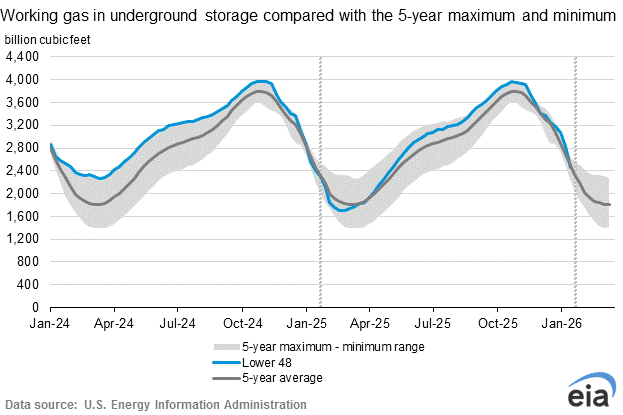
Note: The shaded area indicates the range between the historical minimum and maximum values for the weekly series from 2021 through 2025. The dashed vertical lines indicate current and year-ago weekly periods.
Weather: Winter Storm Fern significantly impacted a large portion of the U.S. from January 23rd to 26th, wreaking havoc across multiple states. The storm left nearly 600,000 homes without power. The air travel industry also felt the impact, with over 11,000 flight cancellations reported. Tragically, the storm's contributed to at least two dozen fatalities. Additionally, U.S. natural gas prices surged by over 17 percent, climbing past $6 for the first time since late 2022. As communities come together to recover and rebuild, the effects of Winter Storm Fern will be felt for quite some time, serving as a stark reminder of the power of nature and the importance of preparation in the face of unpredictable weather patterns.
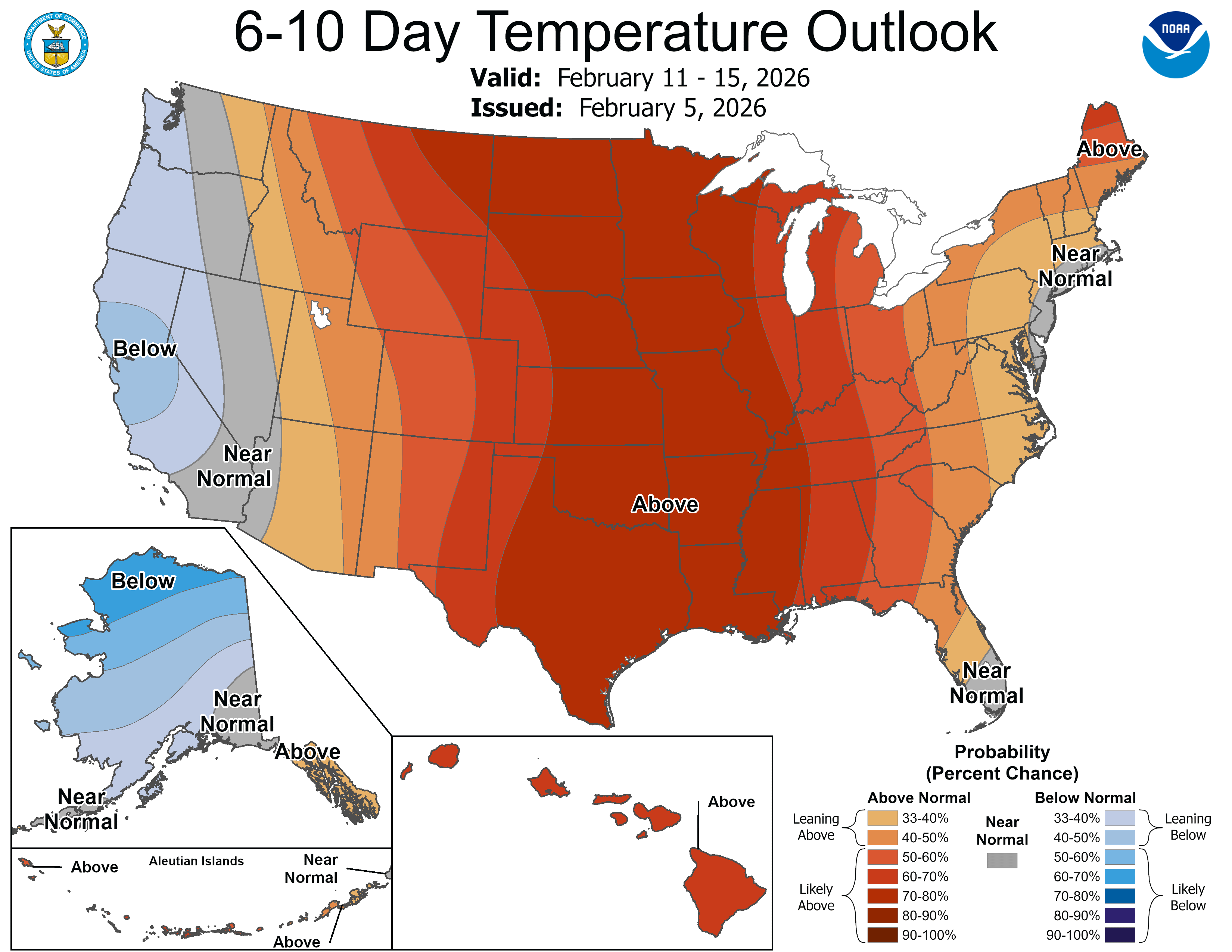
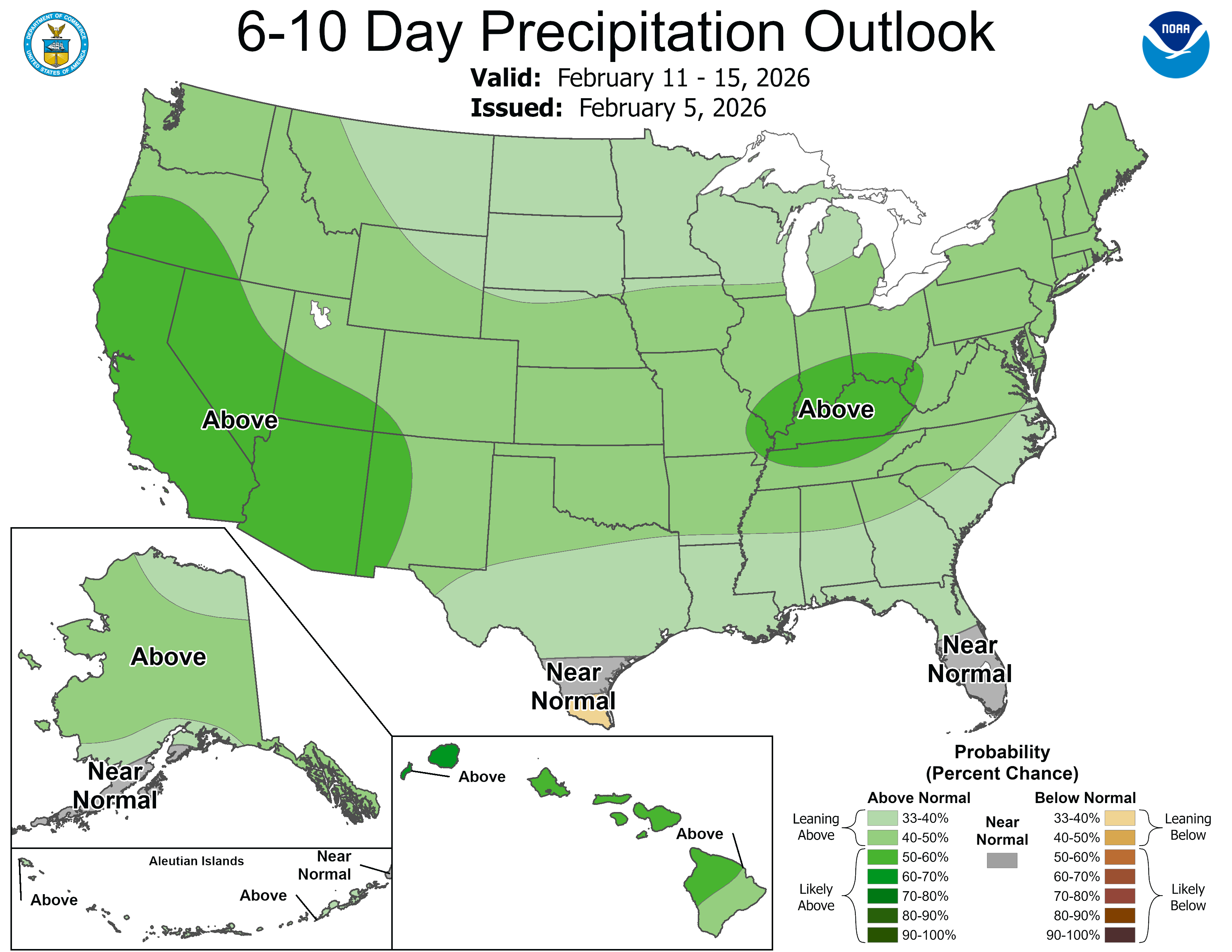
The recent disruption of the polar vortex is expected to occur around mid-February, increasing the likelihood that spring weather will not arrive earlier than usual. Meteorologists anticipate that the polar vortex will split on or around February 10th. During this event, warm air will build in northern Canada, causing one lobe of the polar vortex to settle over the continental U.S. while another lobe shifts to the opposite side of the globe. This split is likely to trigger a winter storm as a trough moves from the west. If a significant winter storm does not develop during this split, it may become challenging for substantial winter precipitation to occur later. Experts project that the split will last until the end of February, but it typically takes a couple of weeks for warmer air to reach the surface following a disruption. Midwest Weather. “Early or Late Spring.” Midwest Weather (Substack), 2026. Subscriber-only newsletter.
Market Data:
February 6, 2026

Weekly Energy News
February 6, 2026
Market Commentary: Market conditions in the U.S. have improved a lot. However, on February 5th, spot market prices were still volatile in some areas, especially in the eastern part of the Lower 48 states, as they prepared for colder weather. Analysts from EBW Analytics warned that "the market may soften in the second half of February," which could lessen any short-term benefits from the expected cold weather over the weekend, as the effects of the weather fade next week. They also mentioned that while the outlook for March looks good, but natural gas prices may keep changing as the market tries to find stability after recent ups and downs.
MAR26’ NYMEX closed Thursday at $3.509 (up $0.044)
• High for the day $3.573
• Low for the day $3.328
Early trading for the prompt month is trading at $3.593
• https://www.cmegroup.com/markets/energy/natural-gas/natural-gas.html
• https://www.fxempire.com/commodities/natural-gas
EIA Storage: During the week ending January 30th, the U.S. natural gas sector achieved a new record by withdrawing 360 billion cubic feet (Bcf) from storage. This increase was driven by severe cold temperatures across much of the country. As reported by the Energy Information Administration (EIA), this significant withdrawal eliminated the surplus compared to the five-year average. The EIA's latest estimate, released on February 5, surpassed the previous record of 359 Bcf set in January 2018. Historically, this withdrawal was very bullish, especially when compared to the five-year average withdrawal of 190 Bcf for the same week and the year-ago withdrawal of 195 Bcf.
Summary
Working gas in storage was 2,463 Bcf as of Friday, January 30, 2026, according to EIA estimates. This represents a net decrease of 360 Bcf from the previous week. Stocks were 41 Bcf higher than last year at this time and 27 Bcf below the five-year average of 2,490 Bcf. At 2,463 Bcf, total working gas is within the five-year historical range.
Note: The shaded area indicates the range between the historical minimum and maximum values for the weekly series from 2021 through 2025. The dashed vertical lines indicate current and year-ago weekly periods.
Weather: Winter Storm Fern significantly impacted a large portion of the U.S. from January 23rd to 26th, wreaking havoc across multiple states. The storm left nearly 600,000 homes without power. The air travel industry also felt the impact, with over 11,000 flight cancellations reported. Tragically, the storm's contributed to at least two dozen fatalities. Additionally, U.S. natural gas prices surged by over 17 percent, climbing past $6 for the first time since late 2022. As communities come together to recover and rebuild, the effects of Winter Storm Fern will be felt for quite some time, serving as a stark reminder of the power of nature and the importance of preparation in the face of unpredictable weather patterns.
The recent disruption of the polar vortex is expected to occur around mid-February, increasing the likelihood that spring weather will not arrive earlier than usual. Meteorologists anticipate that the polar vortex will split on or around February 10th. During this event, warm air will build in northern Canada, causing one lobe of the polar vortex to settle over the continental U.S. while another lobe shifts to the opposite side of the globe. This split is likely to trigger a winter storm as a trough moves from the west. If a significant winter storm does not develop during this split, it may become challenging for substantial winter precipitation to occur later. Experts project that the split will last until the end of February, but it typically takes a couple of weeks for warmer air to reach the surface following a disruption. Midwest Weather. “Early or Late Spring.” Midwest Weather (Substack), 2026. Subscriber-only newsletter.
Market Data:
February 6, 2026
February 6, 2026
Weekly Energy News
Market Commentary: Market conditions in the U.S. have improved a lot. However, on February 5th, spot market prices were still volatile in some areas, especially in the eastern part of the Lower 48 states, as they prepared for colder weather. Analysts from EBW Analytics warned that "the market may soften in the second half of February," which could lessen any short-term benefits from the expected cold weather over the weekend, as the effects of the weather fade next week. They also mentioned that while the outlook for March looks good, but natural gas prices may keep changing as the market tries to find stability after recent ups and downs.
MAR26’ NYMEX closed Thursday at $3.509 (up $0.044)
• High for the day $3.573
• Low for the day $3.328
Early trading for the prompt month is trading at $3.593
• https://www.cmegroup.com/markets/energy/natural-gas/natural-gas.html
• https://www.fxempire.com/commodities/natural-gas
EIA Storage: During the week ending January 30th, the U.S. natural gas sector achieved a new record by withdrawing 360 billion cubic feet (Bcf) from storage. This increase was driven by severe cold temperatures across much of the country. As reported by the Energy Information Administration (EIA), this significant withdrawal eliminated the surplus compared to the five-year average. The EIA's latest estimate, released on February 5, surpassed the previous record of 359 Bcf set in January 2018. Historically, this withdrawal was very bullish, especially when compared to the five-year average withdrawal of 190 Bcf for the same week and the year-ago withdrawal of 195 Bcf.
Summary
Working gas in storage was 2,463 Bcf as of Friday, January 30, 2026, according to EIA estimates. This represents a net decrease of 360 Bcf from the previous week. Stocks were 41 Bcf higher than last year at this time and 27 Bcf below the five-year average of 2,490 Bcf. At 2,463 Bcf, total working gas is within the five-year historical range.
Note: The shaded area indicates the range between the historical minimum and maximum values for the weekly series from 2021 through 2025. The dashed vertical lines indicate current and year-ago weekly periods.
Weather: Winter Storm Fern significantly impacted a large portion of the U.S. from January 23rd to 26th, wreaking havoc across multiple states. The storm left nearly 600,000 homes without power. The air travel industry also felt the impact, with over 11,000 flight cancellations reported. Tragically, the storm's contributed to at least two dozen fatalities. Additionally, U.S. natural gas prices surged by over 17 percent, climbing past $6 for the first time since late 2022. As communities come together to recover and rebuild, the effects of Winter Storm Fern will be felt for quite some time, serving as a stark reminder of the power of nature and the importance of preparation in the face of unpredictable weather patterns.
The recent disruption of the polar vortex is expected to occur around mid-February, increasing the likelihood that spring weather will not arrive earlier than usual. Meteorologists anticipate that the polar vortex will split on or around February 10th. During this event, warm air will build in northern Canada, causing one lobe of the polar vortex to settle over the continental U.S. while another lobe shifts to the opposite side of the globe. This split is likely to trigger a winter storm as a trough moves from the west. If a significant winter storm does not develop during this split, it may become challenging for substantial winter precipitation to occur later. Experts project that the split will last until the end of February, but it typically takes a couple of weeks for warmer air to reach the surface following a disruption. Midwest Weather. “Early or Late Spring.” Midwest Weather (Substack), 2026. Subscriber-only newsletter.
February 6, 2026
Weekly Energy News
Market Commentary: Market conditions in the U.S. have improved a lot. However, on February 5th, spot market prices were still volatile in some areas, especially in the eastern part of the Lower 48 states, as they prepared for colder weather. Analysts from EBW Analytics warned that "the market may soften in the second half of February," which could lessen any short-term benefits from the expected cold weather over the weekend, as the effects of the weather fade next week. They also mentioned that while the outlook for March looks good, but natural gas prices may keep changing as the market tries to find stability after recent ups and downs.
MAR26’ NYMEX closed Thursday at $3.509 (up $0.044)
• High for the day $3.573
• Low for the day $3.328
Early trading for the prompt month is trading at $3.593
• https://www.cmegroup.com/markets/energy/natural-gas/natural-gas.html
• https://www.fxempire.com/commodities/natural-gas
EIA Storage: During the week ending January 30th, the U.S. natural gas sector achieved a new record by withdrawing 360 billion cubic feet (Bcf) from storage. This increase was driven by severe cold temperatures across much of the country. As reported by the Energy Information Administration (EIA), this significant withdrawal eliminated the surplus compared to the five-year average. The EIA's latest estimate, released on February 5, surpassed the previous record of 359 Bcf set in January 2018. Historically, this withdrawal was very bullish, especially when compared to the five-year average withdrawal of 190 Bcf for the same week and the year-ago withdrawal of 195 Bcf.
Summary
Working gas in storage was 2,463 Bcf as of Friday, January 30, 2026, according to EIA estimates. This represents a net decrease of 360 Bcf from the previous week. Stocks were 41 Bcf higher than last year at this time and 27 Bcf below the five-year average of 2,490 Bcf. At 2,463 Bcf, total working gas is within the five-year historical range.
Note: The shaded area indicates the range between the historical minimum and maximum values for the weekly series from 2021 through 2025. The dashed vertical lines indicate current and year-ago weekly periods.
Weather: Winter Storm Fern significantly impacted a large portion of the U.S. from January 23rd to 26th, wreaking havoc across multiple states. The storm left nearly 600,000 homes without power. The air travel industry also felt the impact, with over 11,000 flight cancellations reported. Tragically, the storm's contributed to at least two dozen fatalities. Additionally, U.S. natural gas prices surged by over 17 percent, climbing past $6 for the first time since late 2022. As communities come together to recover and rebuild, the effects of Winter Storm Fern will be felt for quite some time, serving as a stark reminder of the power of nature and the importance of preparation in the face of unpredictable weather patterns.
The recent disruption of the polar vortex is expected to occur around mid-February, increasing the likelihood that spring weather will not arrive earlier than usual. Meteorologists anticipate that the polar vortex will split on or around February 10th. During this event, warm air will build in northern Canada, causing one lobe of the polar vortex to settle over the continental U.S. while another lobe shifts to the opposite side of the globe. This split is likely to trigger a winter storm as a trough moves from the west. If a significant winter storm does not develop during this split, it may become challenging for substantial winter precipitation to occur later. Experts project that the split will last until the end of February, but it typically takes a couple of weeks for warmer air to reach the surface following a disruption. Midwest Weather. “Early or Late Spring.” Midwest Weather (Substack), 2026. Subscriber-only newsletter.
February 6, 2026
Weekly Energy News
Market Commentary: Market conditions in the U.S. have improved a lot. However, on February 5th, spot market prices were still volatile in some areas, especially in the eastern part of the Lower 48 states, as they prepared for colder weather. Analysts from EBW Analytics warned that "the market may soften in the second half of February," which could lessen any short-term benefits from the expected cold weather over the weekend, as the effects of the weather fade next week. They also mentioned that while the outlook for March looks good, but natural gas prices may keep changing as the market tries to find stability after recent ups and downs.
MAR26’ NYMEX closed Thursday at $3.509 (up $0.044)
• High for the day $3.573
• Low for the day $3.328
Early trading for the prompt month is trading at $3.593
• https://www.cmegroup.com/markets/energy/natural-gas/natural-gas.html
• https://www.fxempire.com/commodities/natural-gas
EIA Storage: During the week ending January 30th, the U.S. natural gas sector achieved a new record by withdrawing 360 billion cubic feet (Bcf) from storage. This increase was driven by severe cold temperatures across much of the country. As reported by the Energy Information Administration (EIA), this significant withdrawal eliminated the surplus compared to the five-year average. The EIA's latest estimate, released on February 5, surpassed the previous record of 359 Bcf set in January 2018. Historically, this withdrawal was very bullish, especially when compared to the five-year average withdrawal of 190 Bcf for the same week and the year-ago withdrawal of 195 Bcf.
Summary
Working gas in storage was 2,463 Bcf as of Friday, January 30, 2026, according to EIA estimates. This represents a net decrease of 360 Bcf from the previous week. Stocks were 41 Bcf higher than last year at this time and 27 Bcf below the five-year average of 2,490 Bcf. At 2,463 Bcf, total working gas is within the five-year historical range.
Note: The shaded area indicates the range between the historical minimum and maximum values for the weekly series from 2021 through 2025. The dashed vertical lines indicate current and year-ago weekly periods.
Weather: Winter Storm Fern significantly impacted a large portion of the U.S. from January 23rd to 26th, wreaking havoc across multiple states. The storm left nearly 600,000 homes without power. The air travel industry also felt the impact, with over 11,000 flight cancellations reported. Tragically, the storm's contributed to at least two dozen fatalities. Additionally, U.S. natural gas prices surged by over 17 percent, climbing past $6 for the first time since late 2022. As communities come together to recover and rebuild, the effects of Winter Storm Fern will be felt for quite some time, serving as a stark reminder of the power of nature and the importance of preparation in the face of unpredictable weather patterns.
The recent disruption of the polar vortex is expected to occur around mid-February, increasing the likelihood that spring weather will not arrive earlier than usual. Meteorologists anticipate that the polar vortex will split on or around February 10th. During this event, warm air will build in northern Canada, causing one lobe of the polar vortex to settle over the continental U.S. while another lobe shifts to the opposite side of the globe. This split is likely to trigger a winter storm as a trough moves from the west. If a significant winter storm does not develop during this split, it may become challenging for substantial winter precipitation to occur later. Experts project that the split will last until the end of February, but it typically takes a couple of weeks for warmer air to reach the surface following a disruption. Midwest Weather. “Early or Late Spring.” Midwest Weather (Substack), 2026. Subscriber-only newsletter.

February 6, 2026
Market Commentary: Market conditions in the U.S. have improved a lot. However, on February 5th, spot market prices were still volatile in some areas, especially in the eastern part of the Lower 48 states, as they prepared for colder weather. Analysts from EBW Analytics warned that "the market may soften in the second half of February," which could lessen any short-term benefits from the expected cold weather over the weekend, as the effects of the weather fade next week. They also mentioned that while the outlook for March looks good, but natural gas prices may keep changing as the market tries to find stability after recent ups and downs.
MAR26’ NYMEX closed Thursday at $3.509 (up $0.044)
• High for the day $3.573
• Low for the day $3.328
Early trading for the prompt month is trading at $3.593
• https://www.cmegroup.com/markets/energy/natural-gas/natural-gas.html
• https://www.fxempire.com/commodities/natural-gas
EIA Storage: During the week ending January 30th, the U.S. natural gas sector achieved a new record by withdrawing 360 billion cubic feet (Bcf) from storage. This increase was driven by severe cold temperatures across much of the country. As reported by the Energy Information Administration (EIA), this significant withdrawal eliminated the surplus compared to the five-year average. The EIA's latest estimate, released on February 5, surpassed the previous record of 359 Bcf set in January 2018. Historically, this withdrawal was very bullish, especially when compared to the five-year average withdrawal of 190 Bcf for the same week and the year-ago withdrawal of 195 Bcf.
Summary
Working gas in storage was 2,463 Bcf as of Friday, January 30, 2026, according to EIA estimates. This represents a net decrease of 360 Bcf from the previous week. Stocks were 41 Bcf higher than last year at this time and 27 Bcf below the five-year average of 2,490 Bcf. At 2,463 Bcf, total working gas is within the five-year historical range.
Note: The shaded area indicates the range between the historical minimum and maximum values for the weekly series from 2021 through 2025. The dashed vertical lines indicate current and year-ago weekly periods.
Weather: Winter Storm Fern significantly impacted a large portion of the U.S. from January 23rd to 26th, wreaking havoc across multiple states. The storm left nearly 600,000 homes without power. The air travel industry also felt the impact, with over 11,000 flight cancellations reported. Tragically, the storm's contributed to at least two dozen fatalities. Additionally, U.S. natural gas prices surged by over 17 percent, climbing past $6 for the first time since late 2022. As communities come together to recover and rebuild, the effects of Winter Storm Fern will be felt for quite some time, serving as a stark reminder of the power of nature and the importance of preparation in the face of unpredictable weather patterns.
The recent disruption of the polar vortex is expected to occur around mid-February, increasing the likelihood that spring weather will not arrive earlier than usual. Meteorologists anticipate that the polar vortex will split on or around February 10th. During this event, warm air will build in northern Canada, causing one lobe of the polar vortex to settle over the continental U.S. while another lobe shifts to the opposite side of the globe. This split is likely to trigger a winter storm as a trough moves from the west. If a significant winter storm does not develop during this split, it may become challenging for substantial winter precipitation to occur later. Experts project that the split will last until the end of February, but it typically takes a couple of weeks for warmer air to reach the surface following a disruption. Midwest Weather. “Early or Late Spring.” Midwest Weather (Substack), 2026. Subscriber-only newsletter.
February 6, 2026
Weekly Energy News
Market Commentary: Market conditions in the U.S. have improved a lot. However, on February 5th, spot market prices were still volatile in some areas, especially in the eastern part of the Lower 48 states, as they prepared for colder weather. Analysts from EBW Analytics warned that "the market may soften in the second half of February," which could lessen any short-term benefits from the expected cold weather over the weekend, as the effects of the weather fade next week. They also mentioned that while the outlook for March looks good, but natural gas prices may keep changing as the market tries to find stability after recent ups and downs.
MAR26’ NYMEX closed Thursday at $3.509 (up $0.044)
• High for the day $3.573
• Low for the day $3.328
Early trading for the prompt month is trading at $3.593
• https://www.cmegroup.com/markets/energy/natural-gas/natural-gas.html
• https://www.fxempire.com/commodities/natural-gas
EIA Storage: During the week ending January 30th, the U.S. natural gas sector achieved a new record by withdrawing 360 billion cubic feet (Bcf) from storage. This increase was driven by severe cold temperatures across much of the country. As reported by the Energy Information Administration (EIA), this significant withdrawal eliminated the surplus compared to the five-year average. The EIA's latest estimate, released on February 5, surpassed the previous record of 359 Bcf set in January 2018. Historically, this withdrawal was very bullish, especially when compared to the five-year average withdrawal of 190 Bcf for the same week and the year-ago withdrawal of 195 Bcf.
Summary
Working gas in storage was 2,463 Bcf as of Friday, January 30, 2026, according to EIA estimates. This represents a net decrease of 360 Bcf from the previous week. Stocks were 41 Bcf higher than last year at this time and 27 Bcf below the five-year average of 2,490 Bcf. At 2,463 Bcf, total working gas is within the five-year historical range.
Note: The shaded area indicates the range between the historical minimum and maximum values for the weekly series from 2021 through 2025. The dashed vertical lines indicate current and year-ago weekly periods.
Weather: Winter Storm Fern significantly impacted a large portion of the U.S. from January 23rd to 26th, wreaking havoc across multiple states. The storm left nearly 600,000 homes without power. The air travel industry also felt the impact, with over 11,000 flight cancellations reported. Tragically, the storm's contributed to at least two dozen fatalities. Additionally, U.S. natural gas prices surged by over 17 percent, climbing past $6 for the first time since late 2022. As communities come together to recover and rebuild, the effects of Winter Storm Fern will be felt for quite some time, serving as a stark reminder of the power of nature and the importance of preparation in the face of unpredictable weather patterns.
The recent disruption of the polar vortex is expected to occur around mid-February, increasing the likelihood that spring weather will not arrive earlier than usual. Meteorologists anticipate that the polar vortex will split on or around February 10th. During this event, warm air will build in northern Canada, causing one lobe of the polar vortex to settle over the continental U.S. while another lobe shifts to the opposite side of the globe. This split is likely to trigger a winter storm as a trough moves from the west. If a significant winter storm does not develop during this split, it may become challenging for substantial winter precipitation to occur later. Experts project that the split will last until the end of February, but it typically takes a couple of weeks for warmer air to reach the surface following a disruption. Midwest Weather. “Early or Late Spring.” Midwest Weather (Substack), 2026. Subscriber-only newsletter.
February 6, 2026
Weekly Energy News
Market Commentary: Market conditions in the U.S. have improved a lot. However, on February 5th, spot market prices were still volatile in some areas, especially in the eastern part of the Lower 48 states, as they prepared for colder weather. Analysts from EBW Analytics warned that "the market may soften in the second half of February," which could lessen any short-term benefits from the expected cold weather over the weekend, as the effects of the weather fade next week. They also mentioned that while the outlook for March looks good, but natural gas prices may keep changing as the market tries to find stability after recent ups and downs.
MAR26’ NYMEX closed Thursday at $3.509 (up $0.044)
• High for the day $3.573
• Low for the day $3.328
Early trading for the prompt month is trading at $3.593
• https://www.cmegroup.com/markets/energy/natural-gas/natural-gas.html
• https://www.fxempire.com/commodities/natural-gas
EIA Storage: During the week ending January 30th, the U.S. natural gas sector achieved a new record by withdrawing 360 billion cubic feet (Bcf) from storage. This increase was driven by severe cold temperatures across much of the country. As reported by the Energy Information Administration (EIA), this significant withdrawal eliminated the surplus compared to the five-year average. The EIA's latest estimate, released on February 5, surpassed the previous record of 359 Bcf set in January 2018. Historically, this withdrawal was very bullish, especially when compared to the five-year average withdrawal of 190 Bcf for the same week and the year-ago withdrawal of 195 Bcf.
Summary
Working gas in storage was 2,463 Bcf as of Friday, January 30, 2026, according to EIA estimates. This represents a net decrease of 360 Bcf from the previous week. Stocks were 41 Bcf higher than last year at this time and 27 Bcf below the five-year average of 2,490 Bcf. At 2,463 Bcf, total working gas is within the five-year historical range.
Note: The shaded area indicates the range between the historical minimum and maximum values for the weekly series from 2021 through 2025. The dashed vertical lines indicate current and year-ago weekly periods.
Weather: Winter Storm Fern significantly impacted a large portion of the U.S. from January 23rd to 26th, wreaking havoc across multiple states. The storm left nearly 600,000 homes without power. The air travel industry also felt the impact, with over 11,000 flight cancellations reported. Tragically, the storm's contributed to at least two dozen fatalities. Additionally, U.S. natural gas prices surged by over 17 percent, climbing past $6 for the first time since late 2022. As communities come together to recover and rebuild, the effects of Winter Storm Fern will be felt for quite some time, serving as a stark reminder of the power of nature and the importance of preparation in the face of unpredictable weather patterns.
The recent disruption of the polar vortex is expected to occur around mid-February, increasing the likelihood that spring weather will not arrive earlier than usual. Meteorologists anticipate that the polar vortex will split on or around February 10th. During this event, warm air will build in northern Canada, causing one lobe of the polar vortex to settle over the continental U.S. while another lobe shifts to the opposite side of the globe. This split is likely to trigger a winter storm as a trough moves from the west. If a significant winter storm does not develop during this split, it may become challenging for substantial winter precipitation to occur later. Experts project that the split will last until the end of February, but it typically takes a couple of weeks for warmer air to reach the surface following a disruption. Midwest Weather. “Early or Late Spring.” Midwest Weather (Substack), 2026. Subscriber-only newsletter.
Make Your Choice Gas Selection in Three Easy Steps
Click here to access our online tool, or call our Choice gas commodity experts at 1 (877) 790-4990.
Step 1: Enter your account number
- Your Black Hills Energy account number is located at the top right-hand corner of your bill.
Step 2: Review price options and make your selection
Step 3: Confirm your selection and enter your control number
- You received a control number in your 2026 Choice Gas selection packet mailed to you from Black Hills Energy. If you cannot locate this, you can retrieve your control number by calling 877-245-3506 or visit choicegas.com
Once enrolled, you will be removed from supplier marketing communications within 24 hours.


Sign Up for Our Energy Newsletters
Sign UpRecent Posts