May 1, 2026
Weekly Energy News
Market Update: The U.S. Energy Information Administration reported a 79 Bcf injection into natural gas storage for the week ending April 24, slightly above market expectations of 76 Bcf.
Following the report, the prompt-month June contract on the NYMEX moved higher, initially rising into the mid-$2.60s/MMBtu before climbing to an intraday high near $2.78/MMBtu.
Despite the bullish price reaction, the storage build was bearish relative to historical trends. The five-year average for the same week is 63 Bcf, though last year saw a significantly larger 105 Bcf injection. Total U.S. inventories now stand at 2.142 Tcf—153 Bcf (nearly 8%) above the five-year average and 116 Bcf (about 6%) above year-ago levels.
After rolling into the prompt position, June futures have faced pressure from generally loose market conditions. Prices dipped below $2.60/MMBtu earlier in the week before rebounding, with gains likely supported by short covering following the storage release.
Analysts note that while storage levels remain healthy, bearish pressure may begin to ease. Recent cooler weather across the eastern U.S. has sustained heating demand, and lower production—partly due to pipeline maintenance—has helped tighten near-term fundamentals.
Looking ahead, early estimates suggest another moderate injection for the week ending May 1, with expectations around 76 Bcf—roughly in line with the five-year average.
June 2026 NYMEX closed Thursday at $2.76
· High for the day $2.878
· Low for the day $2.709
Early trading for the prompt month is trading at $2.774
· https://www.cmegroup.com/markets/energy/natural-gas/natural-gas.html
· https://www.fxempire.com/commodities/natural-gas
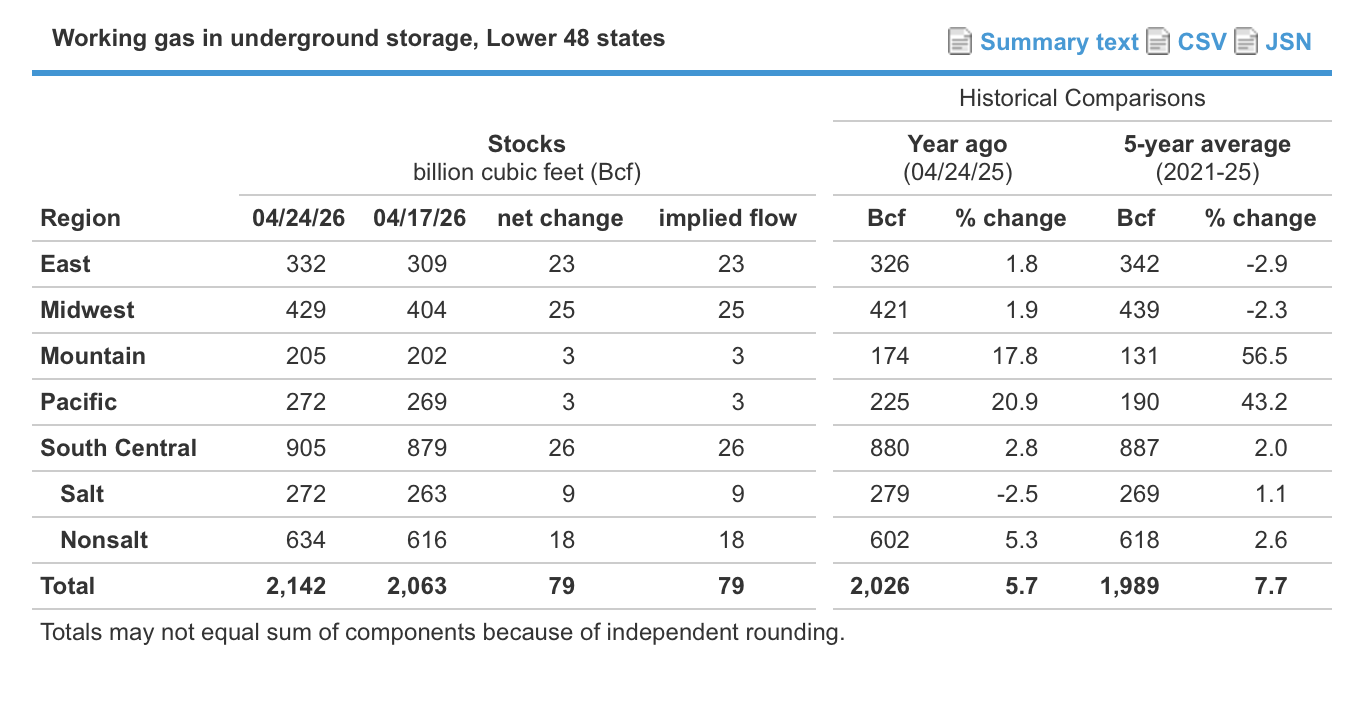
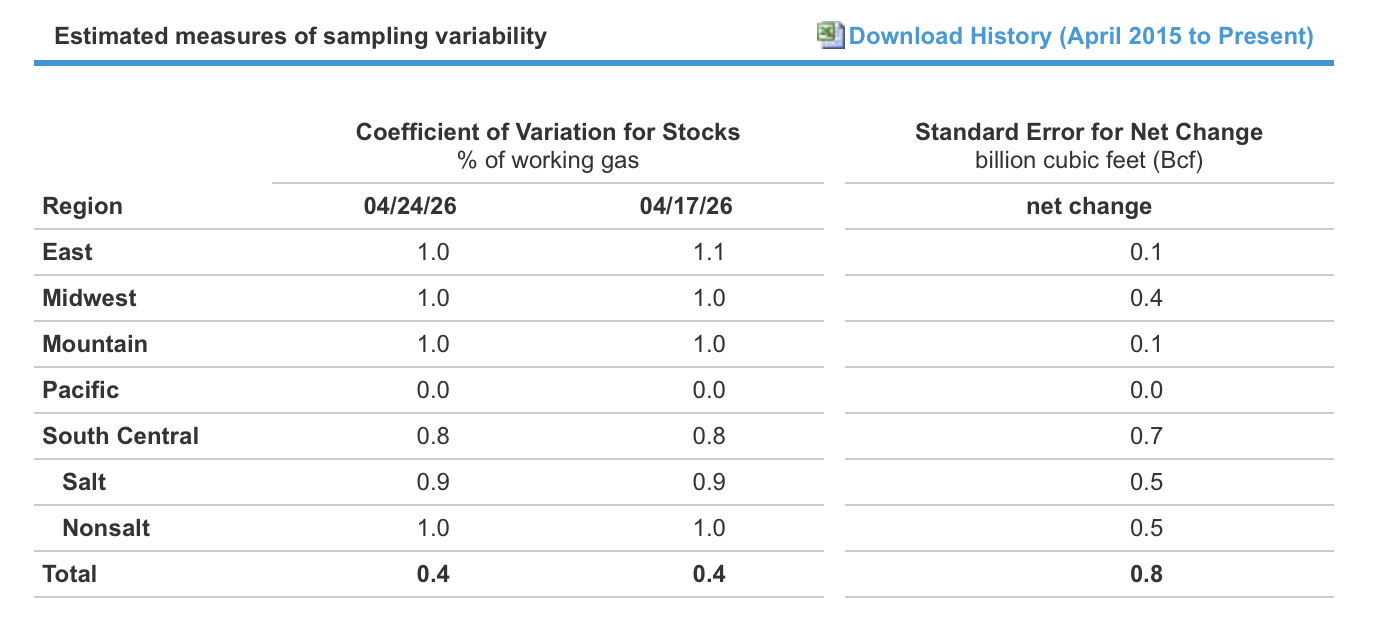
EIA Storage Report: According to estimates from the U.S. Energy Information Administration, working gas in storage totaled 2,142 Bcf as of Friday, April 24, 2026—an increase of 79 Bcf from the prior week.
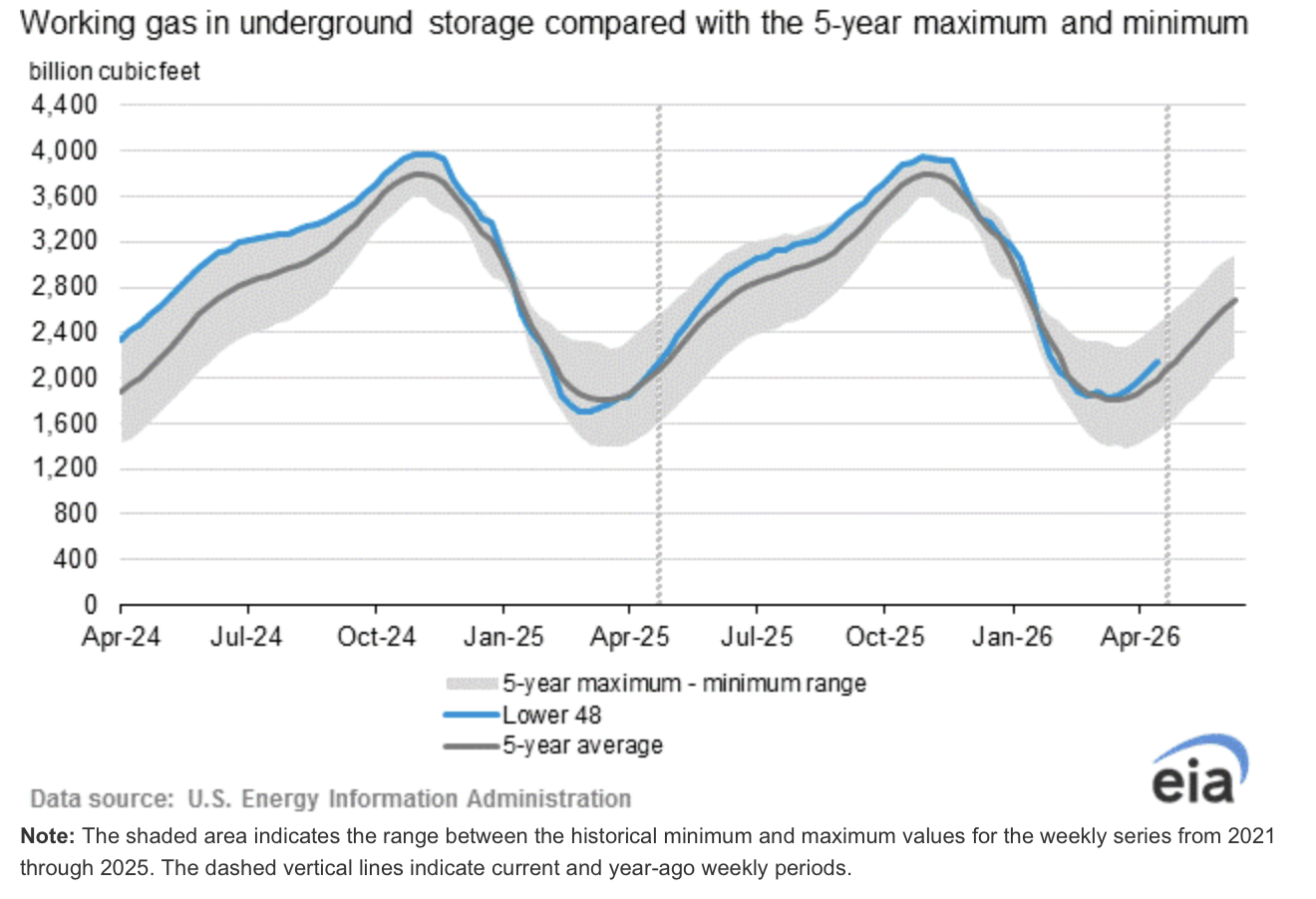
Storage levels are 116 Bcf higher than this time last year and 153 Bcf above the five-year average of 1,989 Bcf. Overall, inventories remain within the historical five-year range.
Weather: The latest outlook from the Climate Prediction Center points to a highly variable weather pattern throughout May, driven by shifting atmospheric conditions and emerging El Niño trends.
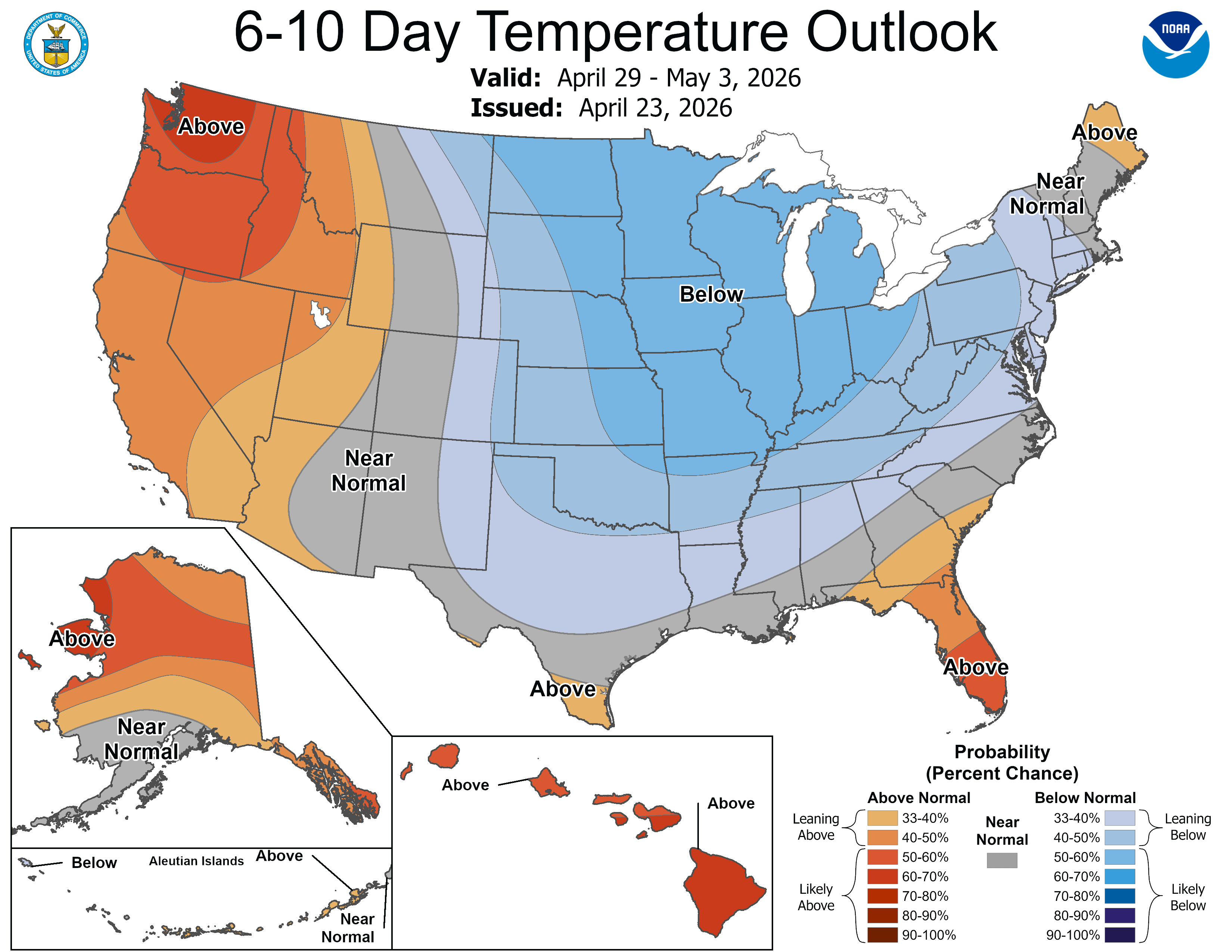
After an unusually warm start to spring, a major pattern shift is underway. Cooler-than-normal temperatures are expected across much of the eastern half of the U.S. through early May, as strong cold fronts move from the Great Plains to the East Coast.
By mid-May, conditions are expected to flip. Warmer-than-normal temperatures are likely to expand across much of the country, particularly in the central and western U.S., as high-pressure systems build. The Pacific Northwest is expected to see the strongest warmth, with temperatures running well above seasonal norms early in the month.
Overall, the eastern U.S. is expected to experience a mixed temperature pattern in May, with no strong lean toward above- or below-normal conditions for the full month.
On the precipitation side, wetter-than-normal conditions are expected across Texas, the Gulf Coast, and parts of the Southeast, especially early in the month. This includes the potential for meaningful rainfall across eastern Texas and Louisiana. Portions of the Southwest may also see above-normal precipitation, though largely due to early-month activity.
In contrast, drier-than-normal conditions are favored across the Pacific Northwest, Northern Rockies, and parts of the Plains and Upper Midwest, particularly as the month progresses.
Market Data:
May 1, 2026

Weekly Energy News
May 1, 2026
Market Update: The U.S. Energy Information Administration reported a 79 Bcf injection into natural gas storage for the week ending April 24, slightly above market expectations of 76 Bcf.
Following the report, the prompt-month June contract on the NYMEX moved higher, initially rising into the mid-$2.60s/MMBtu before climbing to an intraday high near $2.78/MMBtu.
Despite the bullish price reaction, the storage build was bearish relative to historical trends. The five-year average for the same week is 63 Bcf, though last year saw a significantly larger 105 Bcf injection. Total U.S. inventories now stand at 2.142 Tcf—153 Bcf (nearly 8%) above the five-year average and 116 Bcf (about 6%) above year-ago levels.
After rolling into the prompt position, June futures have faced pressure from generally loose market conditions. Prices dipped below $2.60/MMBtu earlier in the week before rebounding, with gains likely supported by short covering following the storage release.
Analysts note that while storage levels remain healthy, bearish pressure may begin to ease. Recent cooler weather across the eastern U.S. has sustained heating demand, and lower production—partly due to pipeline maintenance—has helped tighten near-term fundamentals.
Looking ahead, early estimates suggest another moderate injection for the week ending May 1, with expectations around 76 Bcf—roughly in line with the five-year average.
June 2026 NYMEX closed Thursday at $2.76
· High for the day $2.878
· Low for the day $2.709
Early trading for the prompt month is trading at $2.774
· https://www.cmegroup.com/markets/energy/natural-gas/natural-gas.html
· https://www.fxempire.com/commodities/natural-gas
EIA Storage Report: According to estimates from the U.S. Energy Information Administration, working gas in storage totaled 2,142 Bcf as of Friday, April 24, 2026—an increase of 79 Bcf from the prior week.
Storage levels are 116 Bcf higher than this time last year and 153 Bcf above the five-year average of 1,989 Bcf. Overall, inventories remain within the historical five-year range.
Weather: The latest outlook from the Climate Prediction Center points to a highly variable weather pattern throughout May, driven by shifting atmospheric conditions and emerging El Niño trends.
After an unusually warm start to spring, a major pattern shift is underway. Cooler-than-normal temperatures are expected across much of the eastern half of the U.S. through early May, as strong cold fronts move from the Great Plains to the East Coast.
By mid-May, conditions are expected to flip. Warmer-than-normal temperatures are likely to expand across much of the country, particularly in the central and western U.S., as high-pressure systems build. The Pacific Northwest is expected to see the strongest warmth, with temperatures running well above seasonal norms early in the month.
Overall, the eastern U.S. is expected to experience a mixed temperature pattern in May, with no strong lean toward above- or below-normal conditions for the full month.
On the precipitation side, wetter-than-normal conditions are expected across Texas, the Gulf Coast, and parts of the Southeast, especially early in the month. This includes the potential for meaningful rainfall across eastern Texas and Louisiana. Portions of the Southwest may also see above-normal precipitation, though largely due to early-month activity.
In contrast, drier-than-normal conditions are favored across the Pacific Northwest, Northern Rockies, and parts of the Plains and Upper Midwest, particularly as the month progresses.
Market Data:
May 1, 2026
May 1, 2026
Weekly Energy News
Market Update: The U.S. Energy Information Administration reported a 79 Bcf injection into natural gas storage for the week ending April 24, slightly above market expectations of 76 Bcf.
Following the report, the prompt-month June contract on the NYMEX moved higher, initially rising into the mid-$2.60s/MMBtu before climbing to an intraday high near $2.78/MMBtu.
Despite the bullish price reaction, the storage build was bearish relative to historical trends. The five-year average for the same week is 63 Bcf, though last year saw a significantly larger 105 Bcf injection. Total U.S. inventories now stand at 2.142 Tcf—153 Bcf (nearly 8%) above the five-year average and 116 Bcf (about 6%) above year-ago levels.
After rolling into the prompt position, June futures have faced pressure from generally loose market conditions. Prices dipped below $2.60/MMBtu earlier in the week before rebounding, with gains likely supported by short covering following the storage release.
Analysts note that while storage levels remain healthy, bearish pressure may begin to ease. Recent cooler weather across the eastern U.S. has sustained heating demand, and lower production—partly due to pipeline maintenance—has helped tighten near-term fundamentals.
Looking ahead, early estimates suggest another moderate injection for the week ending May 1, with expectations around 76 Bcf—roughly in line with the five-year average.
June 2026 NYMEX closed Thursday at $2.76
· High for the day $2.878
· Low for the day $2.709
Early trading for the prompt month is trading at $2.774
· https://www.cmegroup.com/markets/energy/natural-gas/natural-gas.html
· https://www.fxempire.com/commodities/natural-gas
EIA Storage Report: According to estimates from the U.S. Energy Information Administration, working gas in storage totaled 2,142 Bcf as of Friday, April 24, 2026—an increase of 79 Bcf from the prior week.
Storage levels are 116 Bcf higher than this time last year and 153 Bcf above the five-year average of 1,989 Bcf. Overall, inventories remain within the historical five-year range.
Weather: The latest outlook from the Climate Prediction Center points to a highly variable weather pattern throughout May, driven by shifting atmospheric conditions and emerging El Niño trends.
After an unusually warm start to spring, a major pattern shift is underway. Cooler-than-normal temperatures are expected across much of the eastern half of the U.S. through early May, as strong cold fronts move from the Great Plains to the East Coast.
By mid-May, conditions are expected to flip. Warmer-than-normal temperatures are likely to expand across much of the country, particularly in the central and western U.S., as high-pressure systems build. The Pacific Northwest is expected to see the strongest warmth, with temperatures running well above seasonal norms early in the month.
Overall, the eastern U.S. is expected to experience a mixed temperature pattern in May, with no strong lean toward above- or below-normal conditions for the full month.
On the precipitation side, wetter-than-normal conditions are expected across Texas, the Gulf Coast, and parts of the Southeast, especially early in the month. This includes the potential for meaningful rainfall across eastern Texas and Louisiana. Portions of the Southwest may also see above-normal precipitation, though largely due to early-month activity.
In contrast, drier-than-normal conditions are favored across the Pacific Northwest, Northern Rockies, and parts of the Plains and Upper Midwest, particularly as the month progresses.
May 1, 2026
Weekly Energy News
Market Update: The U.S. Energy Information Administration reported a 79 Bcf injection into natural gas storage for the week ending April 24, slightly above market expectations of 76 Bcf.
Following the report, the prompt-month June contract on the NYMEX moved higher, initially rising into the mid-$2.60s/MMBtu before climbing to an intraday high near $2.78/MMBtu.
Despite the bullish price reaction, the storage build was bearish relative to historical trends. The five-year average for the same week is 63 Bcf, though last year saw a significantly larger 105 Bcf injection. Total U.S. inventories now stand at 2.142 Tcf—153 Bcf (nearly 8%) above the five-year average and 116 Bcf (about 6%) above year-ago levels.
After rolling into the prompt position, June futures have faced pressure from generally loose market conditions. Prices dipped below $2.60/MMBtu earlier in the week before rebounding, with gains likely supported by short covering following the storage release.
Analysts note that while storage levels remain healthy, bearish pressure may begin to ease. Recent cooler weather across the eastern U.S. has sustained heating demand, and lower production—partly due to pipeline maintenance—has helped tighten near-term fundamentals.
Looking ahead, early estimates suggest another moderate injection for the week ending May 1, with expectations around 76 Bcf—roughly in line with the five-year average.
June 2026 NYMEX closed Thursday at $2.76
· High for the day $2.878
· Low for the day $2.709
Early trading for the prompt month is trading at $2.774
· https://www.cmegroup.com/markets/energy/natural-gas/natural-gas.html
· https://www.fxempire.com/commodities/natural-gas
EIA Storage Report: According to estimates from the U.S. Energy Information Administration, working gas in storage totaled 2,142 Bcf as of Friday, April 24, 2026—an increase of 79 Bcf from the prior week.
Storage levels are 116 Bcf higher than this time last year and 153 Bcf above the five-year average of 1,989 Bcf. Overall, inventories remain within the historical five-year range.
Weather: The latest outlook from the Climate Prediction Center points to a highly variable weather pattern throughout May, driven by shifting atmospheric conditions and emerging El Niño trends.
After an unusually warm start to spring, a major pattern shift is underway. Cooler-than-normal temperatures are expected across much of the eastern half of the U.S. through early May, as strong cold fronts move from the Great Plains to the East Coast.
By mid-May, conditions are expected to flip. Warmer-than-normal temperatures are likely to expand across much of the country, particularly in the central and western U.S., as high-pressure systems build. The Pacific Northwest is expected to see the strongest warmth, with temperatures running well above seasonal norms early in the month.
Overall, the eastern U.S. is expected to experience a mixed temperature pattern in May, with no strong lean toward above- or below-normal conditions for the full month.
On the precipitation side, wetter-than-normal conditions are expected across Texas, the Gulf Coast, and parts of the Southeast, especially early in the month. This includes the potential for meaningful rainfall across eastern Texas and Louisiana. Portions of the Southwest may also see above-normal precipitation, though largely due to early-month activity.
In contrast, drier-than-normal conditions are favored across the Pacific Northwest, Northern Rockies, and parts of the Plains and Upper Midwest, particularly as the month progresses.
May 1, 2026
Weekly Energy News
Market Update: The U.S. Energy Information Administration reported a 79 Bcf injection into natural gas storage for the week ending April 24, slightly above market expectations of 76 Bcf.
Following the report, the prompt-month June contract on the NYMEX moved higher, initially rising into the mid-$2.60s/MMBtu before climbing to an intraday high near $2.78/MMBtu.
Despite the bullish price reaction, the storage build was bearish relative to historical trends. The five-year average for the same week is 63 Bcf, though last year saw a significantly larger 105 Bcf injection. Total U.S. inventories now stand at 2.142 Tcf—153 Bcf (nearly 8%) above the five-year average and 116 Bcf (about 6%) above year-ago levels.
After rolling into the prompt position, June futures have faced pressure from generally loose market conditions. Prices dipped below $2.60/MMBtu earlier in the week before rebounding, with gains likely supported by short covering following the storage release.
Analysts note that while storage levels remain healthy, bearish pressure may begin to ease. Recent cooler weather across the eastern U.S. has sustained heating demand, and lower production—partly due to pipeline maintenance—has helped tighten near-term fundamentals.
Looking ahead, early estimates suggest another moderate injection for the week ending May 1, with expectations around 76 Bcf—roughly in line with the five-year average.
June 2026 NYMEX closed Thursday at $2.76
· High for the day $2.878
· Low for the day $2.709
Early trading for the prompt month is trading at $2.774
· https://www.cmegroup.com/markets/energy/natural-gas/natural-gas.html
· https://www.fxempire.com/commodities/natural-gas
EIA Storage Report: According to estimates from the U.S. Energy Information Administration, working gas in storage totaled 2,142 Bcf as of Friday, April 24, 2026—an increase of 79 Bcf from the prior week.
Storage levels are 116 Bcf higher than this time last year and 153 Bcf above the five-year average of 1,989 Bcf. Overall, inventories remain within the historical five-year range.
Weather: The latest outlook from the Climate Prediction Center points to a highly variable weather pattern throughout May, driven by shifting atmospheric conditions and emerging El Niño trends.
After an unusually warm start to spring, a major pattern shift is underway. Cooler-than-normal temperatures are expected across much of the eastern half of the U.S. through early May, as strong cold fronts move from the Great Plains to the East Coast.
By mid-May, conditions are expected to flip. Warmer-than-normal temperatures are likely to expand across much of the country, particularly in the central and western U.S., as high-pressure systems build. The Pacific Northwest is expected to see the strongest warmth, with temperatures running well above seasonal norms early in the month.
Overall, the eastern U.S. is expected to experience a mixed temperature pattern in May, with no strong lean toward above- or below-normal conditions for the full month.
On the precipitation side, wetter-than-normal conditions are expected across Texas, the Gulf Coast, and parts of the Southeast, especially early in the month. This includes the potential for meaningful rainfall across eastern Texas and Louisiana. Portions of the Southwest may also see above-normal precipitation, though largely due to early-month activity.
In contrast, drier-than-normal conditions are favored across the Pacific Northwest, Northern Rockies, and parts of the Plains and Upper Midwest, particularly as the month progresses.

May 1, 2026
Market Update: The U.S. Energy Information Administration reported a 79 Bcf injection into natural gas storage for the week ending April 24, slightly above market expectations of 76 Bcf.
Following the report, the prompt-month June contract on the NYMEX moved higher, initially rising into the mid-$2.60s/MMBtu before climbing to an intraday high near $2.78/MMBtu.
Despite the bullish price reaction, the storage build was bearish relative to historical trends. The five-year average for the same week is 63 Bcf, though last year saw a significantly larger 105 Bcf injection. Total U.S. inventories now stand at 2.142 Tcf—153 Bcf (nearly 8%) above the five-year average and 116 Bcf (about 6%) above year-ago levels.
After rolling into the prompt position, June futures have faced pressure from generally loose market conditions. Prices dipped below $2.60/MMBtu earlier in the week before rebounding, with gains likely supported by short covering following the storage release.
Analysts note that while storage levels remain healthy, bearish pressure may begin to ease. Recent cooler weather across the eastern U.S. has sustained heating demand, and lower production—partly due to pipeline maintenance—has helped tighten near-term fundamentals.
Looking ahead, early estimates suggest another moderate injection for the week ending May 1, with expectations around 76 Bcf—roughly in line with the five-year average.
June 2026 NYMEX closed Thursday at $2.76
· High for the day $2.878
· Low for the day $2.709
Early trading for the prompt month is trading at $2.774
· https://www.cmegroup.com/markets/energy/natural-gas/natural-gas.html
· https://www.fxempire.com/commodities/natural-gas
EIA Storage Report: According to estimates from the U.S. Energy Information Administration, working gas in storage totaled 2,142 Bcf as of Friday, April 24, 2026—an increase of 79 Bcf from the prior week.
Storage levels are 116 Bcf higher than this time last year and 153 Bcf above the five-year average of 1,989 Bcf. Overall, inventories remain within the historical five-year range.
Weather: The latest outlook from the Climate Prediction Center points to a highly variable weather pattern throughout May, driven by shifting atmospheric conditions and emerging El Niño trends.
After an unusually warm start to spring, a major pattern shift is underway. Cooler-than-normal temperatures are expected across much of the eastern half of the U.S. through early May, as strong cold fronts move from the Great Plains to the East Coast.
By mid-May, conditions are expected to flip. Warmer-than-normal temperatures are likely to expand across much of the country, particularly in the central and western U.S., as high-pressure systems build. The Pacific Northwest is expected to see the strongest warmth, with temperatures running well above seasonal norms early in the month.
Overall, the eastern U.S. is expected to experience a mixed temperature pattern in May, with no strong lean toward above- or below-normal conditions for the full month.
On the precipitation side, wetter-than-normal conditions are expected across Texas, the Gulf Coast, and parts of the Southeast, especially early in the month. This includes the potential for meaningful rainfall across eastern Texas and Louisiana. Portions of the Southwest may also see above-normal precipitation, though largely due to early-month activity.
In contrast, drier-than-normal conditions are favored across the Pacific Northwest, Northern Rockies, and parts of the Plains and Upper Midwest, particularly as the month progresses.
May 1, 2026
Weekly Energy News
Market Update: The U.S. Energy Information Administration reported a 79 Bcf injection into natural gas storage for the week ending April 24, slightly above market expectations of 76 Bcf.
Following the report, the prompt-month June contract on the NYMEX moved higher, initially rising into the mid-$2.60s/MMBtu before climbing to an intraday high near $2.78/MMBtu.
Despite the bullish price reaction, the storage build was bearish relative to historical trends. The five-year average for the same week is 63 Bcf, though last year saw a significantly larger 105 Bcf injection. Total U.S. inventories now stand at 2.142 Tcf—153 Bcf (nearly 8%) above the five-year average and 116 Bcf (about 6%) above year-ago levels.
After rolling into the prompt position, June futures have faced pressure from generally loose market conditions. Prices dipped below $2.60/MMBtu earlier in the week before rebounding, with gains likely supported by short covering following the storage release.
Analysts note that while storage levels remain healthy, bearish pressure may begin to ease. Recent cooler weather across the eastern U.S. has sustained heating demand, and lower production—partly due to pipeline maintenance—has helped tighten near-term fundamentals.
Looking ahead, early estimates suggest another moderate injection for the week ending May 1, with expectations around 76 Bcf—roughly in line with the five-year average.
June 2026 NYMEX closed Thursday at $2.76
· High for the day $2.878
· Low for the day $2.709
Early trading for the prompt month is trading at $2.774
· https://www.cmegroup.com/markets/energy/natural-gas/natural-gas.html
· https://www.fxempire.com/commodities/natural-gas
EIA Storage Report: According to estimates from the U.S. Energy Information Administration, working gas in storage totaled 2,142 Bcf as of Friday, April 24, 2026—an increase of 79 Bcf from the prior week.
Storage levels are 116 Bcf higher than this time last year and 153 Bcf above the five-year average of 1,989 Bcf. Overall, inventories remain within the historical five-year range.
Weather: The latest outlook from the Climate Prediction Center points to a highly variable weather pattern throughout May, driven by shifting atmospheric conditions and emerging El Niño trends.
After an unusually warm start to spring, a major pattern shift is underway. Cooler-than-normal temperatures are expected across much of the eastern half of the U.S. through early May, as strong cold fronts move from the Great Plains to the East Coast.
By mid-May, conditions are expected to flip. Warmer-than-normal temperatures are likely to expand across much of the country, particularly in the central and western U.S., as high-pressure systems build. The Pacific Northwest is expected to see the strongest warmth, with temperatures running well above seasonal norms early in the month.
Overall, the eastern U.S. is expected to experience a mixed temperature pattern in May, with no strong lean toward above- or below-normal conditions for the full month.
On the precipitation side, wetter-than-normal conditions are expected across Texas, the Gulf Coast, and parts of the Southeast, especially early in the month. This includes the potential for meaningful rainfall across eastern Texas and Louisiana. Portions of the Southwest may also see above-normal precipitation, though largely due to early-month activity.
In contrast, drier-than-normal conditions are favored across the Pacific Northwest, Northern Rockies, and parts of the Plains and Upper Midwest, particularly as the month progresses.
May 1, 2026
Weekly Energy News
Market Update: The U.S. Energy Information Administration reported a 79 Bcf injection into natural gas storage for the week ending April 24, slightly above market expectations of 76 Bcf.
Following the report, the prompt-month June contract on the NYMEX moved higher, initially rising into the mid-$2.60s/MMBtu before climbing to an intraday high near $2.78/MMBtu.
Despite the bullish price reaction, the storage build was bearish relative to historical trends. The five-year average for the same week is 63 Bcf, though last year saw a significantly larger 105 Bcf injection. Total U.S. inventories now stand at 2.142 Tcf—153 Bcf (nearly 8%) above the five-year average and 116 Bcf (about 6%) above year-ago levels.
After rolling into the prompt position, June futures have faced pressure from generally loose market conditions. Prices dipped below $2.60/MMBtu earlier in the week before rebounding, with gains likely supported by short covering following the storage release.
Analysts note that while storage levels remain healthy, bearish pressure may begin to ease. Recent cooler weather across the eastern U.S. has sustained heating demand, and lower production—partly due to pipeline maintenance—has helped tighten near-term fundamentals.
Looking ahead, early estimates suggest another moderate injection for the week ending May 1, with expectations around 76 Bcf—roughly in line with the five-year average.
June 2026 NYMEX closed Thursday at $2.76
· High for the day $2.878
· Low for the day $2.709
Early trading for the prompt month is trading at $2.774
· https://www.cmegroup.com/markets/energy/natural-gas/natural-gas.html
· https://www.fxempire.com/commodities/natural-gas
EIA Storage Report: According to estimates from the U.S. Energy Information Administration, working gas in storage totaled 2,142 Bcf as of Friday, April 24, 2026—an increase of 79 Bcf from the prior week.
Storage levels are 116 Bcf higher than this time last year and 153 Bcf above the five-year average of 1,989 Bcf. Overall, inventories remain within the historical five-year range.
Weather: The latest outlook from the Climate Prediction Center points to a highly variable weather pattern throughout May, driven by shifting atmospheric conditions and emerging El Niño trends.
After an unusually warm start to spring, a major pattern shift is underway. Cooler-than-normal temperatures are expected across much of the eastern half of the U.S. through early May, as strong cold fronts move from the Great Plains to the East Coast.
By mid-May, conditions are expected to flip. Warmer-than-normal temperatures are likely to expand across much of the country, particularly in the central and western U.S., as high-pressure systems build. The Pacific Northwest is expected to see the strongest warmth, with temperatures running well above seasonal norms early in the month.
Overall, the eastern U.S. is expected to experience a mixed temperature pattern in May, with no strong lean toward above- or below-normal conditions for the full month.
On the precipitation side, wetter-than-normal conditions are expected across Texas, the Gulf Coast, and parts of the Southeast, especially early in the month. This includes the potential for meaningful rainfall across eastern Texas and Louisiana. Portions of the Southwest may also see above-normal precipitation, though largely due to early-month activity.
In contrast, drier-than-normal conditions are favored across the Pacific Northwest, Northern Rockies, and parts of the Plains and Upper Midwest, particularly as the month progresses.
Make Your Choice Gas Selection in Three Easy Steps
Click here to access our online tool, or call our Choice gas commodity experts at 1 (877) 790-4990.
Step 1: Enter your account number
- Your Black Hills Energy account number is located at the top right-hand corner of your bill.
Step 2: Review price options and make your selection
Step 3: Confirm your selection and enter your control number
- You received a control number in your 2026 Choice Gas selection packet mailed to you from Black Hills Energy. If you cannot locate this, you can retrieve your control number by calling 877-245-3506 or visit choicegas.com
Once enrolled, you will be removed from supplier marketing communications within 24 hours.


Sign Up for Our Energy Newsletters
Sign UpRecent Posts