March 13, 2026
Weekly Energy News
Market Commentary: NYMEX prompt-month natural gas futures rose on March 12, even after the U.S. Energy Information Administration (EIA) reported a weaker-than-expected storage withdrawal. For the week ending March 6, U.S. natural gas inventories declined by 38 billion cubic feet (Bcf), below the consensus estimate of a 43 Bcf withdrawal from the March 10 gas storage survey compiled by S&P Global Commodity Insights.
The reported withdrawal was also smaller than both the five-year average and the draw recorded during the same week last year, which were each 64 Bcf. As a result, the storage deficit compared to the five-year average narrowed to 17 Bcf, or just under 1 percent, while the surplus compared to 2025 levels expanded to 141 Bcf, or more than 8 percent.
Despite the bearish storage data, NYMEX Henry Hub April futures moved higher, trading at $3.25 per million British thermal units in late afternoon trading—up 4 cents from the previous settlement, according to CME Group intraday data.
Analysts noted that natural gas prices have recently been influenced by rising global oil prices amid significant supply disruptions tied to conflict in the Middle East. While U.S. natural gas fundamentals have limited direct exposure to the situation, analysts say ongoing correlations with oil markets and increased financial investment in the broader energy sector are creating short-term bullish pressure on prices.
April 2026 NYMEX closed Thursday at $3.233
· High for the day $3.292
· Low for the day $3.145
Early trading for the prompt month is trading at $3.227
· https://www.cmegroup.com/markets/energy/natural-gas/natural-gas.html
· https://www.fxempire.com/commodities/natural-gas
Outlook: Milder weather could lead to an early storage injection this week, potentially pushing U.S. natural gas inventories into a surplus compared to the five-year average. S&P Global Energy CERA models project 38–45 Bcf of injections for the week ending March 13, compared to the five-year average withdrawal of 29 Bcf and a 1 Bcf withdrawal during the same week last year.
Demand has declined significantly, with residential and commercial demand falling to 29.6 Bcf/d in the week ending March 6 and dropping further to 20.3 Bcf/d between March 7–12. During that period, total demand averaged just over 106 Bcf/d, while supply remained near 112 Bcf/d.
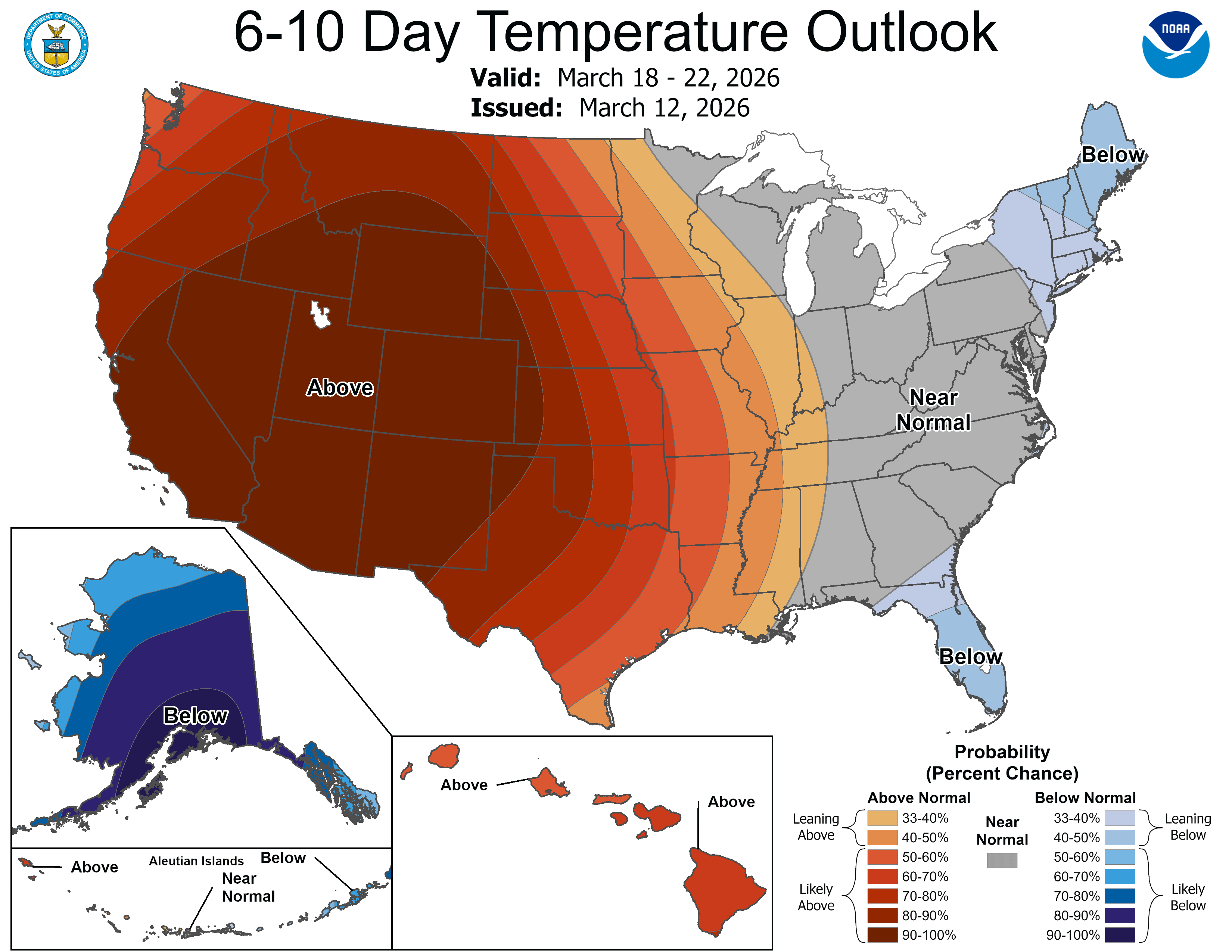
A brief cold spell in the Northeast and Midcontinent around March 16–18 could temporarily boost heating demand and lead to another small withdrawal. However, with warmer weather expected to return soon after, analysts believe storage levels could move into a triple-digit surplus versus the five-year average by April, increasing the likelihood of bearish price pressure in the coming weeks.
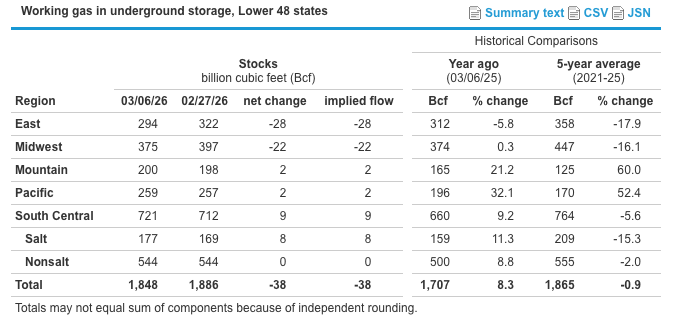
EIA Storage: Working gas in storage totaled 1,848 Bcf as of Friday, March 6, 2026, according to EIA estimates, reflecting a 38 Bcf decline from the previous week. Storage levels were 141 Bcf higher than the same time last year but 17 Bcf below the five-year average of 1,865 Bcf. Overall, inventories remain within the five-year historical range.
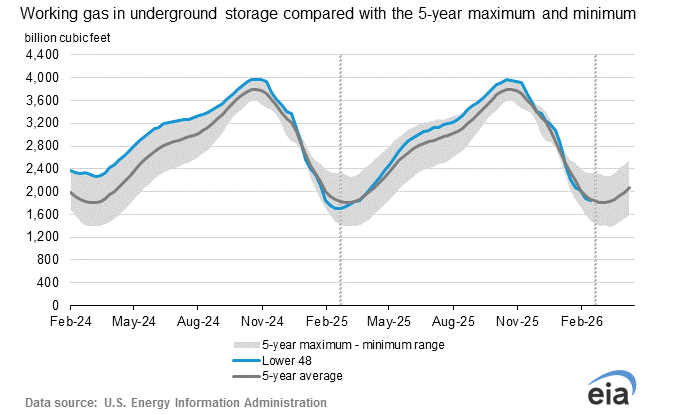
Note: The shaded area indicates the range between the historical minimum and maximum values for the weekly series from 2021 through 2025. The dashed vertical lines indicate current and year-ago weekly periods.
Weather: The current El Niño–Southern Oscillation (ENSO) pattern is expected to transition to a neutral phase around April. ENSO refers to periodic shifts in ocean temperatures and atmospheric conditions across the equatorial Pacific that influence global weather patterns. When ENSO moves into a neutral phase, neither El Niño nor La Niña conditions dominate. Transition periods like this often bring more active weather patterns, particularly in the Mid-Mississippi Valley.
Another factor that could contribute to a more active April is the Madden–Julian Oscillation (MJO). The MJO is a large-scale tropical weather pattern that moves eastward around the globe near the equator. It features alternating periods of enhanced rainfall and thunderstorms followed by quieter, drier conditions. This pattern typically circles the Earth every 30–60 days, influencing tropical weather and occasionally impacting weather patterns in the United States. Midwest Weather. “April Interesting Outlook.” Midwest Weather (Substack), 2026. Subscriber-only newsletter.
Market Data:
March 13, 2026

Weekly Energy News
March 13, 2026
Market Commentary: NYMEX prompt-month natural gas futures rose on March 12, even after the U.S. Energy Information Administration (EIA) reported a weaker-than-expected storage withdrawal. For the week ending March 6, U.S. natural gas inventories declined by 38 billion cubic feet (Bcf), below the consensus estimate of a 43 Bcf withdrawal from the March 10 gas storage survey compiled by S&P Global Commodity Insights.
The reported withdrawal was also smaller than both the five-year average and the draw recorded during the same week last year, which were each 64 Bcf. As a result, the storage deficit compared to the five-year average narrowed to 17 Bcf, or just under 1 percent, while the surplus compared to 2025 levels expanded to 141 Bcf, or more than 8 percent.
Despite the bearish storage data, NYMEX Henry Hub April futures moved higher, trading at $3.25 per million British thermal units in late afternoon trading—up 4 cents from the previous settlement, according to CME Group intraday data.
Analysts noted that natural gas prices have recently been influenced by rising global oil prices amid significant supply disruptions tied to conflict in the Middle East. While U.S. natural gas fundamentals have limited direct exposure to the situation, analysts say ongoing correlations with oil markets and increased financial investment in the broader energy sector are creating short-term bullish pressure on prices.
April 2026 NYMEX closed Thursday at $3.233
· High for the day $3.292
· Low for the day $3.145
Early trading for the prompt month is trading at $3.227
· https://www.cmegroup.com/markets/energy/natural-gas/natural-gas.html
· https://www.fxempire.com/commodities/natural-gas
Outlook: Milder weather could lead to an early storage injection this week, potentially pushing U.S. natural gas inventories into a surplus compared to the five-year average. S&P Global Energy CERA models project 38–45 Bcf of injections for the week ending March 13, compared to the five-year average withdrawal of 29 Bcf and a 1 Bcf withdrawal during the same week last year.
Demand has declined significantly, with residential and commercial demand falling to 29.6 Bcf/d in the week ending March 6 and dropping further to 20.3 Bcf/d between March 7–12. During that period, total demand averaged just over 106 Bcf/d, while supply remained near 112 Bcf/d.
A brief cold spell in the Northeast and Midcontinent around March 16–18 could temporarily boost heating demand and lead to another small withdrawal. However, with warmer weather expected to return soon after, analysts believe storage levels could move into a triple-digit surplus versus the five-year average by April, increasing the likelihood of bearish price pressure in the coming weeks.
EIA Storage: Working gas in storage totaled 1,848 Bcf as of Friday, March 6, 2026, according to EIA estimates, reflecting a 38 Bcf decline from the previous week. Storage levels were 141 Bcf higher than the same time last year but 17 Bcf below the five-year average of 1,865 Bcf. Overall, inventories remain within the five-year historical range.
Note: The shaded area indicates the range between the historical minimum and maximum values for the weekly series from 2021 through 2025. The dashed vertical lines indicate current and year-ago weekly periods.
Weather: The current El Niño–Southern Oscillation (ENSO) pattern is expected to transition to a neutral phase around April. ENSO refers to periodic shifts in ocean temperatures and atmospheric conditions across the equatorial Pacific that influence global weather patterns. When ENSO moves into a neutral phase, neither El Niño nor La Niña conditions dominate. Transition periods like this often bring more active weather patterns, particularly in the Mid-Mississippi Valley.
Another factor that could contribute to a more active April is the Madden–Julian Oscillation (MJO). The MJO is a large-scale tropical weather pattern that moves eastward around the globe near the equator. It features alternating periods of enhanced rainfall and thunderstorms followed by quieter, drier conditions. This pattern typically circles the Earth every 30–60 days, influencing tropical weather and occasionally impacting weather patterns in the United States. Midwest Weather. “April Interesting Outlook.” Midwest Weather (Substack), 2026. Subscriber-only newsletter.
Market Data:
March 13, 2026
March 13, 2026
Weekly Energy News
Market Commentary: NYMEX prompt-month natural gas futures rose on March 12, even after the U.S. Energy Information Administration (EIA) reported a weaker-than-expected storage withdrawal. For the week ending March 6, U.S. natural gas inventories declined by 38 billion cubic feet (Bcf), below the consensus estimate of a 43 Bcf withdrawal from the March 10 gas storage survey compiled by S&P Global Commodity Insights.
The reported withdrawal was also smaller than both the five-year average and the draw recorded during the same week last year, which were each 64 Bcf. As a result, the storage deficit compared to the five-year average narrowed to 17 Bcf, or just under 1 percent, while the surplus compared to 2025 levels expanded to 141 Bcf, or more than 8 percent.
Despite the bearish storage data, NYMEX Henry Hub April futures moved higher, trading at $3.25 per million British thermal units in late afternoon trading—up 4 cents from the previous settlement, according to CME Group intraday data.
Analysts noted that natural gas prices have recently been influenced by rising global oil prices amid significant supply disruptions tied to conflict in the Middle East. While U.S. natural gas fundamentals have limited direct exposure to the situation, analysts say ongoing correlations with oil markets and increased financial investment in the broader energy sector are creating short-term bullish pressure on prices.
April 2026 NYMEX closed Thursday at $3.233
· High for the day $3.292
· Low for the day $3.145
Early trading for the prompt month is trading at $3.227
· https://www.cmegroup.com/markets/energy/natural-gas/natural-gas.html
· https://www.fxempire.com/commodities/natural-gas
Outlook: Milder weather could lead to an early storage injection this week, potentially pushing U.S. natural gas inventories into a surplus compared to the five-year average. S&P Global Energy CERA models project 38–45 Bcf of injections for the week ending March 13, compared to the five-year average withdrawal of 29 Bcf and a 1 Bcf withdrawal during the same week last year.
Demand has declined significantly, with residential and commercial demand falling to 29.6 Bcf/d in the week ending March 6 and dropping further to 20.3 Bcf/d between March 7–12. During that period, total demand averaged just over 106 Bcf/d, while supply remained near 112 Bcf/d.
A brief cold spell in the Northeast and Midcontinent around March 16–18 could temporarily boost heating demand and lead to another small withdrawal. However, with warmer weather expected to return soon after, analysts believe storage levels could move into a triple-digit surplus versus the five-year average by April, increasing the likelihood of bearish price pressure in the coming weeks.
EIA Storage: Working gas in storage totaled 1,848 Bcf as of Friday, March 6, 2026, according to EIA estimates, reflecting a 38 Bcf decline from the previous week. Storage levels were 141 Bcf higher than the same time last year but 17 Bcf below the five-year average of 1,865 Bcf. Overall, inventories remain within the five-year historical range.
Note: The shaded area indicates the range between the historical minimum and maximum values for the weekly series from 2021 through 2025. The dashed vertical lines indicate current and year-ago weekly periods.
Weather: The current El Niño–Southern Oscillation (ENSO) pattern is expected to transition to a neutral phase around April. ENSO refers to periodic shifts in ocean temperatures and atmospheric conditions across the equatorial Pacific that influence global weather patterns. When ENSO moves into a neutral phase, neither El Niño nor La Niña conditions dominate. Transition periods like this often bring more active weather patterns, particularly in the Mid-Mississippi Valley.
Another factor that could contribute to a more active April is the Madden–Julian Oscillation (MJO). The MJO is a large-scale tropical weather pattern that moves eastward around the globe near the equator. It features alternating periods of enhanced rainfall and thunderstorms followed by quieter, drier conditions. This pattern typically circles the Earth every 30–60 days, influencing tropical weather and occasionally impacting weather patterns in the United States. Midwest Weather. “April Interesting Outlook.” Midwest Weather (Substack), 2026. Subscriber-only newsletter.
March 13, 2026
Weekly Energy News
Market Commentary: NYMEX prompt-month natural gas futures rose on March 12, even after the U.S. Energy Information Administration (EIA) reported a weaker-than-expected storage withdrawal. For the week ending March 6, U.S. natural gas inventories declined by 38 billion cubic feet (Bcf), below the consensus estimate of a 43 Bcf withdrawal from the March 10 gas storage survey compiled by S&P Global Commodity Insights.
The reported withdrawal was also smaller than both the five-year average and the draw recorded during the same week last year, which were each 64 Bcf. As a result, the storage deficit compared to the five-year average narrowed to 17 Bcf, or just under 1 percent, while the surplus compared to 2025 levels expanded to 141 Bcf, or more than 8 percent.
Despite the bearish storage data, NYMEX Henry Hub April futures moved higher, trading at $3.25 per million British thermal units in late afternoon trading—up 4 cents from the previous settlement, according to CME Group intraday data.
Analysts noted that natural gas prices have recently been influenced by rising global oil prices amid significant supply disruptions tied to conflict in the Middle East. While U.S. natural gas fundamentals have limited direct exposure to the situation, analysts say ongoing correlations with oil markets and increased financial investment in the broader energy sector are creating short-term bullish pressure on prices.
April 2026 NYMEX closed Thursday at $3.233
· High for the day $3.292
· Low for the day $3.145
Early trading for the prompt month is trading at $3.227
· https://www.cmegroup.com/markets/energy/natural-gas/natural-gas.html
· https://www.fxempire.com/commodities/natural-gas
Outlook: Milder weather could lead to an early storage injection this week, potentially pushing U.S. natural gas inventories into a surplus compared to the five-year average. S&P Global Energy CERA models project 38–45 Bcf of injections for the week ending March 13, compared to the five-year average withdrawal of 29 Bcf and a 1 Bcf withdrawal during the same week last year.
Demand has declined significantly, with residential and commercial demand falling to 29.6 Bcf/d in the week ending March 6 and dropping further to 20.3 Bcf/d between March 7–12. During that period, total demand averaged just over 106 Bcf/d, while supply remained near 112 Bcf/d.
A brief cold spell in the Northeast and Midcontinent around March 16–18 could temporarily boost heating demand and lead to another small withdrawal. However, with warmer weather expected to return soon after, analysts believe storage levels could move into a triple-digit surplus versus the five-year average by April, increasing the likelihood of bearish price pressure in the coming weeks.
EIA Storage: Working gas in storage totaled 1,848 Bcf as of Friday, March 6, 2026, according to EIA estimates, reflecting a 38 Bcf decline from the previous week. Storage levels were 141 Bcf higher than the same time last year but 17 Bcf below the five-year average of 1,865 Bcf. Overall, inventories remain within the five-year historical range.
Note: The shaded area indicates the range between the historical minimum and maximum values for the weekly series from 2021 through 2025. The dashed vertical lines indicate current and year-ago weekly periods.
Weather: The current El Niño–Southern Oscillation (ENSO) pattern is expected to transition to a neutral phase around April. ENSO refers to periodic shifts in ocean temperatures and atmospheric conditions across the equatorial Pacific that influence global weather patterns. When ENSO moves into a neutral phase, neither El Niño nor La Niña conditions dominate. Transition periods like this often bring more active weather patterns, particularly in the Mid-Mississippi Valley.
Another factor that could contribute to a more active April is the Madden–Julian Oscillation (MJO). The MJO is a large-scale tropical weather pattern that moves eastward around the globe near the equator. It features alternating periods of enhanced rainfall and thunderstorms followed by quieter, drier conditions. This pattern typically circles the Earth every 30–60 days, influencing tropical weather and occasionally impacting weather patterns in the United States. Midwest Weather. “April Interesting Outlook.” Midwest Weather (Substack), 2026. Subscriber-only newsletter.
March 13, 2026
Weekly Energy News
Market Commentary: NYMEX prompt-month natural gas futures rose on March 12, even after the U.S. Energy Information Administration (EIA) reported a weaker-than-expected storage withdrawal. For the week ending March 6, U.S. natural gas inventories declined by 38 billion cubic feet (Bcf), below the consensus estimate of a 43 Bcf withdrawal from the March 10 gas storage survey compiled by S&P Global Commodity Insights.
The reported withdrawal was also smaller than both the five-year average and the draw recorded during the same week last year, which were each 64 Bcf. As a result, the storage deficit compared to the five-year average narrowed to 17 Bcf, or just under 1 percent, while the surplus compared to 2025 levels expanded to 141 Bcf, or more than 8 percent.
Despite the bearish storage data, NYMEX Henry Hub April futures moved higher, trading at $3.25 per million British thermal units in late afternoon trading—up 4 cents from the previous settlement, according to CME Group intraday data.
Analysts noted that natural gas prices have recently been influenced by rising global oil prices amid significant supply disruptions tied to conflict in the Middle East. While U.S. natural gas fundamentals have limited direct exposure to the situation, analysts say ongoing correlations with oil markets and increased financial investment in the broader energy sector are creating short-term bullish pressure on prices.
April 2026 NYMEX closed Thursday at $3.233
· High for the day $3.292
· Low for the day $3.145
Early trading for the prompt month is trading at $3.227
· https://www.cmegroup.com/markets/energy/natural-gas/natural-gas.html
· https://www.fxempire.com/commodities/natural-gas
Outlook: Milder weather could lead to an early storage injection this week, potentially pushing U.S. natural gas inventories into a surplus compared to the five-year average. S&P Global Energy CERA models project 38–45 Bcf of injections for the week ending March 13, compared to the five-year average withdrawal of 29 Bcf and a 1 Bcf withdrawal during the same week last year.
Demand has declined significantly, with residential and commercial demand falling to 29.6 Bcf/d in the week ending March 6 and dropping further to 20.3 Bcf/d between March 7–12. During that period, total demand averaged just over 106 Bcf/d, while supply remained near 112 Bcf/d.
A brief cold spell in the Northeast and Midcontinent around March 16–18 could temporarily boost heating demand and lead to another small withdrawal. However, with warmer weather expected to return soon after, analysts believe storage levels could move into a triple-digit surplus versus the five-year average by April, increasing the likelihood of bearish price pressure in the coming weeks.
EIA Storage: Working gas in storage totaled 1,848 Bcf as of Friday, March 6, 2026, according to EIA estimates, reflecting a 38 Bcf decline from the previous week. Storage levels were 141 Bcf higher than the same time last year but 17 Bcf below the five-year average of 1,865 Bcf. Overall, inventories remain within the five-year historical range.
Note: The shaded area indicates the range between the historical minimum and maximum values for the weekly series from 2021 through 2025. The dashed vertical lines indicate current and year-ago weekly periods.
Weather: The current El Niño–Southern Oscillation (ENSO) pattern is expected to transition to a neutral phase around April. ENSO refers to periodic shifts in ocean temperatures and atmospheric conditions across the equatorial Pacific that influence global weather patterns. When ENSO moves into a neutral phase, neither El Niño nor La Niña conditions dominate. Transition periods like this often bring more active weather patterns, particularly in the Mid-Mississippi Valley.
Another factor that could contribute to a more active April is the Madden–Julian Oscillation (MJO). The MJO is a large-scale tropical weather pattern that moves eastward around the globe near the equator. It features alternating periods of enhanced rainfall and thunderstorms followed by quieter, drier conditions. This pattern typically circles the Earth every 30–60 days, influencing tropical weather and occasionally impacting weather patterns in the United States. Midwest Weather. “April Interesting Outlook.” Midwest Weather (Substack), 2026. Subscriber-only newsletter.

March 13, 2026
Market Commentary: NYMEX prompt-month natural gas futures rose on March 12, even after the U.S. Energy Information Administration (EIA) reported a weaker-than-expected storage withdrawal. For the week ending March 6, U.S. natural gas inventories declined by 38 billion cubic feet (Bcf), below the consensus estimate of a 43 Bcf withdrawal from the March 10 gas storage survey compiled by S&P Global Commodity Insights.
The reported withdrawal was also smaller than both the five-year average and the draw recorded during the same week last year, which were each 64 Bcf. As a result, the storage deficit compared to the five-year average narrowed to 17 Bcf, or just under 1 percent, while the surplus compared to 2025 levels expanded to 141 Bcf, or more than 8 percent.
Despite the bearish storage data, NYMEX Henry Hub April futures moved higher, trading at $3.25 per million British thermal units in late afternoon trading—up 4 cents from the previous settlement, according to CME Group intraday data.
Analysts noted that natural gas prices have recently been influenced by rising global oil prices amid significant supply disruptions tied to conflict in the Middle East. While U.S. natural gas fundamentals have limited direct exposure to the situation, analysts say ongoing correlations with oil markets and increased financial investment in the broader energy sector are creating short-term bullish pressure on prices.
April 2026 NYMEX closed Thursday at $3.233
· High for the day $3.292
· Low for the day $3.145
Early trading for the prompt month is trading at $3.227
· https://www.cmegroup.com/markets/energy/natural-gas/natural-gas.html
· https://www.fxempire.com/commodities/natural-gas
Outlook: Milder weather could lead to an early storage injection this week, potentially pushing U.S. natural gas inventories into a surplus compared to the five-year average. S&P Global Energy CERA models project 38–45 Bcf of injections for the week ending March 13, compared to the five-year average withdrawal of 29 Bcf and a 1 Bcf withdrawal during the same week last year.
Demand has declined significantly, with residential and commercial demand falling to 29.6 Bcf/d in the week ending March 6 and dropping further to 20.3 Bcf/d between March 7–12. During that period, total demand averaged just over 106 Bcf/d, while supply remained near 112 Bcf/d.
A brief cold spell in the Northeast and Midcontinent around March 16–18 could temporarily boost heating demand and lead to another small withdrawal. However, with warmer weather expected to return soon after, analysts believe storage levels could move into a triple-digit surplus versus the five-year average by April, increasing the likelihood of bearish price pressure in the coming weeks.
EIA Storage: Working gas in storage totaled 1,848 Bcf as of Friday, March 6, 2026, according to EIA estimates, reflecting a 38 Bcf decline from the previous week. Storage levels were 141 Bcf higher than the same time last year but 17 Bcf below the five-year average of 1,865 Bcf. Overall, inventories remain within the five-year historical range.
Note: The shaded area indicates the range between the historical minimum and maximum values for the weekly series from 2021 through 2025. The dashed vertical lines indicate current and year-ago weekly periods.
Weather: The current El Niño–Southern Oscillation (ENSO) pattern is expected to transition to a neutral phase around April. ENSO refers to periodic shifts in ocean temperatures and atmospheric conditions across the equatorial Pacific that influence global weather patterns. When ENSO moves into a neutral phase, neither El Niño nor La Niña conditions dominate. Transition periods like this often bring more active weather patterns, particularly in the Mid-Mississippi Valley.
Another factor that could contribute to a more active April is the Madden–Julian Oscillation (MJO). The MJO is a large-scale tropical weather pattern that moves eastward around the globe near the equator. It features alternating periods of enhanced rainfall and thunderstorms followed by quieter, drier conditions. This pattern typically circles the Earth every 30–60 days, influencing tropical weather and occasionally impacting weather patterns in the United States. Midwest Weather. “April Interesting Outlook.” Midwest Weather (Substack), 2026. Subscriber-only newsletter.
March 13, 2026
Weekly Energy News
Market Commentary: NYMEX prompt-month natural gas futures rose on March 12, even after the U.S. Energy Information Administration (EIA) reported a weaker-than-expected storage withdrawal. For the week ending March 6, U.S. natural gas inventories declined by 38 billion cubic feet (Bcf), below the consensus estimate of a 43 Bcf withdrawal from the March 10 gas storage survey compiled by S&P Global Commodity Insights.
The reported withdrawal was also smaller than both the five-year average and the draw recorded during the same week last year, which were each 64 Bcf. As a result, the storage deficit compared to the five-year average narrowed to 17 Bcf, or just under 1 percent, while the surplus compared to 2025 levels expanded to 141 Bcf, or more than 8 percent.
Despite the bearish storage data, NYMEX Henry Hub April futures moved higher, trading at $3.25 per million British thermal units in late afternoon trading—up 4 cents from the previous settlement, according to CME Group intraday data.
Analysts noted that natural gas prices have recently been influenced by rising global oil prices amid significant supply disruptions tied to conflict in the Middle East. While U.S. natural gas fundamentals have limited direct exposure to the situation, analysts say ongoing correlations with oil markets and increased financial investment in the broader energy sector are creating short-term bullish pressure on prices.
April 2026 NYMEX closed Thursday at $3.233
· High for the day $3.292
· Low for the day $3.145
Early trading for the prompt month is trading at $3.227
· https://www.cmegroup.com/markets/energy/natural-gas/natural-gas.html
· https://www.fxempire.com/commodities/natural-gas
Outlook: Milder weather could lead to an early storage injection this week, potentially pushing U.S. natural gas inventories into a surplus compared to the five-year average. S&P Global Energy CERA models project 38–45 Bcf of injections for the week ending March 13, compared to the five-year average withdrawal of 29 Bcf and a 1 Bcf withdrawal during the same week last year.
Demand has declined significantly, with residential and commercial demand falling to 29.6 Bcf/d in the week ending March 6 and dropping further to 20.3 Bcf/d between March 7–12. During that period, total demand averaged just over 106 Bcf/d, while supply remained near 112 Bcf/d.
A brief cold spell in the Northeast and Midcontinent around March 16–18 could temporarily boost heating demand and lead to another small withdrawal. However, with warmer weather expected to return soon after, analysts believe storage levels could move into a triple-digit surplus versus the five-year average by April, increasing the likelihood of bearish price pressure in the coming weeks.
EIA Storage: Working gas in storage totaled 1,848 Bcf as of Friday, March 6, 2026, according to EIA estimates, reflecting a 38 Bcf decline from the previous week. Storage levels were 141 Bcf higher than the same time last year but 17 Bcf below the five-year average of 1,865 Bcf. Overall, inventories remain within the five-year historical range.
Note: The shaded area indicates the range between the historical minimum and maximum values for the weekly series from 2021 through 2025. The dashed vertical lines indicate current and year-ago weekly periods.
Weather: The current El Niño–Southern Oscillation (ENSO) pattern is expected to transition to a neutral phase around April. ENSO refers to periodic shifts in ocean temperatures and atmospheric conditions across the equatorial Pacific that influence global weather patterns. When ENSO moves into a neutral phase, neither El Niño nor La Niña conditions dominate. Transition periods like this often bring more active weather patterns, particularly in the Mid-Mississippi Valley.
Another factor that could contribute to a more active April is the Madden–Julian Oscillation (MJO). The MJO is a large-scale tropical weather pattern that moves eastward around the globe near the equator. It features alternating periods of enhanced rainfall and thunderstorms followed by quieter, drier conditions. This pattern typically circles the Earth every 30–60 days, influencing tropical weather and occasionally impacting weather patterns in the United States. Midwest Weather. “April Interesting Outlook.” Midwest Weather (Substack), 2026. Subscriber-only newsletter.
March 13, 2026
Weekly Energy News
Market Commentary: NYMEX prompt-month natural gas futures rose on March 12, even after the U.S. Energy Information Administration (EIA) reported a weaker-than-expected storage withdrawal. For the week ending March 6, U.S. natural gas inventories declined by 38 billion cubic feet (Bcf), below the consensus estimate of a 43 Bcf withdrawal from the March 10 gas storage survey compiled by S&P Global Commodity Insights.
The reported withdrawal was also smaller than both the five-year average and the draw recorded during the same week last year, which were each 64 Bcf. As a result, the storage deficit compared to the five-year average narrowed to 17 Bcf, or just under 1 percent, while the surplus compared to 2025 levels expanded to 141 Bcf, or more than 8 percent.
Despite the bearish storage data, NYMEX Henry Hub April futures moved higher, trading at $3.25 per million British thermal units in late afternoon trading—up 4 cents from the previous settlement, according to CME Group intraday data.
Analysts noted that natural gas prices have recently been influenced by rising global oil prices amid significant supply disruptions tied to conflict in the Middle East. While U.S. natural gas fundamentals have limited direct exposure to the situation, analysts say ongoing correlations with oil markets and increased financial investment in the broader energy sector are creating short-term bullish pressure on prices.
April 2026 NYMEX closed Thursday at $3.233
· High for the day $3.292
· Low for the day $3.145
Early trading for the prompt month is trading at $3.227
· https://www.cmegroup.com/markets/energy/natural-gas/natural-gas.html
· https://www.fxempire.com/commodities/natural-gas
Outlook: Milder weather could lead to an early storage injection this week, potentially pushing U.S. natural gas inventories into a surplus compared to the five-year average. S&P Global Energy CERA models project 38–45 Bcf of injections for the week ending March 13, compared to the five-year average withdrawal of 29 Bcf and a 1 Bcf withdrawal during the same week last year.
Demand has declined significantly, with residential and commercial demand falling to 29.6 Bcf/d in the week ending March 6 and dropping further to 20.3 Bcf/d between March 7–12. During that period, total demand averaged just over 106 Bcf/d, while supply remained near 112 Bcf/d.
A brief cold spell in the Northeast and Midcontinent around March 16–18 could temporarily boost heating demand and lead to another small withdrawal. However, with warmer weather expected to return soon after, analysts believe storage levels could move into a triple-digit surplus versus the five-year average by April, increasing the likelihood of bearish price pressure in the coming weeks.
EIA Storage: Working gas in storage totaled 1,848 Bcf as of Friday, March 6, 2026, according to EIA estimates, reflecting a 38 Bcf decline from the previous week. Storage levels were 141 Bcf higher than the same time last year but 17 Bcf below the five-year average of 1,865 Bcf. Overall, inventories remain within the five-year historical range.
Note: The shaded area indicates the range between the historical minimum and maximum values for the weekly series from 2021 through 2025. The dashed vertical lines indicate current and year-ago weekly periods.
Weather: The current El Niño–Southern Oscillation (ENSO) pattern is expected to transition to a neutral phase around April. ENSO refers to periodic shifts in ocean temperatures and atmospheric conditions across the equatorial Pacific that influence global weather patterns. When ENSO moves into a neutral phase, neither El Niño nor La Niña conditions dominate. Transition periods like this often bring more active weather patterns, particularly in the Mid-Mississippi Valley.
Another factor that could contribute to a more active April is the Madden–Julian Oscillation (MJO). The MJO is a large-scale tropical weather pattern that moves eastward around the globe near the equator. It features alternating periods of enhanced rainfall and thunderstorms followed by quieter, drier conditions. This pattern typically circles the Earth every 30–60 days, influencing tropical weather and occasionally impacting weather patterns in the United States. Midwest Weather. “April Interesting Outlook.” Midwest Weather (Substack), 2026. Subscriber-only newsletter.
Make Your Choice Gas Selection in Three Easy Steps
Click here to access our online tool, or call our Choice gas commodity experts at 1 (877) 790-4990.
Step 1: Enter your account number
- Your Black Hills Energy account number is located at the top right-hand corner of your bill.
Step 2: Review price options and make your selection
Step 3: Confirm your selection and enter your control number
- You received a control number in your 2026 Choice Gas selection packet mailed to you from Black Hills Energy. If you cannot locate this, you can retrieve your control number by calling 877-245-3506 or visit choicegas.com
Once enrolled, you will be removed from supplier marketing communications within 24 hours.


Sign Up for Our Energy Newsletters
Sign UpRecent Posts