June 5, 2026
Weekly Energy News
Market Update: Natural gas prices moved higher Thursday after the government’s weekly storage report showed a smaller-than-expected build. The report was bullish on two counts: the injection came in below the five-year average and — for the first time this season — total storage dipped below where it was a year ago. That shift has been building all spring, as last year’s unusually large storage builds set a tough bar to match. With summer heat now arriving and demand for gas-fired power picking up, the market is starting to price in a tighter balance ahead.
July 2026 NYMEX was trading at $3.34/MMBtu Thursday afternoon, up 13 cents from the prior settlement
· High for the day $3.34
· Low for the day $3.22
Early trading for the prompt month:
· https://www.cmegroup.com/markets/energy/natural-gas/natural-gas.html
· https://www.fxempire.com/commodities/natural-gas
After an initial dip right after the storage release, July futures quickly recovered and finished the day up 13 cents. Much of that strength came from the year-over-year story: as recently as April 17, US gas inventories were 142 Bcf above last year’s level. This week, that cushion is completely gone — storage is now 3 Bcf below where it was in 2025. The shift reflects last spring’s unusually large injections, which set a high bar this year’s more modest builds simply couldn’t clear. On the supply side, Cameron LNG in Louisiana wrapped up scheduled maintenance on June 4, helping push overall US feedgas demand back toward 18 Bcf/d after it dipped to a January low just two days earlier.
Looking ahead, the focus shifts to weather. June heat is expected to push power demand higher, which will slow the pace of storage builds and likely keep prices supported heading into the heart of summer.
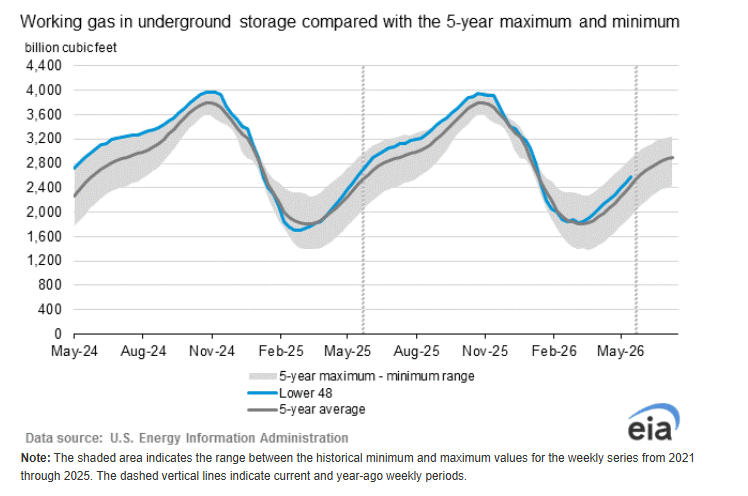
EIA Storage Report: According to the EIA, working natural gas in storage totaled 2,578 Bcf as of May 29, 2026, reflecting a 95 Bcf increase from the prior week. That injection came in below the five-year average of 101 Bcf and well below the year-ago addition of 119 Bcf, and was 4 Bcf short of the Platts consensus estimate. Total storage is now 138 Bcf above the five-year average but 3 Bcf below year-ago levels — the first week this injection season that inventories have slipped below 2025 levels. Overall inventories remain within the historical five-year range.

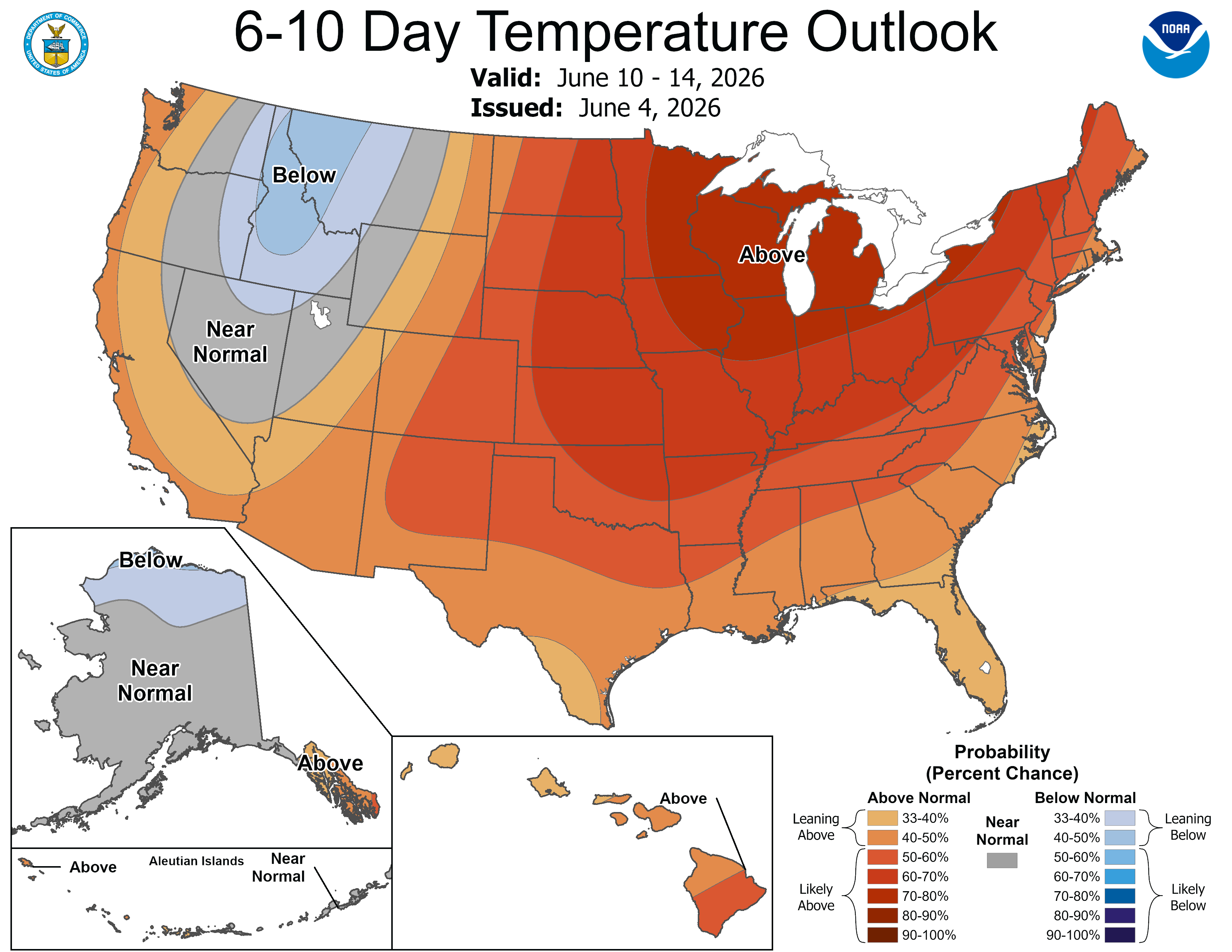
Weather: NOAA’s latest long-range outlook calls for above-normal temperatures across most of the country this summer. The strongest heat signal is over the West and Rockies, where there is a 60–70% chance of above-normal temperatures for May through July. The interior Southeast also leans warm. The northern Plains, Upper Midwest, and Great Lakes are the one area where the outlook is less certain, with equal chances of above-, near-, or below-normal temperatures. El Niño is expected to develop this summer and strengthen through the end of 2026, which typically brings hotter, drier conditions to much of the US and tends to keep Atlantic hurricane activity below normal.
Market Data:
June 5, 2026

Weekly Energy News
June 5, 2026
Market Update: Natural gas prices moved higher Thursday after the government’s weekly storage report showed a smaller-than-expected build. The report was bullish on two counts: the injection came in below the five-year average and — for the first time this season — total storage dipped below where it was a year ago. That shift has been building all spring, as last year’s unusually large storage builds set a tough bar to match. With summer heat now arriving and demand for gas-fired power picking up, the market is starting to price in a tighter balance ahead.
July 2026 NYMEX was trading at $3.34/MMBtu Thursday afternoon, up 13 cents from the prior settlement
· High for the day $3.34
· Low for the day $3.22
Early trading for the prompt month:
· https://www.cmegroup.com/markets/energy/natural-gas/natural-gas.html
· https://www.fxempire.com/commodities/natural-gas
After an initial dip right after the storage release, July futures quickly recovered and finished the day up 13 cents. Much of that strength came from the year-over-year story: as recently as April 17, US gas inventories were 142 Bcf above last year’s level. This week, that cushion is completely gone — storage is now 3 Bcf below where it was in 2025. The shift reflects last spring’s unusually large injections, which set a high bar this year’s more modest builds simply couldn’t clear. On the supply side, Cameron LNG in Louisiana wrapped up scheduled maintenance on June 4, helping push overall US feedgas demand back toward 18 Bcf/d after it dipped to a January low just two days earlier.
Looking ahead, the focus shifts to weather. June heat is expected to push power demand higher, which will slow the pace of storage builds and likely keep prices supported heading into the heart of summer.
EIA Storage Report: According to the EIA, working natural gas in storage totaled 2,578 Bcf as of May 29, 2026, reflecting a 95 Bcf increase from the prior week. That injection came in below the five-year average of 101 Bcf and well below the year-ago addition of 119 Bcf, and was 4 Bcf short of the Platts consensus estimate. Total storage is now 138 Bcf above the five-year average but 3 Bcf below year-ago levels — the first week this injection season that inventories have slipped below 2025 levels. Overall inventories remain within the historical five-year range.
Weather: NOAA’s latest long-range outlook calls for above-normal temperatures across most of the country this summer. The strongest heat signal is over the West and Rockies, where there is a 60–70% chance of above-normal temperatures for May through July. The interior Southeast also leans warm. The northern Plains, Upper Midwest, and Great Lakes are the one area where the outlook is less certain, with equal chances of above-, near-, or below-normal temperatures. El Niño is expected to develop this summer and strengthen through the end of 2026, which typically brings hotter, drier conditions to much of the US and tends to keep Atlantic hurricane activity below normal.
Market Data:
June 5, 2026
June 5, 2026
Weekly Energy News
Market Update: Natural gas prices moved higher Thursday after the government’s weekly storage report showed a smaller-than-expected build. The report was bullish on two counts: the injection came in below the five-year average and — for the first time this season — total storage dipped below where it was a year ago. That shift has been building all spring, as last year’s unusually large storage builds set a tough bar to match. With summer heat now arriving and demand for gas-fired power picking up, the market is starting to price in a tighter balance ahead.
July 2026 NYMEX was trading at $3.34/MMBtu Thursday afternoon, up 13 cents from the prior settlement
· High for the day $3.34
· Low for the day $3.22
Early trading for the prompt month:
· https://www.cmegroup.com/markets/energy/natural-gas/natural-gas.html
· https://www.fxempire.com/commodities/natural-gas
After an initial dip right after the storage release, July futures quickly recovered and finished the day up 13 cents. Much of that strength came from the year-over-year story: as recently as April 17, US gas inventories were 142 Bcf above last year’s level. This week, that cushion is completely gone — storage is now 3 Bcf below where it was in 2025. The shift reflects last spring’s unusually large injections, which set a high bar this year’s more modest builds simply couldn’t clear. On the supply side, Cameron LNG in Louisiana wrapped up scheduled maintenance on June 4, helping push overall US feedgas demand back toward 18 Bcf/d after it dipped to a January low just two days earlier.
Looking ahead, the focus shifts to weather. June heat is expected to push power demand higher, which will slow the pace of storage builds and likely keep prices supported heading into the heart of summer.
EIA Storage Report: According to the EIA, working natural gas in storage totaled 2,578 Bcf as of May 29, 2026, reflecting a 95 Bcf increase from the prior week. That injection came in below the five-year average of 101 Bcf and well below the year-ago addition of 119 Bcf, and was 4 Bcf short of the Platts consensus estimate. Total storage is now 138 Bcf above the five-year average but 3 Bcf below year-ago levels — the first week this injection season that inventories have slipped below 2025 levels. Overall inventories remain within the historical five-year range.
Weather: NOAA’s latest long-range outlook calls for above-normal temperatures across most of the country this summer. The strongest heat signal is over the West and Rockies, where there is a 60–70% chance of above-normal temperatures for May through July. The interior Southeast also leans warm. The northern Plains, Upper Midwest, and Great Lakes are the one area where the outlook is less certain, with equal chances of above-, near-, or below-normal temperatures. El Niño is expected to develop this summer and strengthen through the end of 2026, which typically brings hotter, drier conditions to much of the US and tends to keep Atlantic hurricane activity below normal.
June 5, 2026
Weekly Energy News
Market Update: Natural gas prices moved higher Thursday after the government’s weekly storage report showed a smaller-than-expected build. The report was bullish on two counts: the injection came in below the five-year average and — for the first time this season — total storage dipped below where it was a year ago. That shift has been building all spring, as last year’s unusually large storage builds set a tough bar to match. With summer heat now arriving and demand for gas-fired power picking up, the market is starting to price in a tighter balance ahead.
July 2026 NYMEX was trading at $3.34/MMBtu Thursday afternoon, up 13 cents from the prior settlement
· High for the day $3.34
· Low for the day $3.22
Early trading for the prompt month:
· https://www.cmegroup.com/markets/energy/natural-gas/natural-gas.html
· https://www.fxempire.com/commodities/natural-gas
After an initial dip right after the storage release, July futures quickly recovered and finished the day up 13 cents. Much of that strength came from the year-over-year story: as recently as April 17, US gas inventories were 142 Bcf above last year’s level. This week, that cushion is completely gone — storage is now 3 Bcf below where it was in 2025. The shift reflects last spring’s unusually large injections, which set a high bar this year’s more modest builds simply couldn’t clear. On the supply side, Cameron LNG in Louisiana wrapped up scheduled maintenance on June 4, helping push overall US feedgas demand back toward 18 Bcf/d after it dipped to a January low just two days earlier.
Looking ahead, the focus shifts to weather. June heat is expected to push power demand higher, which will slow the pace of storage builds and likely keep prices supported heading into the heart of summer.
EIA Storage Report: According to the EIA, working natural gas in storage totaled 2,578 Bcf as of May 29, 2026, reflecting a 95 Bcf increase from the prior week. That injection came in below the five-year average of 101 Bcf and well below the year-ago addition of 119 Bcf, and was 4 Bcf short of the Platts consensus estimate. Total storage is now 138 Bcf above the five-year average but 3 Bcf below year-ago levels — the first week this injection season that inventories have slipped below 2025 levels. Overall inventories remain within the historical five-year range.
Weather: NOAA’s latest long-range outlook calls for above-normal temperatures across most of the country this summer. The strongest heat signal is over the West and Rockies, where there is a 60–70% chance of above-normal temperatures for May through July. The interior Southeast also leans warm. The northern Plains, Upper Midwest, and Great Lakes are the one area where the outlook is less certain, with equal chances of above-, near-, or below-normal temperatures. El Niño is expected to develop this summer and strengthen through the end of 2026, which typically brings hotter, drier conditions to much of the US and tends to keep Atlantic hurricane activity below normal.
June 5, 2026
Weekly Energy News
Market Update: Natural gas prices moved higher Thursday after the government’s weekly storage report showed a smaller-than-expected build. The report was bullish on two counts: the injection came in below the five-year average and — for the first time this season — total storage dipped below where it was a year ago. That shift has been building all spring, as last year’s unusually large storage builds set a tough bar to match. With summer heat now arriving and demand for gas-fired power picking up, the market is starting to price in a tighter balance ahead.
July 2026 NYMEX was trading at $3.34/MMBtu Thursday afternoon, up 13 cents from the prior settlement
· High for the day $3.34
· Low for the day $3.22
Early trading for the prompt month:
· https://www.cmegroup.com/markets/energy/natural-gas/natural-gas.html
· https://www.fxempire.com/commodities/natural-gas
After an initial dip right after the storage release, July futures quickly recovered and finished the day up 13 cents. Much of that strength came from the year-over-year story: as recently as April 17, US gas inventories were 142 Bcf above last year’s level. This week, that cushion is completely gone — storage is now 3 Bcf below where it was in 2025. The shift reflects last spring’s unusually large injections, which set a high bar this year’s more modest builds simply couldn’t clear. On the supply side, Cameron LNG in Louisiana wrapped up scheduled maintenance on June 4, helping push overall US feedgas demand back toward 18 Bcf/d after it dipped to a January low just two days earlier.
Looking ahead, the focus shifts to weather. June heat is expected to push power demand higher, which will slow the pace of storage builds and likely keep prices supported heading into the heart of summer.
EIA Storage Report: According to the EIA, working natural gas in storage totaled 2,578 Bcf as of May 29, 2026, reflecting a 95 Bcf increase from the prior week. That injection came in below the five-year average of 101 Bcf and well below the year-ago addition of 119 Bcf, and was 4 Bcf short of the Platts consensus estimate. Total storage is now 138 Bcf above the five-year average but 3 Bcf below year-ago levels — the first week this injection season that inventories have slipped below 2025 levels. Overall inventories remain within the historical five-year range.
Weather: NOAA’s latest long-range outlook calls for above-normal temperatures across most of the country this summer. The strongest heat signal is over the West and Rockies, where there is a 60–70% chance of above-normal temperatures for May through July. The interior Southeast also leans warm. The northern Plains, Upper Midwest, and Great Lakes are the one area where the outlook is less certain, with equal chances of above-, near-, or below-normal temperatures. El Niño is expected to develop this summer and strengthen through the end of 2026, which typically brings hotter, drier conditions to much of the US and tends to keep Atlantic hurricane activity below normal.

June 5, 2026
Market Update: Natural gas prices moved higher Thursday after the government’s weekly storage report showed a smaller-than-expected build. The report was bullish on two counts: the injection came in below the five-year average and — for the first time this season — total storage dipped below where it was a year ago. That shift has been building all spring, as last year’s unusually large storage builds set a tough bar to match. With summer heat now arriving and demand for gas-fired power picking up, the market is starting to price in a tighter balance ahead.
July 2026 NYMEX was trading at $3.34/MMBtu Thursday afternoon, up 13 cents from the prior settlement
· High for the day $3.34
· Low for the day $3.22
Early trading for the prompt month:
· https://www.cmegroup.com/markets/energy/natural-gas/natural-gas.html
· https://www.fxempire.com/commodities/natural-gas
After an initial dip right after the storage release, July futures quickly recovered and finished the day up 13 cents. Much of that strength came from the year-over-year story: as recently as April 17, US gas inventories were 142 Bcf above last year’s level. This week, that cushion is completely gone — storage is now 3 Bcf below where it was in 2025. The shift reflects last spring’s unusually large injections, which set a high bar this year’s more modest builds simply couldn’t clear. On the supply side, Cameron LNG in Louisiana wrapped up scheduled maintenance on June 4, helping push overall US feedgas demand back toward 18 Bcf/d after it dipped to a January low just two days earlier.
Looking ahead, the focus shifts to weather. June heat is expected to push power demand higher, which will slow the pace of storage builds and likely keep prices supported heading into the heart of summer.
EIA Storage Report: According to the EIA, working natural gas in storage totaled 2,578 Bcf as of May 29, 2026, reflecting a 95 Bcf increase from the prior week. That injection came in below the five-year average of 101 Bcf and well below the year-ago addition of 119 Bcf, and was 4 Bcf short of the Platts consensus estimate. Total storage is now 138 Bcf above the five-year average but 3 Bcf below year-ago levels — the first week this injection season that inventories have slipped below 2025 levels. Overall inventories remain within the historical five-year range.
Weather: NOAA’s latest long-range outlook calls for above-normal temperatures across most of the country this summer. The strongest heat signal is over the West and Rockies, where there is a 60–70% chance of above-normal temperatures for May through July. The interior Southeast also leans warm. The northern Plains, Upper Midwest, and Great Lakes are the one area where the outlook is less certain, with equal chances of above-, near-, or below-normal temperatures. El Niño is expected to develop this summer and strengthen through the end of 2026, which typically brings hotter, drier conditions to much of the US and tends to keep Atlantic hurricane activity below normal.
June 5, 2026
Weekly Energy News
Market Update: Natural gas prices moved higher Thursday after the government’s weekly storage report showed a smaller-than-expected build. The report was bullish on two counts: the injection came in below the five-year average and — for the first time this season — total storage dipped below where it was a year ago. That shift has been building all spring, as last year’s unusually large storage builds set a tough bar to match. With summer heat now arriving and demand for gas-fired power picking up, the market is starting to price in a tighter balance ahead.
July 2026 NYMEX was trading at $3.34/MMBtu Thursday afternoon, up 13 cents from the prior settlement
· High for the day $3.34
· Low for the day $3.22
Early trading for the prompt month:
· https://www.cmegroup.com/markets/energy/natural-gas/natural-gas.html
· https://www.fxempire.com/commodities/natural-gas
After an initial dip right after the storage release, July futures quickly recovered and finished the day up 13 cents. Much of that strength came from the year-over-year story: as recently as April 17, US gas inventories were 142 Bcf above last year’s level. This week, that cushion is completely gone — storage is now 3 Bcf below where it was in 2025. The shift reflects last spring’s unusually large injections, which set a high bar this year’s more modest builds simply couldn’t clear. On the supply side, Cameron LNG in Louisiana wrapped up scheduled maintenance on June 4, helping push overall US feedgas demand back toward 18 Bcf/d after it dipped to a January low just two days earlier.
Looking ahead, the focus shifts to weather. June heat is expected to push power demand higher, which will slow the pace of storage builds and likely keep prices supported heading into the heart of summer.
EIA Storage Report: According to the EIA, working natural gas in storage totaled 2,578 Bcf as of May 29, 2026, reflecting a 95 Bcf increase from the prior week. That injection came in below the five-year average of 101 Bcf and well below the year-ago addition of 119 Bcf, and was 4 Bcf short of the Platts consensus estimate. Total storage is now 138 Bcf above the five-year average but 3 Bcf below year-ago levels — the first week this injection season that inventories have slipped below 2025 levels. Overall inventories remain within the historical five-year range.
Weather: NOAA’s latest long-range outlook calls for above-normal temperatures across most of the country this summer. The strongest heat signal is over the West and Rockies, where there is a 60–70% chance of above-normal temperatures for May through July. The interior Southeast also leans warm. The northern Plains, Upper Midwest, and Great Lakes are the one area where the outlook is less certain, with equal chances of above-, near-, or below-normal temperatures. El Niño is expected to develop this summer and strengthen through the end of 2026, which typically brings hotter, drier conditions to much of the US and tends to keep Atlantic hurricane activity below normal.
June 5, 2026
Weekly Energy News
Market Update: Natural gas prices moved higher Thursday after the government’s weekly storage report showed a smaller-than-expected build. The report was bullish on two counts: the injection came in below the five-year average and — for the first time this season — total storage dipped below where it was a year ago. That shift has been building all spring, as last year’s unusually large storage builds set a tough bar to match. With summer heat now arriving and demand for gas-fired power picking up, the market is starting to price in a tighter balance ahead.
July 2026 NYMEX was trading at $3.34/MMBtu Thursday afternoon, up 13 cents from the prior settlement
· High for the day $3.34
· Low for the day $3.22
Early trading for the prompt month:
· https://www.cmegroup.com/markets/energy/natural-gas/natural-gas.html
· https://www.fxempire.com/commodities/natural-gas
After an initial dip right after the storage release, July futures quickly recovered and finished the day up 13 cents. Much of that strength came from the year-over-year story: as recently as April 17, US gas inventories were 142 Bcf above last year’s level. This week, that cushion is completely gone — storage is now 3 Bcf below where it was in 2025. The shift reflects last spring’s unusually large injections, which set a high bar this year’s more modest builds simply couldn’t clear. On the supply side, Cameron LNG in Louisiana wrapped up scheduled maintenance on June 4, helping push overall US feedgas demand back toward 18 Bcf/d after it dipped to a January low just two days earlier.
Looking ahead, the focus shifts to weather. June heat is expected to push power demand higher, which will slow the pace of storage builds and likely keep prices supported heading into the heart of summer.
EIA Storage Report: According to the EIA, working natural gas in storage totaled 2,578 Bcf as of May 29, 2026, reflecting a 95 Bcf increase from the prior week. That injection came in below the five-year average of 101 Bcf and well below the year-ago addition of 119 Bcf, and was 4 Bcf short of the Platts consensus estimate. Total storage is now 138 Bcf above the five-year average but 3 Bcf below year-ago levels — the first week this injection season that inventories have slipped below 2025 levels. Overall inventories remain within the historical five-year range.
Weather: NOAA’s latest long-range outlook calls for above-normal temperatures across most of the country this summer. The strongest heat signal is over the West and Rockies, where there is a 60–70% chance of above-normal temperatures for May through July. The interior Southeast also leans warm. The northern Plains, Upper Midwest, and Great Lakes are the one area where the outlook is less certain, with equal chances of above-, near-, or below-normal temperatures. El Niño is expected to develop this summer and strengthen through the end of 2026, which typically brings hotter, drier conditions to much of the US and tends to keep Atlantic hurricane activity below normal.
Make Your Choice Gas Selection in Three Easy Steps
Click here to access our online tool, or call our Choice gas commodity experts at 1 (877) 790-4990.
Step 1: Enter your account number
- Your Black Hills Energy account number is located at the top right-hand corner of your bill.
Step 2: Review price options and make your selection
Step 3: Confirm your selection and enter your control number
- You received a control number in your 2026 Choice Gas selection packet mailed to you from Black Hills Energy. If you cannot locate this, you can retrieve your control number by calling 877-245-3506 or visit choicegas.com
Once enrolled, you will be removed from supplier marketing communications within 24 hours.


Sign Up for Our Energy Newsletters
Sign UpRecent Posts