August 7, 2026
Weekly Energy News
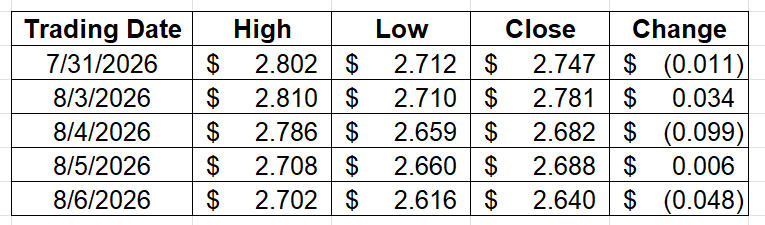
Market Update: Natural gas markets came under renewed pressure this week as a larger-than-expected storage build and a softening weather outlook pushed NYMEX September futures to a four-month low at $2.616/MMBtu. The October and November contracts also touched new lows at $2.67 and $2.90/MMBtu, respectively. EBW Analytics noted that cooling in the near-term forecast suggests "the next five days may mark the last major national cooling demand boost of the summer," adding potential for further downside. The national average cash price was $2.410/MMBtu on August 6.
On the supply side, Permian Basin production curtailments have largely reversed following the startup of new pipeline egress in June. Waha spot prices, which averaged negative $3.74/MMBtu during February–May, have turned solidly positive. Meanwhile, Cheniere Energy flagged tightening global LNG fundamentals, noting European storage is only about 58% full — well below 70% at this point last year — as buyers focus increasingly on supply security heading into winter.
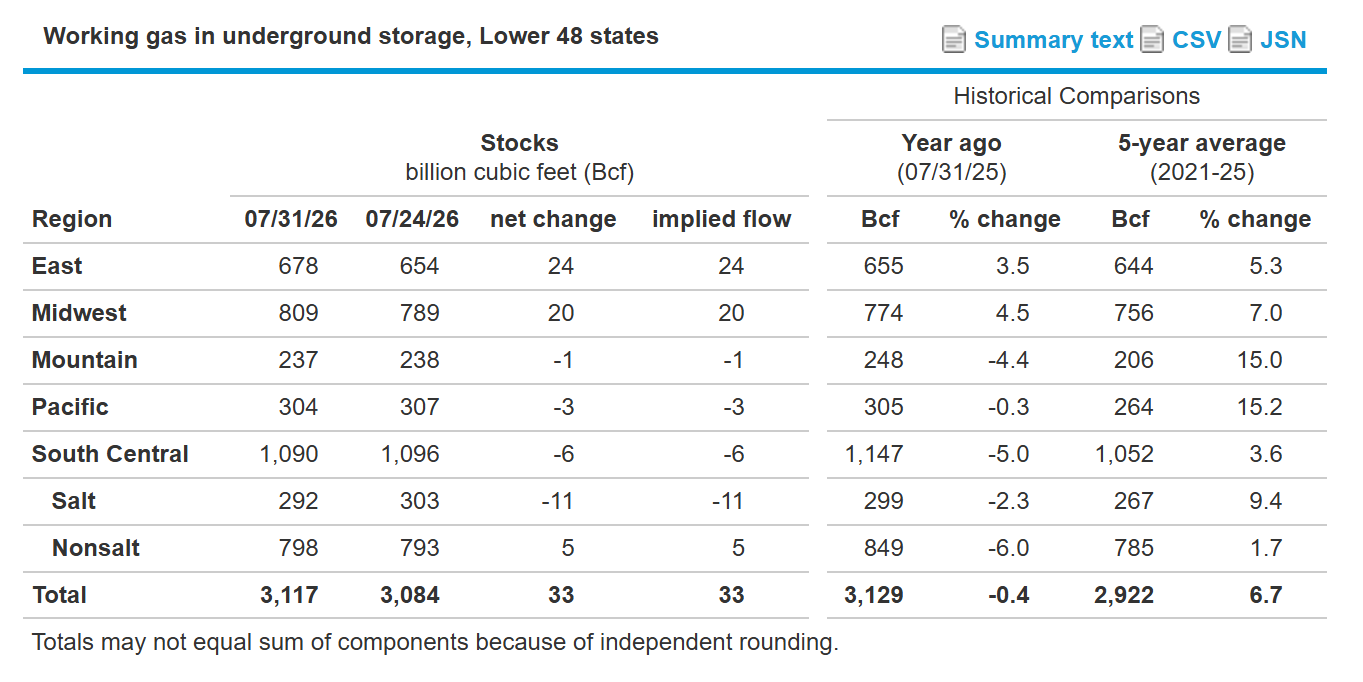
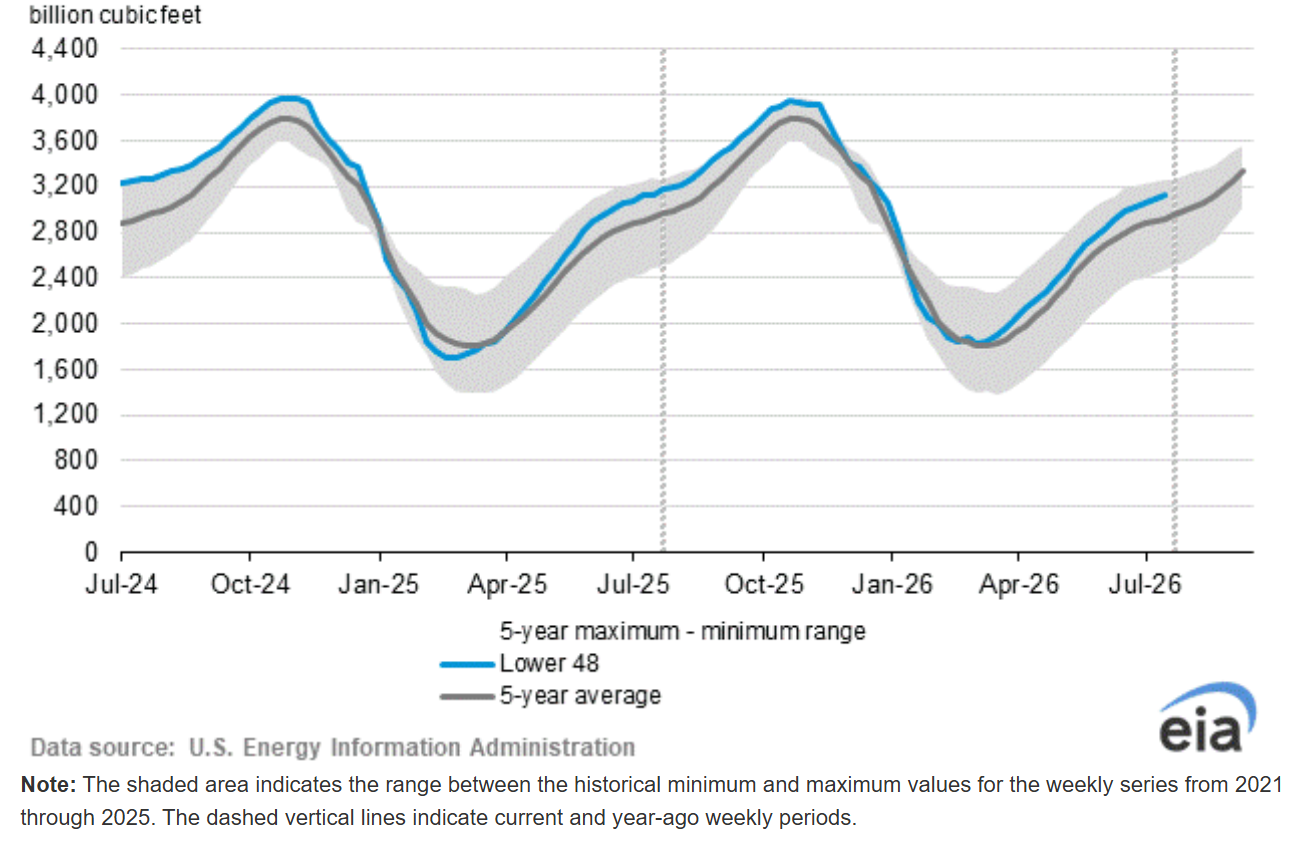
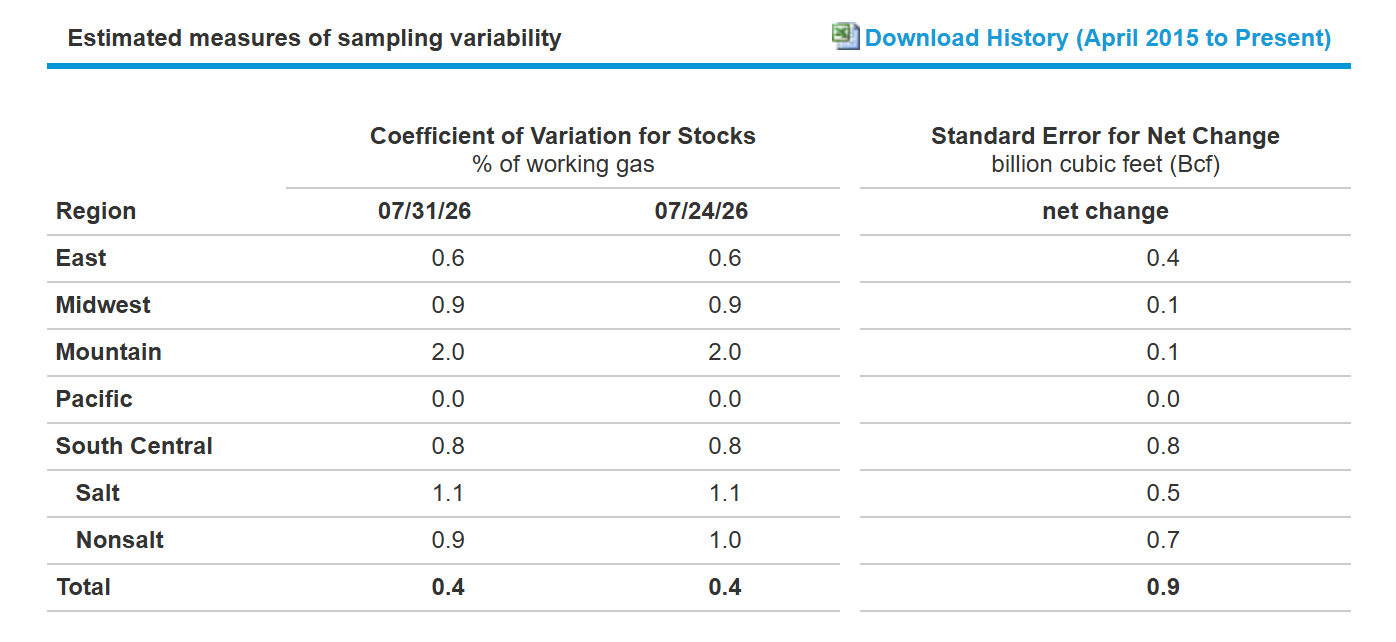
Storage Report: For the week ending July 31, 2026, the EIA reported injection — 3 Bcf above consensus — bringing total working gas to 3,117 Bcf. Stocks now sit 195 Bcf (6.7%) above the five-year average and just 12 Bcf below year-ago levels. Injections were led by the East (+24 Bcf) and Midwest (+20 Bcf), while South Central saw a modest 6 Bcf draw. Analysts expect a slightly smaller 25–30 Bcf build for the week ending August 7.
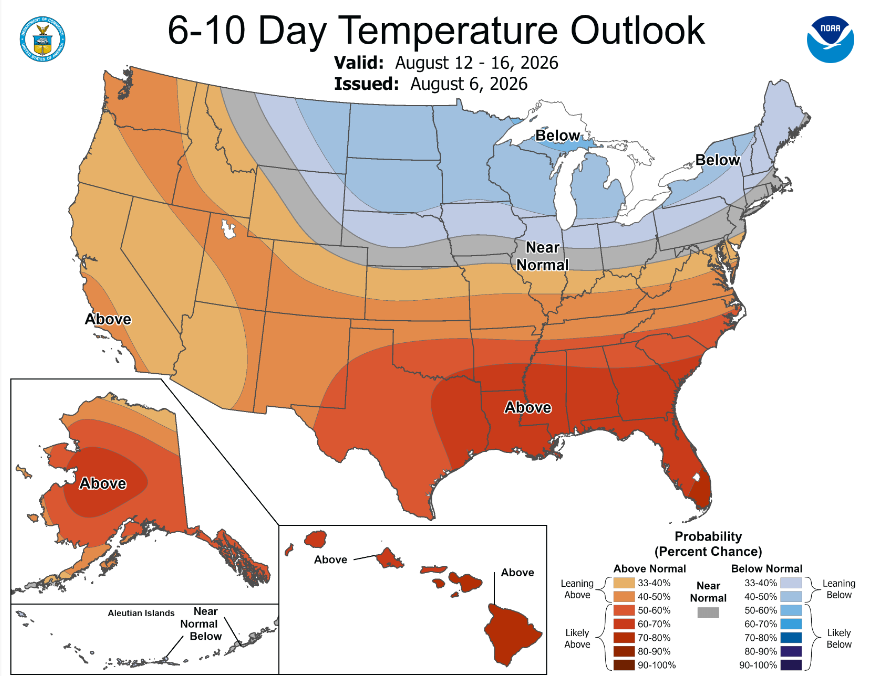
Weather: The NOAA 6–10 day outlook (valid August 12–16) shows above-normal temperatures favored across the Southeast and much of the West, supporting continued power burn in those regions. However, below-normal temperatures are expected from the Northern Plains through the Great Lakes and into the Northeast, with near-normal conditions across the Central Plains and Mid-Atlantic.
Overall, the pattern points to waning summer cooling demand nationally as the northern tier cools heading into the back half of August — a bearish signal for gas prices consistent with the current soft market tone.
Market Data:
August 7, 2026

Weekly Energy News
August 7, 2026
Market Update: Natural gas markets came under renewed pressure this week as a larger-than-expected storage build and a softening weather outlook pushed NYMEX September futures to a four-month low at $2.616/MMBtu. The October and November contracts also touched new lows at $2.67 and $2.90/MMBtu, respectively. EBW Analytics noted that cooling in the near-term forecast suggests "the next five days may mark the last major national cooling demand boost of the summer," adding potential for further downside. The national average cash price was $2.410/MMBtu on August 6.
On the supply side, Permian Basin production curtailments have largely reversed following the startup of new pipeline egress in June. Waha spot prices, which averaged negative $3.74/MMBtu during February–May, have turned solidly positive. Meanwhile, Cheniere Energy flagged tightening global LNG fundamentals, noting European storage is only about 58% full — well below 70% at this point last year — as buyers focus increasingly on supply security heading into winter.
Storage Report: For the week ending July 31, 2026, the EIA reported injection — 3 Bcf above consensus — bringing total working gas to 3,117 Bcf. Stocks now sit 195 Bcf (6.7%) above the five-year average and just 12 Bcf below year-ago levels. Injections were led by the East (+24 Bcf) and Midwest (+20 Bcf), while South Central saw a modest 6 Bcf draw. Analysts expect a slightly smaller 25–30 Bcf build for the week ending August 7.
Weather: The NOAA 6–10 day outlook (valid August 12–16) shows above-normal temperatures favored across the Southeast and much of the West, supporting continued power burn in those regions. However, below-normal temperatures are expected from the Northern Plains through the Great Lakes and into the Northeast, with near-normal conditions across the Central Plains and Mid-Atlantic.
Overall, the pattern points to waning summer cooling demand nationally as the northern tier cools heading into the back half of August — a bearish signal for gas prices consistent with the current soft market tone.
Market Data:
August 7, 2026
August 7, 2026
Weekly Energy News
Market Update: Natural gas markets came under renewed pressure this week as a larger-than-expected storage build and a softening weather outlook pushed NYMEX September futures to a four-month low at $2.616/MMBtu. The October and November contracts also touched new lows at $2.67 and $2.90/MMBtu, respectively. EBW Analytics noted that cooling in the near-term forecast suggests "the next five days may mark the last major national cooling demand boost of the summer," adding potential for further downside. The national average cash price was $2.410/MMBtu on August 6.
On the supply side, Permian Basin production curtailments have largely reversed following the startup of new pipeline egress in June. Waha spot prices, which averaged negative $3.74/MMBtu during February–May, have turned solidly positive. Meanwhile, Cheniere Energy flagged tightening global LNG fundamentals, noting European storage is only about 58% full — well below 70% at this point last year — as buyers focus increasingly on supply security heading into winter.
Storage Report: For the week ending July 31, 2026, the EIA reported injection — 3 Bcf above consensus — bringing total working gas to 3,117 Bcf. Stocks now sit 195 Bcf (6.7%) above the five-year average and just 12 Bcf below year-ago levels. Injections were led by the East (+24 Bcf) and Midwest (+20 Bcf), while South Central saw a modest 6 Bcf draw. Analysts expect a slightly smaller 25–30 Bcf build for the week ending August 7.
Weather: The NOAA 6–10 day outlook (valid August 12–16) shows above-normal temperatures favored across the Southeast and much of the West, supporting continued power burn in those regions. However, below-normal temperatures are expected from the Northern Plains through the Great Lakes and into the Northeast, with near-normal conditions across the Central Plains and Mid-Atlantic.
Overall, the pattern points to waning summer cooling demand nationally as the northern tier cools heading into the back half of August — a bearish signal for gas prices consistent with the current soft market tone.
August 7, 2026
Weekly Energy News
Market Update: Natural gas markets came under renewed pressure this week as a larger-than-expected storage build and a softening weather outlook pushed NYMEX September futures to a four-month low at $2.616/MMBtu. The October and November contracts also touched new lows at $2.67 and $2.90/MMBtu, respectively. EBW Analytics noted that cooling in the near-term forecast suggests "the next five days may mark the last major national cooling demand boost of the summer," adding potential for further downside. The national average cash price was $2.410/MMBtu on August 6.
On the supply side, Permian Basin production curtailments have largely reversed following the startup of new pipeline egress in June. Waha spot prices, which averaged negative $3.74/MMBtu during February–May, have turned solidly positive. Meanwhile, Cheniere Energy flagged tightening global LNG fundamentals, noting European storage is only about 58% full — well below 70% at this point last year — as buyers focus increasingly on supply security heading into winter.
Storage Report: For the week ending July 31, 2026, the EIA reported injection — 3 Bcf above consensus — bringing total working gas to 3,117 Bcf. Stocks now sit 195 Bcf (6.7%) above the five-year average and just 12 Bcf below year-ago levels. Injections were led by the East (+24 Bcf) and Midwest (+20 Bcf), while South Central saw a modest 6 Bcf draw. Analysts expect a slightly smaller 25–30 Bcf build for the week ending August 7.
Weather: The NOAA 6–10 day outlook (valid August 12–16) shows above-normal temperatures favored across the Southeast and much of the West, supporting continued power burn in those regions. However, below-normal temperatures are expected from the Northern Plains through the Great Lakes and into the Northeast, with near-normal conditions across the Central Plains and Mid-Atlantic.
Overall, the pattern points to waning summer cooling demand nationally as the northern tier cools heading into the back half of August — a bearish signal for gas prices consistent with the current soft market tone.
August 7, 2026
Weekly Energy News
Market Update: Natural gas markets came under renewed pressure this week as a larger-than-expected storage build and a softening weather outlook pushed NYMEX September futures to a four-month low at $2.616/MMBtu. The October and November contracts also touched new lows at $2.67 and $2.90/MMBtu, respectively. EBW Analytics noted that cooling in the near-term forecast suggests "the next five days may mark the last major national cooling demand boost of the summer," adding potential for further downside. The national average cash price was $2.410/MMBtu on August 6.
On the supply side, Permian Basin production curtailments have largely reversed following the startup of new pipeline egress in June. Waha spot prices, which averaged negative $3.74/MMBtu during February–May, have turned solidly positive. Meanwhile, Cheniere Energy flagged tightening global LNG fundamentals, noting European storage is only about 58% full — well below 70% at this point last year — as buyers focus increasingly on supply security heading into winter.
Storage Report: For the week ending July 31, 2026, the EIA reported injection — 3 Bcf above consensus — bringing total working gas to 3,117 Bcf. Stocks now sit 195 Bcf (6.7%) above the five-year average and just 12 Bcf below year-ago levels. Injections were led by the East (+24 Bcf) and Midwest (+20 Bcf), while South Central saw a modest 6 Bcf draw. Analysts expect a slightly smaller 25–30 Bcf build for the week ending August 7.
Weather: The NOAA 6–10 day outlook (valid August 12–16) shows above-normal temperatures favored across the Southeast and much of the West, supporting continued power burn in those regions. However, below-normal temperatures are expected from the Northern Plains through the Great Lakes and into the Northeast, with near-normal conditions across the Central Plains and Mid-Atlantic.
Overall, the pattern points to waning summer cooling demand nationally as the northern tier cools heading into the back half of August — a bearish signal for gas prices consistent with the current soft market tone.

August 7, 2026
Market Update: Natural gas markets came under renewed pressure this week as a larger-than-expected storage build and a softening weather outlook pushed NYMEX September futures to a four-month low at $2.616/MMBtu. The October and November contracts also touched new lows at $2.67 and $2.90/MMBtu, respectively. EBW Analytics noted that cooling in the near-term forecast suggests "the next five days may mark the last major national cooling demand boost of the summer," adding potential for further downside. The national average cash price was $2.410/MMBtu on August 6.
On the supply side, Permian Basin production curtailments have largely reversed following the startup of new pipeline egress in June. Waha spot prices, which averaged negative $3.74/MMBtu during February–May, have turned solidly positive. Meanwhile, Cheniere Energy flagged tightening global LNG fundamentals, noting European storage is only about 58% full — well below 70% at this point last year — as buyers focus increasingly on supply security heading into winter.
Storage Report: For the week ending July 31, 2026, the EIA reported injection — 3 Bcf above consensus — bringing total working gas to 3,117 Bcf. Stocks now sit 195 Bcf (6.7%) above the five-year average and just 12 Bcf below year-ago levels. Injections were led by the East (+24 Bcf) and Midwest (+20 Bcf), while South Central saw a modest 6 Bcf draw. Analysts expect a slightly smaller 25–30 Bcf build for the week ending August 7.
Weather: The NOAA 6–10 day outlook (valid August 12–16) shows above-normal temperatures favored across the Southeast and much of the West, supporting continued power burn in those regions. However, below-normal temperatures are expected from the Northern Plains through the Great Lakes and into the Northeast, with near-normal conditions across the Central Plains and Mid-Atlantic.
Overall, the pattern points to waning summer cooling demand nationally as the northern tier cools heading into the back half of August — a bearish signal for gas prices consistent with the current soft market tone.
August 7, 2026
Weekly Energy News
Market Update: Natural gas markets came under renewed pressure this week as a larger-than-expected storage build and a softening weather outlook pushed NYMEX September futures to a four-month low at $2.616/MMBtu. The October and November contracts also touched new lows at $2.67 and $2.90/MMBtu, respectively. EBW Analytics noted that cooling in the near-term forecast suggests "the next five days may mark the last major national cooling demand boost of the summer," adding potential for further downside. The national average cash price was $2.410/MMBtu on August 6.
On the supply side, Permian Basin production curtailments have largely reversed following the startup of new pipeline egress in June. Waha spot prices, which averaged negative $3.74/MMBtu during February–May, have turned solidly positive. Meanwhile, Cheniere Energy flagged tightening global LNG fundamentals, noting European storage is only about 58% full — well below 70% at this point last year — as buyers focus increasingly on supply security heading into winter.
Storage Report: For the week ending July 31, 2026, the EIA reported injection — 3 Bcf above consensus — bringing total working gas to 3,117 Bcf. Stocks now sit 195 Bcf (6.7%) above the five-year average and just 12 Bcf below year-ago levels. Injections were led by the East (+24 Bcf) and Midwest (+20 Bcf), while South Central saw a modest 6 Bcf draw. Analysts expect a slightly smaller 25–30 Bcf build for the week ending August 7.
Weather: The NOAA 6–10 day outlook (valid August 12–16) shows above-normal temperatures favored across the Southeast and much of the West, supporting continued power burn in those regions. However, below-normal temperatures are expected from the Northern Plains through the Great Lakes and into the Northeast, with near-normal conditions across the Central Plains and Mid-Atlantic.
Overall, the pattern points to waning summer cooling demand nationally as the northern tier cools heading into the back half of August — a bearish signal for gas prices consistent with the current soft market tone.
August 7, 2026
Weekly Energy News
Market Update: Natural gas markets came under renewed pressure this week as a larger-than-expected storage build and a softening weather outlook pushed NYMEX September futures to a four-month low at $2.616/MMBtu. The October and November contracts also touched new lows at $2.67 and $2.90/MMBtu, respectively. EBW Analytics noted that cooling in the near-term forecast suggests "the next five days may mark the last major national cooling demand boost of the summer," adding potential for further downside. The national average cash price was $2.410/MMBtu on August 6.
On the supply side, Permian Basin production curtailments have largely reversed following the startup of new pipeline egress in June. Waha spot prices, which averaged negative $3.74/MMBtu during February–May, have turned solidly positive. Meanwhile, Cheniere Energy flagged tightening global LNG fundamentals, noting European storage is only about 58% full — well below 70% at this point last year — as buyers focus increasingly on supply security heading into winter.
Storage Report: For the week ending July 31, 2026, the EIA reported injection — 3 Bcf above consensus — bringing total working gas to 3,117 Bcf. Stocks now sit 195 Bcf (6.7%) above the five-year average and just 12 Bcf below year-ago levels. Injections were led by the East (+24 Bcf) and Midwest (+20 Bcf), while South Central saw a modest 6 Bcf draw. Analysts expect a slightly smaller 25–30 Bcf build for the week ending August 7.
Weather: The NOAA 6–10 day outlook (valid August 12–16) shows above-normal temperatures favored across the Southeast and much of the West, supporting continued power burn in those regions. However, below-normal temperatures are expected from the Northern Plains through the Great Lakes and into the Northeast, with near-normal conditions across the Central Plains and Mid-Atlantic.
Overall, the pattern points to waning summer cooling demand nationally as the northern tier cools heading into the back half of August — a bearish signal for gas prices consistent with the current soft market tone.
Make Your Choice Gas Selection in Three Easy Steps
Click here to access our online tool, or call our Choice gas commodity experts at 1 (877) 790-4990.
Step 1: Enter your account number
- Your Black Hills Energy account number is located at the top right-hand corner of your bill.
Step 2: Review price options and make your selection
Step 3: Confirm your selection and enter your control number
- You received a control number in your 2026 Choice Gas selection packet mailed to you from Black Hills Energy. If you cannot locate this, you can retrieve your control number by calling 877-245-3506 or visit choicegas.com
Once enrolled, you will be removed from supplier marketing communications within 24 hours.


Sign Up for Our Energy Newsletters
Sign UpRecent Posts