August 14, 2026
Weekly Energy News
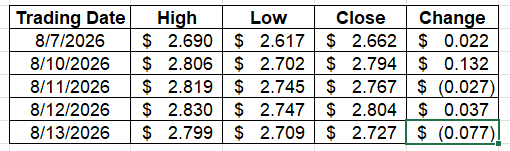
Market Update: Natural gas markets found modest footing Thursday as a strengthening weather forecast helped stabilize prices following an above-consensus storage build. NYMEX September futures touched an intraday low of $2.71/MMBtu on the EIA report before recovering above $2.77/MMBtu as near-term heat models firmed. The national average cash price settled at $2.540/MMBtu on August 13, with Henry Hub at $2.760/MMBtu. EBW Analytics noted August is now on pace to be the hottest in a decade, with hot weather extending into early September pointing to a medium-term end-of-season storage target near 3,900 Bcf — providing some upside support against an otherwise bearish surplus backdrop.
The EIA also reported this week that U.S. marketed natural gas production is on track for a record 122.5 Bcf/d in 2026, led by 6% growth in the Permian Basin and a 9% jump in the Haynesville. Drilling activity is easing at the margin, however, with gas-directed rigs falling four to 139 for the week ending August 12 — including two lost in the Haynesville — as producers exercise caution at sub-$3.00/MMBtu prompt prices.
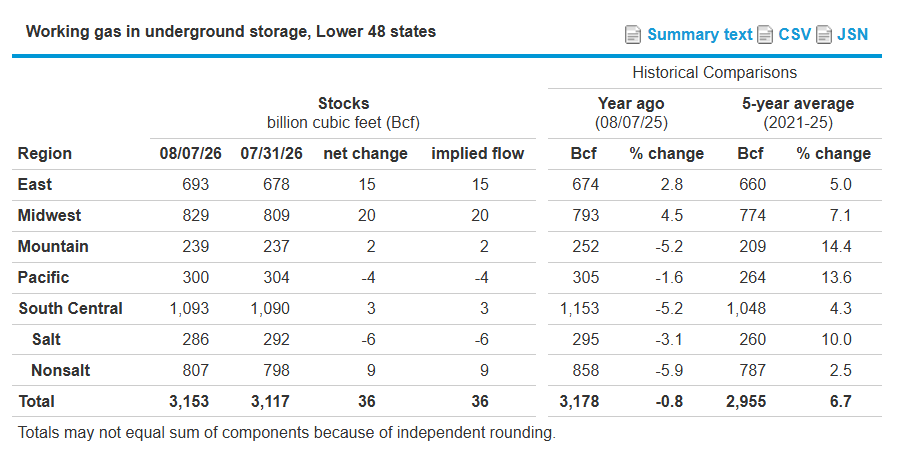
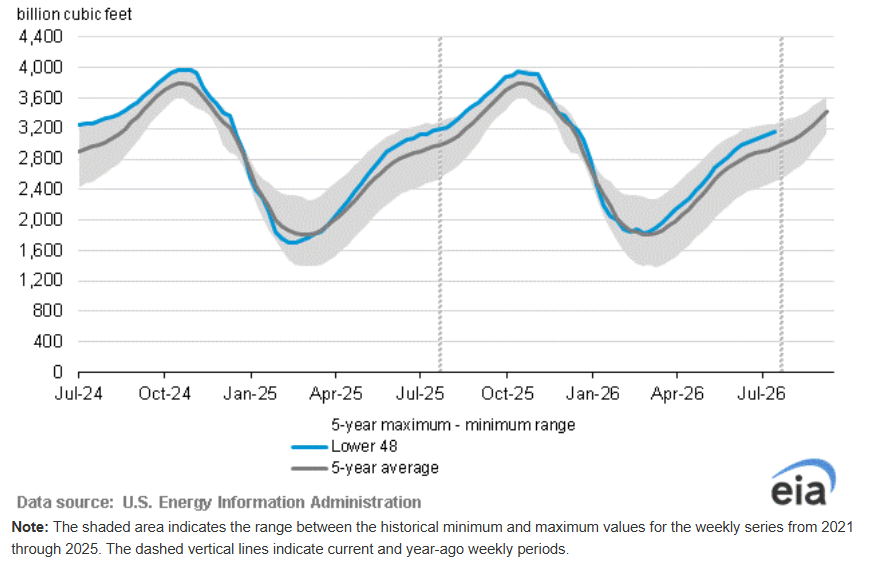
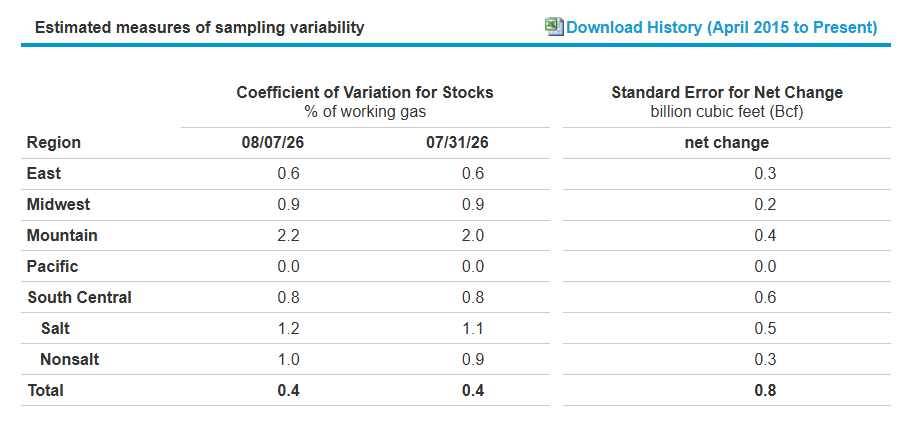
Storage Report: For the week ending August 7, 2026, the EIA reported a 36 Bcf injection — above the consensus estimate of 33 Bcf — bringing total working gas to 3,153 Bcf. Stocks now sit 198 Bcf (6.7%) above the five-year average, the highest surplus of the summer, and 25 Bcf below year-ago levels. Looking ahead, S&P Global Energy's Gaslytics model projects a much smaller 12 Bcf build for the week ending August 14, as elevated power burn driven by persistent heat slows the injection pace.
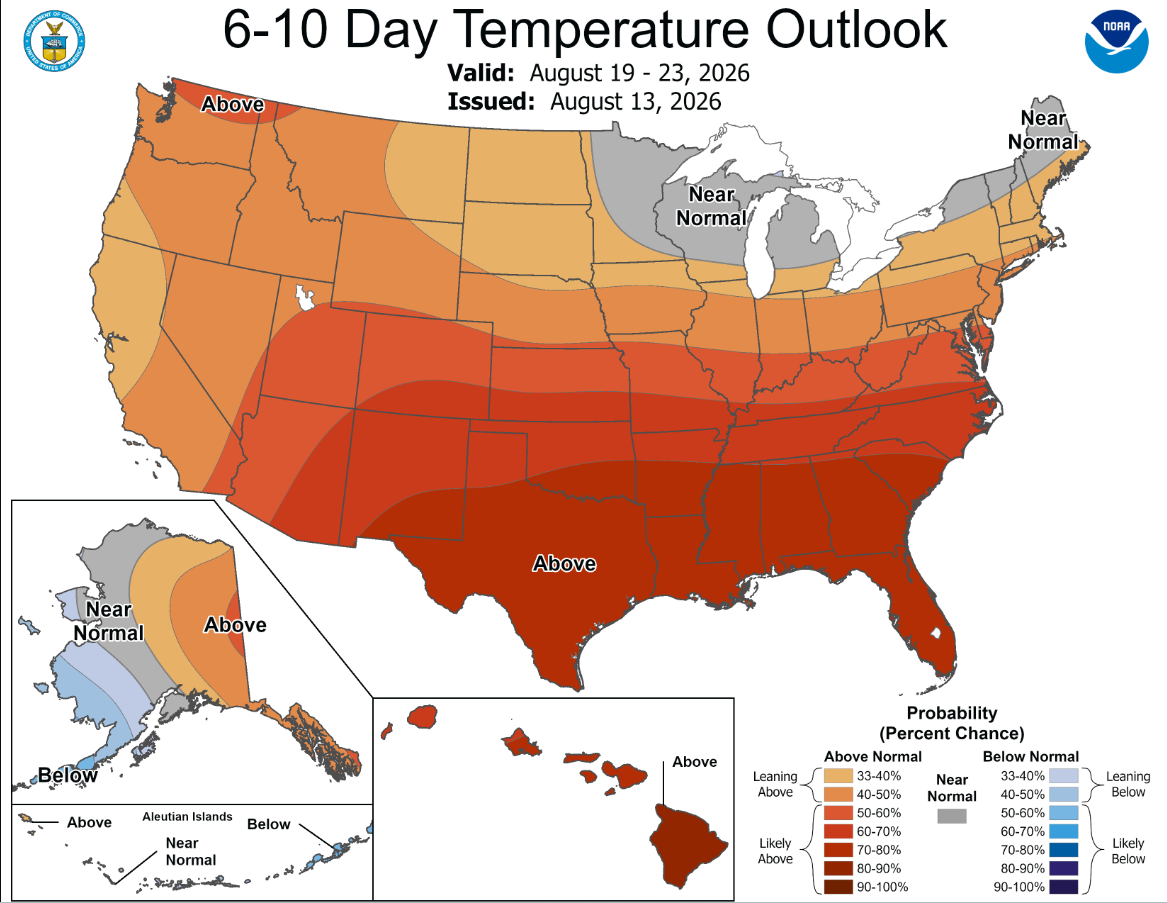
Weather: The NOAA 6–10 day outlook (valid August 19–23) favors above-normal temperatures across most of the continental U.S., with the strongest signals — 70 to 80 percent probability above normal — across the south-central and southeastern regions. Near-normal conditions are limited to portions of the north-central states and Northeast. The broad upper-level ridge keeps gas-fired power demand elevated heading into the back half of August, tempering what would otherwise be an early shoulder-season softening — though the 198 Bcf five-year surplus remains a structural ceiling on any meaningful price recovery.
Market Data:
August 14, 2026

Weekly Energy News
August 14, 2026
Market Update: Natural gas markets found modest footing Thursday as a strengthening weather forecast helped stabilize prices following an above-consensus storage build. NYMEX September futures touched an intraday low of $2.71/MMBtu on the EIA report before recovering above $2.77/MMBtu as near-term heat models firmed. The national average cash price settled at $2.540/MMBtu on August 13, with Henry Hub at $2.760/MMBtu. EBW Analytics noted August is now on pace to be the hottest in a decade, with hot weather extending into early September pointing to a medium-term end-of-season storage target near 3,900 Bcf — providing some upside support against an otherwise bearish surplus backdrop.
The EIA also reported this week that U.S. marketed natural gas production is on track for a record 122.5 Bcf/d in 2026, led by 6% growth in the Permian Basin and a 9% jump in the Haynesville. Drilling activity is easing at the margin, however, with gas-directed rigs falling four to 139 for the week ending August 12 — including two lost in the Haynesville — as producers exercise caution at sub-$3.00/MMBtu prompt prices.
Storage Report: For the week ending August 7, 2026, the EIA reported a 36 Bcf injection — above the consensus estimate of 33 Bcf — bringing total working gas to 3,153 Bcf. Stocks now sit 198 Bcf (6.7%) above the five-year average, the highest surplus of the summer, and 25 Bcf below year-ago levels. Looking ahead, S&P Global Energy's Gaslytics model projects a much smaller 12 Bcf build for the week ending August 14, as elevated power burn driven by persistent heat slows the injection pace.
Weather: The NOAA 6–10 day outlook (valid August 19–23) favors above-normal temperatures across most of the continental U.S., with the strongest signals — 70 to 80 percent probability above normal — across the south-central and southeastern regions. Near-normal conditions are limited to portions of the north-central states and Northeast. The broad upper-level ridge keeps gas-fired power demand elevated heading into the back half of August, tempering what would otherwise be an early shoulder-season softening — though the 198 Bcf five-year surplus remains a structural ceiling on any meaningful price recovery.
Market Data:
August 14, 2026
August 14, 2026
Weekly Energy News
Market Update: Natural gas markets found modest footing Thursday as a strengthening weather forecast helped stabilize prices following an above-consensus storage build. NYMEX September futures touched an intraday low of $2.71/MMBtu on the EIA report before recovering above $2.77/MMBtu as near-term heat models firmed. The national average cash price settled at $2.540/MMBtu on August 13, with Henry Hub at $2.760/MMBtu. EBW Analytics noted August is now on pace to be the hottest in a decade, with hot weather extending into early September pointing to a medium-term end-of-season storage target near 3,900 Bcf — providing some upside support against an otherwise bearish surplus backdrop.
The EIA also reported this week that U.S. marketed natural gas production is on track for a record 122.5 Bcf/d in 2026, led by 6% growth in the Permian Basin and a 9% jump in the Haynesville. Drilling activity is easing at the margin, however, with gas-directed rigs falling four to 139 for the week ending August 12 — including two lost in the Haynesville — as producers exercise caution at sub-$3.00/MMBtu prompt prices.
Storage Report: For the week ending August 7, 2026, the EIA reported a 36 Bcf injection — above the consensus estimate of 33 Bcf — bringing total working gas to 3,153 Bcf. Stocks now sit 198 Bcf (6.7%) above the five-year average, the highest surplus of the summer, and 25 Bcf below year-ago levels. Looking ahead, S&P Global Energy's Gaslytics model projects a much smaller 12 Bcf build for the week ending August 14, as elevated power burn driven by persistent heat slows the injection pace.
Weather: The NOAA 6–10 day outlook (valid August 19–23) favors above-normal temperatures across most of the continental U.S., with the strongest signals — 70 to 80 percent probability above normal — across the south-central and southeastern regions. Near-normal conditions are limited to portions of the north-central states and Northeast. The broad upper-level ridge keeps gas-fired power demand elevated heading into the back half of August, tempering what would otherwise be an early shoulder-season softening — though the 198 Bcf five-year surplus remains a structural ceiling on any meaningful price recovery.
August 14, 2026
Weekly Energy News
Market Update: Natural gas markets found modest footing Thursday as a strengthening weather forecast helped stabilize prices following an above-consensus storage build. NYMEX September futures touched an intraday low of $2.71/MMBtu on the EIA report before recovering above $2.77/MMBtu as near-term heat models firmed. The national average cash price settled at $2.540/MMBtu on August 13, with Henry Hub at $2.760/MMBtu. EBW Analytics noted August is now on pace to be the hottest in a decade, with hot weather extending into early September pointing to a medium-term end-of-season storage target near 3,900 Bcf — providing some upside support against an otherwise bearish surplus backdrop.
The EIA also reported this week that U.S. marketed natural gas production is on track for a record 122.5 Bcf/d in 2026, led by 6% growth in the Permian Basin and a 9% jump in the Haynesville. Drilling activity is easing at the margin, however, with gas-directed rigs falling four to 139 for the week ending August 12 — including two lost in the Haynesville — as producers exercise caution at sub-$3.00/MMBtu prompt prices.
Storage Report: For the week ending August 7, 2026, the EIA reported a 36 Bcf injection — above the consensus estimate of 33 Bcf — bringing total working gas to 3,153 Bcf. Stocks now sit 198 Bcf (6.7%) above the five-year average, the highest surplus of the summer, and 25 Bcf below year-ago levels. Looking ahead, S&P Global Energy's Gaslytics model projects a much smaller 12 Bcf build for the week ending August 14, as elevated power burn driven by persistent heat slows the injection pace.
Weather: The NOAA 6–10 day outlook (valid August 19–23) favors above-normal temperatures across most of the continental U.S., with the strongest signals — 70 to 80 percent probability above normal — across the south-central and southeastern regions. Near-normal conditions are limited to portions of the north-central states and Northeast. The broad upper-level ridge keeps gas-fired power demand elevated heading into the back half of August, tempering what would otherwise be an early shoulder-season softening — though the 198 Bcf five-year surplus remains a structural ceiling on any meaningful price recovery.
August 14, 2026
Weekly Energy News
Market Update: Natural gas markets found modest footing Thursday as a strengthening weather forecast helped stabilize prices following an above-consensus storage build. NYMEX September futures touched an intraday low of $2.71/MMBtu on the EIA report before recovering above $2.77/MMBtu as near-term heat models firmed. The national average cash price settled at $2.540/MMBtu on August 13, with Henry Hub at $2.760/MMBtu. EBW Analytics noted August is now on pace to be the hottest in a decade, with hot weather extending into early September pointing to a medium-term end-of-season storage target near 3,900 Bcf — providing some upside support against an otherwise bearish surplus backdrop.
The EIA also reported this week that U.S. marketed natural gas production is on track for a record 122.5 Bcf/d in 2026, led by 6% growth in the Permian Basin and a 9% jump in the Haynesville. Drilling activity is easing at the margin, however, with gas-directed rigs falling four to 139 for the week ending August 12 — including two lost in the Haynesville — as producers exercise caution at sub-$3.00/MMBtu prompt prices.
Storage Report: For the week ending August 7, 2026, the EIA reported a 36 Bcf injection — above the consensus estimate of 33 Bcf — bringing total working gas to 3,153 Bcf. Stocks now sit 198 Bcf (6.7%) above the five-year average, the highest surplus of the summer, and 25 Bcf below year-ago levels. Looking ahead, S&P Global Energy's Gaslytics model projects a much smaller 12 Bcf build for the week ending August 14, as elevated power burn driven by persistent heat slows the injection pace.
Weather: The NOAA 6–10 day outlook (valid August 19–23) favors above-normal temperatures across most of the continental U.S., with the strongest signals — 70 to 80 percent probability above normal — across the south-central and southeastern regions. Near-normal conditions are limited to portions of the north-central states and Northeast. The broad upper-level ridge keeps gas-fired power demand elevated heading into the back half of August, tempering what would otherwise be an early shoulder-season softening — though the 198 Bcf five-year surplus remains a structural ceiling on any meaningful price recovery.

August 14, 2026
Market Update: Natural gas markets found modest footing Thursday as a strengthening weather forecast helped stabilize prices following an above-consensus storage build. NYMEX September futures touched an intraday low of $2.71/MMBtu on the EIA report before recovering above $2.77/MMBtu as near-term heat models firmed. The national average cash price settled at $2.540/MMBtu on August 13, with Henry Hub at $2.760/MMBtu. EBW Analytics noted August is now on pace to be the hottest in a decade, with hot weather extending into early September pointing to a medium-term end-of-season storage target near 3,900 Bcf — providing some upside support against an otherwise bearish surplus backdrop.
The EIA also reported this week that U.S. marketed natural gas production is on track for a record 122.5 Bcf/d in 2026, led by 6% growth in the Permian Basin and a 9% jump in the Haynesville. Drilling activity is easing at the margin, however, with gas-directed rigs falling four to 139 for the week ending August 12 — including two lost in the Haynesville — as producers exercise caution at sub-$3.00/MMBtu prompt prices.
Storage Report: For the week ending August 7, 2026, the EIA reported a 36 Bcf injection — above the consensus estimate of 33 Bcf — bringing total working gas to 3,153 Bcf. Stocks now sit 198 Bcf (6.7%) above the five-year average, the highest surplus of the summer, and 25 Bcf below year-ago levels. Looking ahead, S&P Global Energy's Gaslytics model projects a much smaller 12 Bcf build for the week ending August 14, as elevated power burn driven by persistent heat slows the injection pace.
Weather: The NOAA 6–10 day outlook (valid August 19–23) favors above-normal temperatures across most of the continental U.S., with the strongest signals — 70 to 80 percent probability above normal — across the south-central and southeastern regions. Near-normal conditions are limited to portions of the north-central states and Northeast. The broad upper-level ridge keeps gas-fired power demand elevated heading into the back half of August, tempering what would otherwise be an early shoulder-season softening — though the 198 Bcf five-year surplus remains a structural ceiling on any meaningful price recovery.
August 14, 2026
Weekly Energy News
Market Update: Natural gas markets found modest footing Thursday as a strengthening weather forecast helped stabilize prices following an above-consensus storage build. NYMEX September futures touched an intraday low of $2.71/MMBtu on the EIA report before recovering above $2.77/MMBtu as near-term heat models firmed. The national average cash price settled at $2.540/MMBtu on August 13, with Henry Hub at $2.760/MMBtu. EBW Analytics noted August is now on pace to be the hottest in a decade, with hot weather extending into early September pointing to a medium-term end-of-season storage target near 3,900 Bcf — providing some upside support against an otherwise bearish surplus backdrop.
The EIA also reported this week that U.S. marketed natural gas production is on track for a record 122.5 Bcf/d in 2026, led by 6% growth in the Permian Basin and a 9% jump in the Haynesville. Drilling activity is easing at the margin, however, with gas-directed rigs falling four to 139 for the week ending August 12 — including two lost in the Haynesville — as producers exercise caution at sub-$3.00/MMBtu prompt prices.
Storage Report: For the week ending August 7, 2026, the EIA reported a 36 Bcf injection — above the consensus estimate of 33 Bcf — bringing total working gas to 3,153 Bcf. Stocks now sit 198 Bcf (6.7%) above the five-year average, the highest surplus of the summer, and 25 Bcf below year-ago levels. Looking ahead, S&P Global Energy's Gaslytics model projects a much smaller 12 Bcf build for the week ending August 14, as elevated power burn driven by persistent heat slows the injection pace.
Weather: The NOAA 6–10 day outlook (valid August 19–23) favors above-normal temperatures across most of the continental U.S., with the strongest signals — 70 to 80 percent probability above normal — across the south-central and southeastern regions. Near-normal conditions are limited to portions of the north-central states and Northeast. The broad upper-level ridge keeps gas-fired power demand elevated heading into the back half of August, tempering what would otherwise be an early shoulder-season softening — though the 198 Bcf five-year surplus remains a structural ceiling on any meaningful price recovery.
August 14, 2026
Weekly Energy News
Market Update: Natural gas markets found modest footing Thursday as a strengthening weather forecast helped stabilize prices following an above-consensus storage build. NYMEX September futures touched an intraday low of $2.71/MMBtu on the EIA report before recovering above $2.77/MMBtu as near-term heat models firmed. The national average cash price settled at $2.540/MMBtu on August 13, with Henry Hub at $2.760/MMBtu. EBW Analytics noted August is now on pace to be the hottest in a decade, with hot weather extending into early September pointing to a medium-term end-of-season storage target near 3,900 Bcf — providing some upside support against an otherwise bearish surplus backdrop.
The EIA also reported this week that U.S. marketed natural gas production is on track for a record 122.5 Bcf/d in 2026, led by 6% growth in the Permian Basin and a 9% jump in the Haynesville. Drilling activity is easing at the margin, however, with gas-directed rigs falling four to 139 for the week ending August 12 — including two lost in the Haynesville — as producers exercise caution at sub-$3.00/MMBtu prompt prices.
Storage Report: For the week ending August 7, 2026, the EIA reported a 36 Bcf injection — above the consensus estimate of 33 Bcf — bringing total working gas to 3,153 Bcf. Stocks now sit 198 Bcf (6.7%) above the five-year average, the highest surplus of the summer, and 25 Bcf below year-ago levels. Looking ahead, S&P Global Energy's Gaslytics model projects a much smaller 12 Bcf build for the week ending August 14, as elevated power burn driven by persistent heat slows the injection pace.
Weather: The NOAA 6–10 day outlook (valid August 19–23) favors above-normal temperatures across most of the continental U.S., with the strongest signals — 70 to 80 percent probability above normal — across the south-central and southeastern regions. Near-normal conditions are limited to portions of the north-central states and Northeast. The broad upper-level ridge keeps gas-fired power demand elevated heading into the back half of August, tempering what would otherwise be an early shoulder-season softening — though the 198 Bcf five-year surplus remains a structural ceiling on any meaningful price recovery.
Make Your Choice Gas Selection in Three Easy Steps
Click here to access our online tool, or call our Choice gas commodity experts at 1 (877) 790-4990.
Step 1: Enter your account number
- Your Black Hills Energy account number is located at the top right-hand corner of your bill.
Step 2: Review price options and make your selection
Step 3: Confirm your selection and enter your control number
- You received a control number in your 2026 Choice Gas selection packet mailed to you from Black Hills Energy. If you cannot locate this, you can retrieve your control number by calling 877-245-3506 or visit choicegas.com
Once enrolled, you will be removed from supplier marketing communications within 24 hours.


Sign Up for Our Energy Newsletters
Sign UpRecent Posts