April 10, 2026
Weekly Energy News
Market Commentary: Following news of a pause in Middle East hostilities, NYMEX natural gas futures faced additional downward pressure on April 8, driven in part by a sharp decline in crude oil prices. By the close of trading, the May contract managed to hold a price floor near $2.70/MMBtu. Although prices saw a modest 3–4 cent increase in overnight trading, momentum weakened after the U.S. Energy Information Administration released its storage report at 10:30 a.m. ET on April 9.
Market conditions are expected to remain soft in the near term, with loose fundamentals continuing to weigh on prices. Eli Rubin of EBW Analytics noted that natural gas remains on bearish footing both technically and fundamentally through mid-April, with the storage surplus compared to five-year averages potentially tripling to more than 175 Bcf by late April.
Looking ahead, analysts anticipate another sizable storage injection in the upcoming report, which could further expand the surplus. According to S&P Global, the next report is expected to show a 64 Bcf build for the week ending April 10. This would be notably bearish relative to historical benchmarks, as the five-year average for the same week is 38 Bcf, while last year’s injection totaled just 22 Bcf.
May 2026 NYMEX closed Thursday at $2.670
· High for the day $2.738
· Low for the day $2.655
Early trading for the prompt month is trading at $2.632
· https://www.cmegroup.com/markets/energy/natural-gas/natural-gas.html
· https://www.fxempire.com/commodities/natural-gas
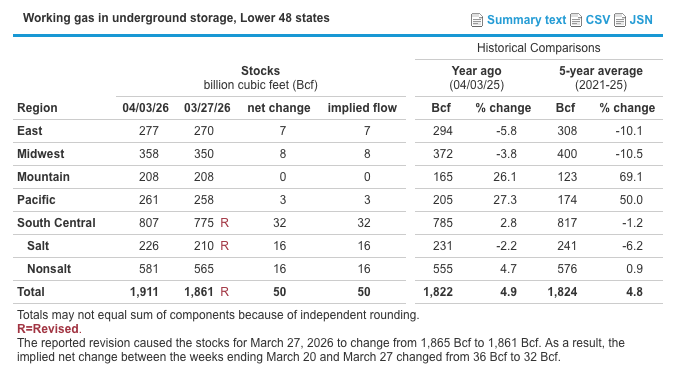
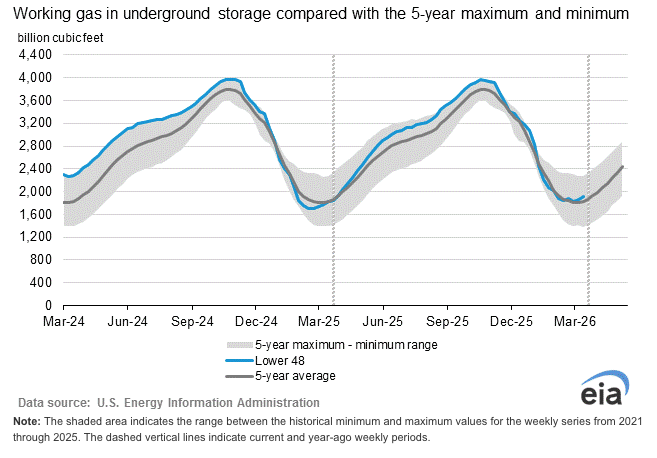
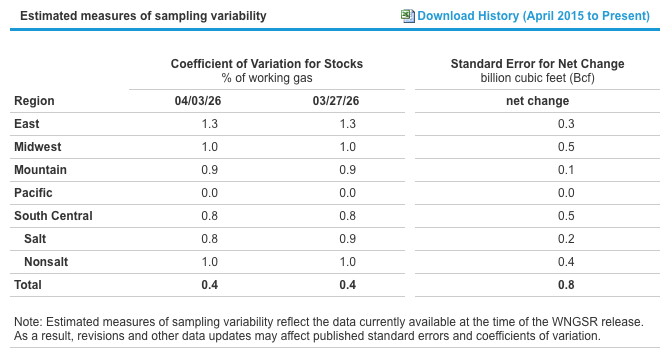
EIA Storage Report: Working gas in storage totaled 1,911 Bcf as of Friday, April 3, 2026, according to estimates from the U.S. Energy Information Administration. This reflects a week-over-week increase of 50 Bcf. Inventories are currently 89 Bcf above year-ago levels and 87 Bcf higher than the five-year average of 1,824 Bcf, placing total storage within the historical five-year range.
Weather: The National Oceanic and Atmospheric Administration (NOAA) reports that several key factors are shaping this spring’s outlook, including the El Niño-Southern Oscillation (ENSO), reduced snowpack across the western U.S., and soil moisture conditions nationwide. According to Ken Graham, the climate system has transitioned out of La Niña into an ENSO-neutral phase, meaning neither La Niña nor El Niño is currently dominant.
Recent observations confirm this neutral state, with near-average sea surface temperatures at the equator in the Pacific and steadily warming subsurface temperatures over the past several months. However, this pattern is expected to evolve, as forecast models indicate ENSO-neutral conditions will likely persist through early summer before transitioning toward El Niño, which has a greater than 60% chance of developing by May–July and continuing through the end of 2026.
This expected shift toward El Niño is already influencing broader seasonal outlooks. Early forecasts for the 2026 Atlantic hurricane season call for slightly below-average activity, largely due to El Niño’s tendency to increase wind shear and suppress storm development. Current projections suggest fewer storms than normal, with around 13 named storms and 6 hurricanes anticipated.
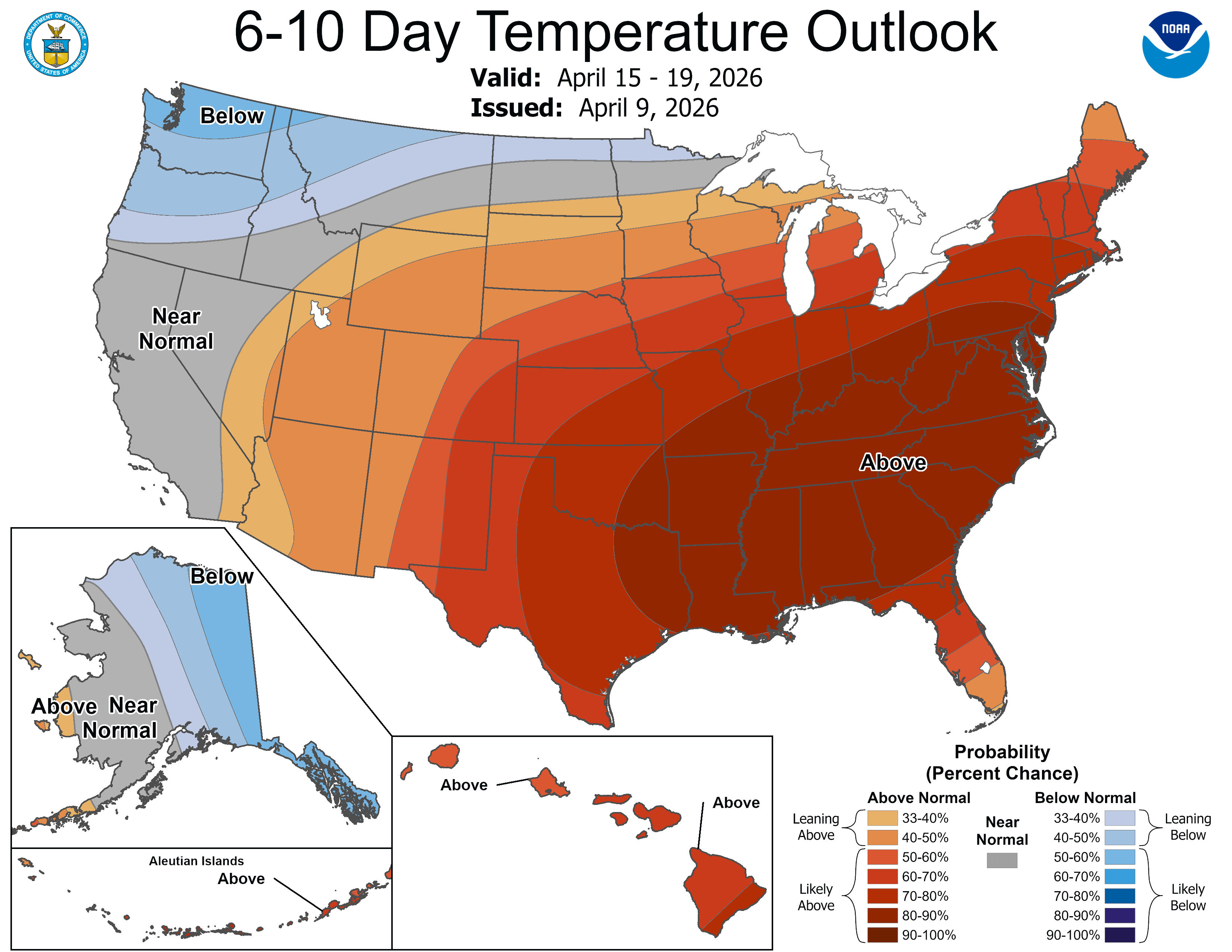
From a temperature perspective, NOAA’s April through June outlook favors above-normal temperatures across much of the United States, stretching from the West through the Plains and into the Southeast and Mid-Atlantic. The highest probabilities for above-average temperatures are centered in the Southwest and Intermountain West, while east-central Alaska is one of the few regions expected to see cooler-than-normal conditions.
Market Data:
April 10, 2026

Weekly Energy News
April 10, 2026
Market Commentary: Following news of a pause in Middle East hostilities, NYMEX natural gas futures faced additional downward pressure on April 8, driven in part by a sharp decline in crude oil prices. By the close of trading, the May contract managed to hold a price floor near $2.70/MMBtu. Although prices saw a modest 3–4 cent increase in overnight trading, momentum weakened after the U.S. Energy Information Administration released its storage report at 10:30 a.m. ET on April 9.
Market conditions are expected to remain soft in the near term, with loose fundamentals continuing to weigh on prices. Eli Rubin of EBW Analytics noted that natural gas remains on bearish footing both technically and fundamentally through mid-April, with the storage surplus compared to five-year averages potentially tripling to more than 175 Bcf by late April.
Looking ahead, analysts anticipate another sizable storage injection in the upcoming report, which could further expand the surplus. According to S&P Global, the next report is expected to show a 64 Bcf build for the week ending April 10. This would be notably bearish relative to historical benchmarks, as the five-year average for the same week is 38 Bcf, while last year’s injection totaled just 22 Bcf.
May 2026 NYMEX closed Thursday at $2.670
· High for the day $2.738
· Low for the day $2.655
Early trading for the prompt month is trading at $2.632
· https://www.cmegroup.com/markets/energy/natural-gas/natural-gas.html
· https://www.fxempire.com/commodities/natural-gas
EIA Storage Report: Working gas in storage totaled 1,911 Bcf as of Friday, April 3, 2026, according to estimates from the U.S. Energy Information Administration. This reflects a week-over-week increase of 50 Bcf. Inventories are currently 89 Bcf above year-ago levels and 87 Bcf higher than the five-year average of 1,824 Bcf, placing total storage within the historical five-year range.
Weather: The National Oceanic and Atmospheric Administration (NOAA) reports that several key factors are shaping this spring’s outlook, including the El Niño-Southern Oscillation (ENSO), reduced snowpack across the western U.S., and soil moisture conditions nationwide. According to Ken Graham, the climate system has transitioned out of La Niña into an ENSO-neutral phase, meaning neither La Niña nor El Niño is currently dominant.
Recent observations confirm this neutral state, with near-average sea surface temperatures at the equator in the Pacific and steadily warming subsurface temperatures over the past several months. However, this pattern is expected to evolve, as forecast models indicate ENSO-neutral conditions will likely persist through early summer before transitioning toward El Niño, which has a greater than 60% chance of developing by May–July and continuing through the end of 2026.
This expected shift toward El Niño is already influencing broader seasonal outlooks. Early forecasts for the 2026 Atlantic hurricane season call for slightly below-average activity, largely due to El Niño’s tendency to increase wind shear and suppress storm development. Current projections suggest fewer storms than normal, with around 13 named storms and 6 hurricanes anticipated.
From a temperature perspective, NOAA’s April through June outlook favors above-normal temperatures across much of the United States, stretching from the West through the Plains and into the Southeast and Mid-Atlantic. The highest probabilities for above-average temperatures are centered in the Southwest and Intermountain West, while east-central Alaska is one of the few regions expected to see cooler-than-normal conditions.
Market Data:
April 10, 2026
April 10, 2026
Weekly Energy News
Market Commentary: Following news of a pause in Middle East hostilities, NYMEX natural gas futures faced additional downward pressure on April 8, driven in part by a sharp decline in crude oil prices. By the close of trading, the May contract managed to hold a price floor near $2.70/MMBtu. Although prices saw a modest 3–4 cent increase in overnight trading, momentum weakened after the U.S. Energy Information Administration released its storage report at 10:30 a.m. ET on April 9.
Market conditions are expected to remain soft in the near term, with loose fundamentals continuing to weigh on prices. Eli Rubin of EBW Analytics noted that natural gas remains on bearish footing both technically and fundamentally through mid-April, with the storage surplus compared to five-year averages potentially tripling to more than 175 Bcf by late April.
Looking ahead, analysts anticipate another sizable storage injection in the upcoming report, which could further expand the surplus. According to S&P Global, the next report is expected to show a 64 Bcf build for the week ending April 10. This would be notably bearish relative to historical benchmarks, as the five-year average for the same week is 38 Bcf, while last year’s injection totaled just 22 Bcf.
May 2026 NYMEX closed Thursday at $2.670
· High for the day $2.738
· Low for the day $2.655
Early trading for the prompt month is trading at $2.632
· https://www.cmegroup.com/markets/energy/natural-gas/natural-gas.html
· https://www.fxempire.com/commodities/natural-gas
EIA Storage Report: Working gas in storage totaled 1,911 Bcf as of Friday, April 3, 2026, according to estimates from the U.S. Energy Information Administration. This reflects a week-over-week increase of 50 Bcf. Inventories are currently 89 Bcf above year-ago levels and 87 Bcf higher than the five-year average of 1,824 Bcf, placing total storage within the historical five-year range.
Weather: The National Oceanic and Atmospheric Administration (NOAA) reports that several key factors are shaping this spring’s outlook, including the El Niño-Southern Oscillation (ENSO), reduced snowpack across the western U.S., and soil moisture conditions nationwide. According to Ken Graham, the climate system has transitioned out of La Niña into an ENSO-neutral phase, meaning neither La Niña nor El Niño is currently dominant.
Recent observations confirm this neutral state, with near-average sea surface temperatures at the equator in the Pacific and steadily warming subsurface temperatures over the past several months. However, this pattern is expected to evolve, as forecast models indicate ENSO-neutral conditions will likely persist through early summer before transitioning toward El Niño, which has a greater than 60% chance of developing by May–July and continuing through the end of 2026.
This expected shift toward El Niño is already influencing broader seasonal outlooks. Early forecasts for the 2026 Atlantic hurricane season call for slightly below-average activity, largely due to El Niño’s tendency to increase wind shear and suppress storm development. Current projections suggest fewer storms than normal, with around 13 named storms and 6 hurricanes anticipated.
From a temperature perspective, NOAA’s April through June outlook favors above-normal temperatures across much of the United States, stretching from the West through the Plains and into the Southeast and Mid-Atlantic. The highest probabilities for above-average temperatures are centered in the Southwest and Intermountain West, while east-central Alaska is one of the few regions expected to see cooler-than-normal conditions.
April 10, 2026
Weekly Energy News
Market Commentary: Following news of a pause in Middle East hostilities, NYMEX natural gas futures faced additional downward pressure on April 8, driven in part by a sharp decline in crude oil prices. By the close of trading, the May contract managed to hold a price floor near $2.70/MMBtu. Although prices saw a modest 3–4 cent increase in overnight trading, momentum weakened after the U.S. Energy Information Administration released its storage report at 10:30 a.m. ET on April 9.
Market conditions are expected to remain soft in the near term, with loose fundamentals continuing to weigh on prices. Eli Rubin of EBW Analytics noted that natural gas remains on bearish footing both technically and fundamentally through mid-April, with the storage surplus compared to five-year averages potentially tripling to more than 175 Bcf by late April.
Looking ahead, analysts anticipate another sizable storage injection in the upcoming report, which could further expand the surplus. According to S&P Global, the next report is expected to show a 64 Bcf build for the week ending April 10. This would be notably bearish relative to historical benchmarks, as the five-year average for the same week is 38 Bcf, while last year’s injection totaled just 22 Bcf.
May 2026 NYMEX closed Thursday at $2.670
· High for the day $2.738
· Low for the day $2.655
Early trading for the prompt month is trading at $2.632
· https://www.cmegroup.com/markets/energy/natural-gas/natural-gas.html
· https://www.fxempire.com/commodities/natural-gas
EIA Storage Report: Working gas in storage totaled 1,911 Bcf as of Friday, April 3, 2026, according to estimates from the U.S. Energy Information Administration. This reflects a week-over-week increase of 50 Bcf. Inventories are currently 89 Bcf above year-ago levels and 87 Bcf higher than the five-year average of 1,824 Bcf, placing total storage within the historical five-year range.
Weather: The National Oceanic and Atmospheric Administration (NOAA) reports that several key factors are shaping this spring’s outlook, including the El Niño-Southern Oscillation (ENSO), reduced snowpack across the western U.S., and soil moisture conditions nationwide. According to Ken Graham, the climate system has transitioned out of La Niña into an ENSO-neutral phase, meaning neither La Niña nor El Niño is currently dominant.
Recent observations confirm this neutral state, with near-average sea surface temperatures at the equator in the Pacific and steadily warming subsurface temperatures over the past several months. However, this pattern is expected to evolve, as forecast models indicate ENSO-neutral conditions will likely persist through early summer before transitioning toward El Niño, which has a greater than 60% chance of developing by May–July and continuing through the end of 2026.
This expected shift toward El Niño is already influencing broader seasonal outlooks. Early forecasts for the 2026 Atlantic hurricane season call for slightly below-average activity, largely due to El Niño’s tendency to increase wind shear and suppress storm development. Current projections suggest fewer storms than normal, with around 13 named storms and 6 hurricanes anticipated.
From a temperature perspective, NOAA’s April through June outlook favors above-normal temperatures across much of the United States, stretching from the West through the Plains and into the Southeast and Mid-Atlantic. The highest probabilities for above-average temperatures are centered in the Southwest and Intermountain West, while east-central Alaska is one of the few regions expected to see cooler-than-normal conditions.
April 10, 2026
Weekly Energy News
Market Commentary: Following news of a pause in Middle East hostilities, NYMEX natural gas futures faced additional downward pressure on April 8, driven in part by a sharp decline in crude oil prices. By the close of trading, the May contract managed to hold a price floor near $2.70/MMBtu. Although prices saw a modest 3–4 cent increase in overnight trading, momentum weakened after the U.S. Energy Information Administration released its storage report at 10:30 a.m. ET on April 9.
Market conditions are expected to remain soft in the near term, with loose fundamentals continuing to weigh on prices. Eli Rubin of EBW Analytics noted that natural gas remains on bearish footing both technically and fundamentally through mid-April, with the storage surplus compared to five-year averages potentially tripling to more than 175 Bcf by late April.
Looking ahead, analysts anticipate another sizable storage injection in the upcoming report, which could further expand the surplus. According to S&P Global, the next report is expected to show a 64 Bcf build for the week ending April 10. This would be notably bearish relative to historical benchmarks, as the five-year average for the same week is 38 Bcf, while last year’s injection totaled just 22 Bcf.
May 2026 NYMEX closed Thursday at $2.670
· High for the day $2.738
· Low for the day $2.655
Early trading for the prompt month is trading at $2.632
· https://www.cmegroup.com/markets/energy/natural-gas/natural-gas.html
· https://www.fxempire.com/commodities/natural-gas
EIA Storage Report: Working gas in storage totaled 1,911 Bcf as of Friday, April 3, 2026, according to estimates from the U.S. Energy Information Administration. This reflects a week-over-week increase of 50 Bcf. Inventories are currently 89 Bcf above year-ago levels and 87 Bcf higher than the five-year average of 1,824 Bcf, placing total storage within the historical five-year range.
Weather: The National Oceanic and Atmospheric Administration (NOAA) reports that several key factors are shaping this spring’s outlook, including the El Niño-Southern Oscillation (ENSO), reduced snowpack across the western U.S., and soil moisture conditions nationwide. According to Ken Graham, the climate system has transitioned out of La Niña into an ENSO-neutral phase, meaning neither La Niña nor El Niño is currently dominant.
Recent observations confirm this neutral state, with near-average sea surface temperatures at the equator in the Pacific and steadily warming subsurface temperatures over the past several months. However, this pattern is expected to evolve, as forecast models indicate ENSO-neutral conditions will likely persist through early summer before transitioning toward El Niño, which has a greater than 60% chance of developing by May–July and continuing through the end of 2026.
This expected shift toward El Niño is already influencing broader seasonal outlooks. Early forecasts for the 2026 Atlantic hurricane season call for slightly below-average activity, largely due to El Niño’s tendency to increase wind shear and suppress storm development. Current projections suggest fewer storms than normal, with around 13 named storms and 6 hurricanes anticipated.
From a temperature perspective, NOAA’s April through June outlook favors above-normal temperatures across much of the United States, stretching from the West through the Plains and into the Southeast and Mid-Atlantic. The highest probabilities for above-average temperatures are centered in the Southwest and Intermountain West, while east-central Alaska is one of the few regions expected to see cooler-than-normal conditions.

April 10, 2026
Market Commentary: Following news of a pause in Middle East hostilities, NYMEX natural gas futures faced additional downward pressure on April 8, driven in part by a sharp decline in crude oil prices. By the close of trading, the May contract managed to hold a price floor near $2.70/MMBtu. Although prices saw a modest 3–4 cent increase in overnight trading, momentum weakened after the U.S. Energy Information Administration released its storage report at 10:30 a.m. ET on April 9.
Market conditions are expected to remain soft in the near term, with loose fundamentals continuing to weigh on prices. Eli Rubin of EBW Analytics noted that natural gas remains on bearish footing both technically and fundamentally through mid-April, with the storage surplus compared to five-year averages potentially tripling to more than 175 Bcf by late April.
Looking ahead, analysts anticipate another sizable storage injection in the upcoming report, which could further expand the surplus. According to S&P Global, the next report is expected to show a 64 Bcf build for the week ending April 10. This would be notably bearish relative to historical benchmarks, as the five-year average for the same week is 38 Bcf, while last year’s injection totaled just 22 Bcf.
May 2026 NYMEX closed Thursday at $2.670
· High for the day $2.738
· Low for the day $2.655
Early trading for the prompt month is trading at $2.632
· https://www.cmegroup.com/markets/energy/natural-gas/natural-gas.html
· https://www.fxempire.com/commodities/natural-gas
EIA Storage Report: Working gas in storage totaled 1,911 Bcf as of Friday, April 3, 2026, according to estimates from the U.S. Energy Information Administration. This reflects a week-over-week increase of 50 Bcf. Inventories are currently 89 Bcf above year-ago levels and 87 Bcf higher than the five-year average of 1,824 Bcf, placing total storage within the historical five-year range.
Weather: The National Oceanic and Atmospheric Administration (NOAA) reports that several key factors are shaping this spring’s outlook, including the El Niño-Southern Oscillation (ENSO), reduced snowpack across the western U.S., and soil moisture conditions nationwide. According to Ken Graham, the climate system has transitioned out of La Niña into an ENSO-neutral phase, meaning neither La Niña nor El Niño is currently dominant.
Recent observations confirm this neutral state, with near-average sea surface temperatures at the equator in the Pacific and steadily warming subsurface temperatures over the past several months. However, this pattern is expected to evolve, as forecast models indicate ENSO-neutral conditions will likely persist through early summer before transitioning toward El Niño, which has a greater than 60% chance of developing by May–July and continuing through the end of 2026.
This expected shift toward El Niño is already influencing broader seasonal outlooks. Early forecasts for the 2026 Atlantic hurricane season call for slightly below-average activity, largely due to El Niño’s tendency to increase wind shear and suppress storm development. Current projections suggest fewer storms than normal, with around 13 named storms and 6 hurricanes anticipated.
From a temperature perspective, NOAA’s April through June outlook favors above-normal temperatures across much of the United States, stretching from the West through the Plains and into the Southeast and Mid-Atlantic. The highest probabilities for above-average temperatures are centered in the Southwest and Intermountain West, while east-central Alaska is one of the few regions expected to see cooler-than-normal conditions.
April 10, 2026
Weekly Energy News
Market Commentary: Following news of a pause in Middle East hostilities, NYMEX natural gas futures faced additional downward pressure on April 8, driven in part by a sharp decline in crude oil prices. By the close of trading, the May contract managed to hold a price floor near $2.70/MMBtu. Although prices saw a modest 3–4 cent increase in overnight trading, momentum weakened after the U.S. Energy Information Administration released its storage report at 10:30 a.m. ET on April 9.
Market conditions are expected to remain soft in the near term, with loose fundamentals continuing to weigh on prices. Eli Rubin of EBW Analytics noted that natural gas remains on bearish footing both technically and fundamentally through mid-April, with the storage surplus compared to five-year averages potentially tripling to more than 175 Bcf by late April.
Looking ahead, analysts anticipate another sizable storage injection in the upcoming report, which could further expand the surplus. According to S&P Global, the next report is expected to show a 64 Bcf build for the week ending April 10. This would be notably bearish relative to historical benchmarks, as the five-year average for the same week is 38 Bcf, while last year’s injection totaled just 22 Bcf.
May 2026 NYMEX closed Thursday at $2.670
· High for the day $2.738
· Low for the day $2.655
Early trading for the prompt month is trading at $2.632
· https://www.cmegroup.com/markets/energy/natural-gas/natural-gas.html
· https://www.fxempire.com/commodities/natural-gas
EIA Storage Report: Working gas in storage totaled 1,911 Bcf as of Friday, April 3, 2026, according to estimates from the U.S. Energy Information Administration. This reflects a week-over-week increase of 50 Bcf. Inventories are currently 89 Bcf above year-ago levels and 87 Bcf higher than the five-year average of 1,824 Bcf, placing total storage within the historical five-year range.
Weather: The National Oceanic and Atmospheric Administration (NOAA) reports that several key factors are shaping this spring’s outlook, including the El Niño-Southern Oscillation (ENSO), reduced snowpack across the western U.S., and soil moisture conditions nationwide. According to Ken Graham, the climate system has transitioned out of La Niña into an ENSO-neutral phase, meaning neither La Niña nor El Niño is currently dominant.
Recent observations confirm this neutral state, with near-average sea surface temperatures at the equator in the Pacific and steadily warming subsurface temperatures over the past several months. However, this pattern is expected to evolve, as forecast models indicate ENSO-neutral conditions will likely persist through early summer before transitioning toward El Niño, which has a greater than 60% chance of developing by May–July and continuing through the end of 2026.
This expected shift toward El Niño is already influencing broader seasonal outlooks. Early forecasts for the 2026 Atlantic hurricane season call for slightly below-average activity, largely due to El Niño’s tendency to increase wind shear and suppress storm development. Current projections suggest fewer storms than normal, with around 13 named storms and 6 hurricanes anticipated.
From a temperature perspective, NOAA’s April through June outlook favors above-normal temperatures across much of the United States, stretching from the West through the Plains and into the Southeast and Mid-Atlantic. The highest probabilities for above-average temperatures are centered in the Southwest and Intermountain West, while east-central Alaska is one of the few regions expected to see cooler-than-normal conditions.
April 10, 2026
Weekly Energy News
Market Commentary: Following news of a pause in Middle East hostilities, NYMEX natural gas futures faced additional downward pressure on April 8, driven in part by a sharp decline in crude oil prices. By the close of trading, the May contract managed to hold a price floor near $2.70/MMBtu. Although prices saw a modest 3–4 cent increase in overnight trading, momentum weakened after the U.S. Energy Information Administration released its storage report at 10:30 a.m. ET on April 9.
Market conditions are expected to remain soft in the near term, with loose fundamentals continuing to weigh on prices. Eli Rubin of EBW Analytics noted that natural gas remains on bearish footing both technically and fundamentally through mid-April, with the storage surplus compared to five-year averages potentially tripling to more than 175 Bcf by late April.
Looking ahead, analysts anticipate another sizable storage injection in the upcoming report, which could further expand the surplus. According to S&P Global, the next report is expected to show a 64 Bcf build for the week ending April 10. This would be notably bearish relative to historical benchmarks, as the five-year average for the same week is 38 Bcf, while last year’s injection totaled just 22 Bcf.
May 2026 NYMEX closed Thursday at $2.670
· High for the day $2.738
· Low for the day $2.655
Early trading for the prompt month is trading at $2.632
· https://www.cmegroup.com/markets/energy/natural-gas/natural-gas.html
· https://www.fxempire.com/commodities/natural-gas
EIA Storage Report: Working gas in storage totaled 1,911 Bcf as of Friday, April 3, 2026, according to estimates from the U.S. Energy Information Administration. This reflects a week-over-week increase of 50 Bcf. Inventories are currently 89 Bcf above year-ago levels and 87 Bcf higher than the five-year average of 1,824 Bcf, placing total storage within the historical five-year range.
Weather: The National Oceanic and Atmospheric Administration (NOAA) reports that several key factors are shaping this spring’s outlook, including the El Niño-Southern Oscillation (ENSO), reduced snowpack across the western U.S., and soil moisture conditions nationwide. According to Ken Graham, the climate system has transitioned out of La Niña into an ENSO-neutral phase, meaning neither La Niña nor El Niño is currently dominant.
Recent observations confirm this neutral state, with near-average sea surface temperatures at the equator in the Pacific and steadily warming subsurface temperatures over the past several months. However, this pattern is expected to evolve, as forecast models indicate ENSO-neutral conditions will likely persist through early summer before transitioning toward El Niño, which has a greater than 60% chance of developing by May–July and continuing through the end of 2026.
This expected shift toward El Niño is already influencing broader seasonal outlooks. Early forecasts for the 2026 Atlantic hurricane season call for slightly below-average activity, largely due to El Niño’s tendency to increase wind shear and suppress storm development. Current projections suggest fewer storms than normal, with around 13 named storms and 6 hurricanes anticipated.
From a temperature perspective, NOAA’s April through June outlook favors above-normal temperatures across much of the United States, stretching from the West through the Plains and into the Southeast and Mid-Atlantic. The highest probabilities for above-average temperatures are centered in the Southwest and Intermountain West, while east-central Alaska is one of the few regions expected to see cooler-than-normal conditions.
Make Your Choice Gas Selection in Three Easy Steps
Click here to access our online tool, or call our Choice gas commodity experts at 1 (877) 790-4990.
Step 1: Enter your account number
- Your Black Hills Energy account number is located at the top right-hand corner of your bill.
Step 2: Review price options and make your selection
Step 3: Confirm your selection and enter your control number
- You received a control number in your 2026 Choice Gas selection packet mailed to you from Black Hills Energy. If you cannot locate this, you can retrieve your control number by calling 877-245-3506 or visit choicegas.com
Once enrolled, you will be removed from supplier marketing communications within 24 hours.


Sign Up for Our Energy Newsletters
Sign UpRecent Posts